11 Best Places To Call Home In The Ozarks In 2026

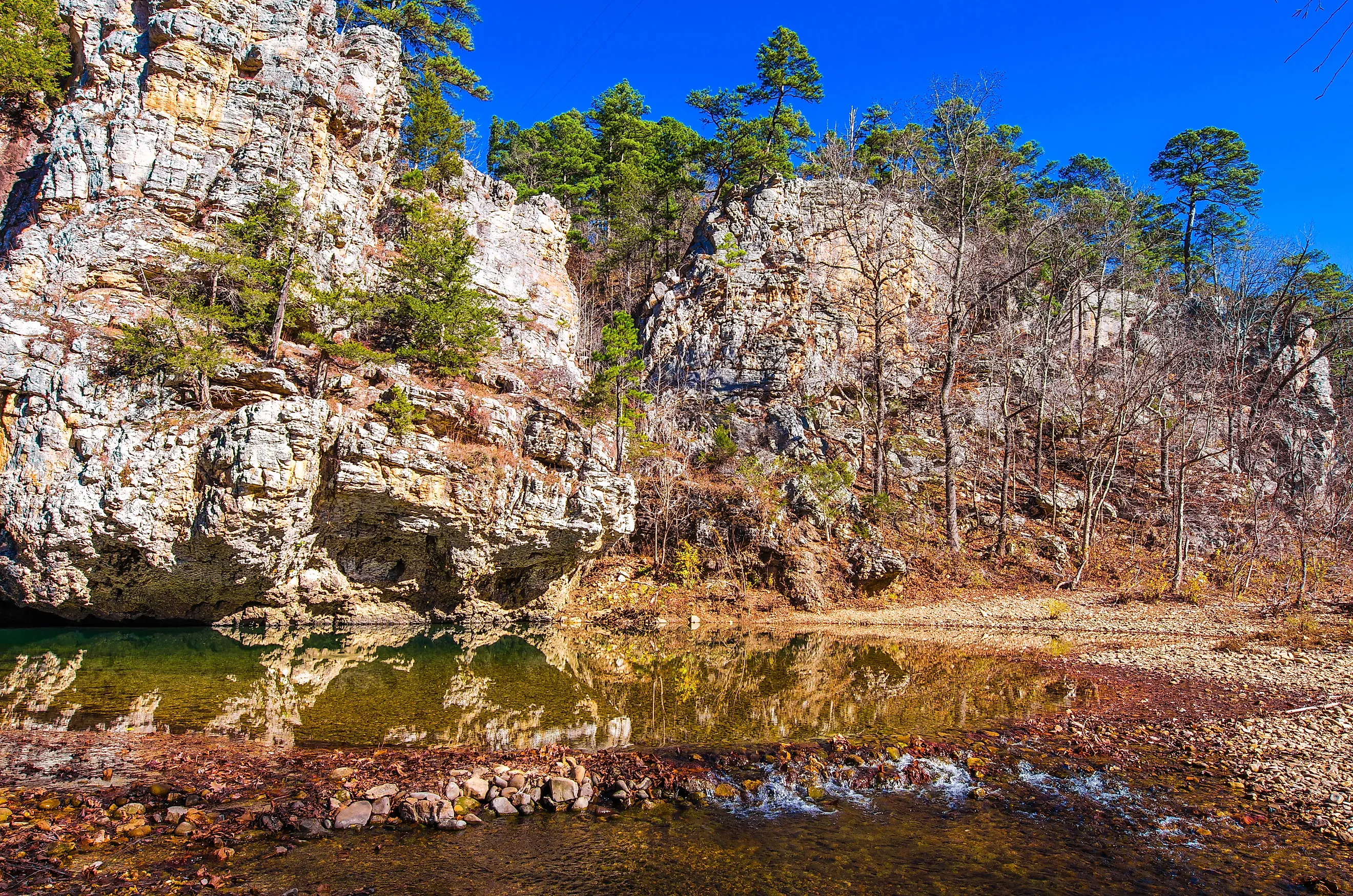
The Ozarks that shows up in most rankings is lake country. Shoreline made the resort towns, and resort towns carry resort prices. Away from the impoundments, the Ozark Plateau keeps a different kind of water. It surfaces cold out of limestone, or runs down a valley nobody ever dammed.
Eleven small towns across three states sit beside that water with each one costing less than its state's typical home.
Eminence, Missouri

Five hundred and thirty-two people operate a county seat here, and their county happens to contain a national park corridor. Ozark National Scenic Riverways protects 134 miles of the free-flowing Current and Jacks Fork rivers. Alley Spring lies west of town, where a red mill stands over a pool the color of bottle glass. The Alley Spring General Store serves the same ground, and the Jacks Fork carries canoes past both.
A typical Eminence house came to $199,468 in June 2026, roughly 27 percent under the Missouri number. The Shannon County Health Center keeps an office on Grey Jones Drive, one block from the courthouse. Its doors stay open until six on the first Tuesday of every month.
Eminence R-1 runs an elementary building and a high school, and law enforcement comes from the county sheriff, whom the city contracts rather than staffing its own force.
Van Buren, Missouri

The same park runs downstream to Van Buren, where headquarters for all 134 of those river miles occupies a settlement of 792 people. Ozark National Scenic Riverways administers both rivers from here. Few towns of that size anywhere administer a federal park unit, and Van Buren does.
Big Spring lies south of the city limits and belonged to Missouri until 1969, when the state handed it to the National Park Service. Watercress Park draws on the spring that feeds it.
Carter County counts 5,418 residents altogether, and nothing else in it is bigger than this. Royal Oak Enterprises, The Landing, and Riverways Manor carry the payroll alongside timber and the schools, per the Ozark Foothills Regional Planning Commission.
Missouri Highlands Health Care, a nonprofit serving seven counties, lists a location in town. A county health center works on Health Center Road, and both take appointments. Housing tracks the scale of the place at $191,526, close to 30 percent below the statewide figure.
Alton, Missouri

Greer Spring discharges about 210 million gallons a day. Only one Missouri spring runs bigger, and none of the first-magnitude springs carries a longer branch. Its branch travels a little over a mile to the Eleven Point, and a Forest Service trail drops just under a mile downhill from the highway to the water. Greer Mill stands nearby, restored by the same agency and reached on a short connecting path.
Congress named the Eleven Point one of the original eight National Wild and Scenic Rivers on October 2, 1968. The scenic designation covers 44.4 miles. Alton keeps the Oregon County seat with 702 residents, and Ozarks Medical Center operates a rural health clinic on Medical Drive. A house here fetches $179,948, a discount of nearly 34 percent against the Missouri median. The spring itself became federal property in 1993.
Thayer, Missouri

Elsewhere in the same county, Bussell Branch disappears into the ground at Grand Gulf and surfaces about nine miles later across the Arkansas line. The gulf is what a collapsed dolomite cave system leaves behind, with 130-foot walls above a chasm roughly three-quarters of a mile from end to end.
One stretch of the old cave never fell in, and it survives as a natural bridge spanning 250 feet with an opening 75 feet high. Boardwalk and rim trails carry visitors to the overlooks, and 57,524 people came in 2022.
Ownership makes the place unusual. The L-A-D Foundation owns the land privately and leases it for public use, an arrangement that produced a park in 1984. Thayer grew as a Frisco rail town on the Warm Fork Spring River.
Warm Fork Park sits north of the bypass under an agreement with the Missouri Department of Conservation. Ozarks Healthcare runs a clinic and a public pharmacy in town. Thayer R-II serves the schools, a branch library keeps regular hours, and a house runs $148,497. No town here opens a wider gap against its own state figure, at 45 percent.
Cabool, Missouri
Two real estate promoters named this place after the capital of Afghanistan. Ralph and Frances Walker mapped out the townsite in 1882 and borrowed an older English spelling of Kabul. The State Historical Society of Missouri records that Frances never came to Cabool at all. Her husband left as soon as the enterprise was under way.
Before the Walkers arrived, the settlement went by Cedar Bluff, and no other Cabool exists in the country today.
The K spelling turns up around town regardless. The high school yearbook is the Kabul, and a nursing home on Main Street carries the same name. The Cabool History Society runs a museum on Pine Street, and Lemuel C. Roberts Park offers an amphitheater and a trail.
Missouri Ozarks Community Health operates one of its seven clinics here. Housing runs $204,355 for the typical place, roughly a quarter short of the state.
Mansfield, Missouri

One county west of Cabool, Laura Ingalls Wilder wrote the Little House books at Rocky Ridge Farm, about a mile out from the square. She and Almanzo made it their home from 1896, and she lived on it until her death in 1957.
Two houses remain on the property. The first is the white farmhouse that the couple built for themselves. The other is the Rock House that their daughter, Rose Wilder Lane, put up as a gift, where they lived from 1928 to 1936.
The museum beside them keeps the fiddle that Charles Ingalls played, handwritten manuscripts, Almanzo's tools, and the Braille slate that belonged to Mary.
The property became a National Historic Landmark on July 17, 1991. Anyone planning a visit should watch the calendar, because the site opens March first and closes November 15.
A regional nonprofit keeps a clinic in town. Housing reads $226,489, which is 17 percent shy of what Missouri records.
Neosho, Missouri

Federal crews have raised fish in Neosho since 1888, longer than at any other working federal hatchery in the United States.
The town took its name from an Osage word for clear cold water, and dozens of cold springs rise in the valleys around it. Admission costs nothing, and a third-mile paved loop circles the ponds and raceways. Inside the visitor center, an aquarium has a bubble that a child can crawl into for a view from within the tank.
Neosho counts 12,590 residents at the 2020 census, the largest town on this list, and services scale to match. Freeman Neosho Hospital staffs an emergency department around the clock on West Hickory Street, and in December 2025, the system opened an 8,300-square-foot rehabilitation center on South Wood Street.
Crowder College and its Longwell Museum keep a Thomas Hart Benton collection, and a five-panel mural inside the Newton County Courthouse traces local history. At $231,535, housing still runs about 15 percent under Missouri.
Stilwell, Oklahoma

Oklahoma's governor and legislature declared this town the Strawberry Capital of the World in 1949. The festival that goes with the title fills the second Saturday in May, and the city calls it the oldest continuous festival in the state.
Stilwell holds the Adair County seat inside the sovereign territory of the Cherokee Nation and, by the city's own account, it has more Cherokee residents per capita than any of the other 13 Cherokee Nation communities.
Starr Springs rises two miles south at the head of Sallisaw Creek and supplied municipal water from 1911 onward. The Wilma P. Mankiller Health Center, named for the first female Principal Chief, provides primary care.
Indian Capital Technology Center maintains a campus in town. Railroad builder, Arthur Stilwell, lent the place his name, and the old Kansas City Southern depot now houses the county historical association. Housing costs $172,479, nearly 24 percent off what Oklahoma records.
Marshall, Arkansas

Boston Mountain Rural Health Center has 21 medical clinics and three dental clinics across a dozen counties. It works from a board room on Highway 65 North, among 1,320 residents, and has done so since its founding in 1994.
The Searcy County Courthouse commands the square, built in 1889 from roughly cut native sandstone and listed on the National Register in 1976. A renovated 1902 jail nearby serves as the Buffalo River Historic Jail and Museum.
Exhibits there follow the Buffalo National River watershed and honor Elton Britt, a local, who became the first country performer to receive a Gold Record. Raccoon Springs Park holds ground near the square with a small fishing lake, pavilions, and a track with rainbow trout are stocked. A drive-in theater operates in town.
At $138,317, housing costs roughly 40 percent less than Arkansas as a whole.
Clinton, Arkansas

One county south of Marshall, Archey Fork park cuts through the middle of town, and a riverwalk follows it from two park areas into the historic downtown. Paved paths, playgrounds, and ball fields fill the ground between the two, while South Fork Nature Center adds a nature park and trails.
Clinton keeps the Van Buren County seat at an elevation of 564 feet. Its courthouse dates to 1934, an Art Deco and WPA Rustic design by Erhart and Eichenbaum, paid for with Works Progress Administration money.
Labor Day weekend brings the National Championship Chuckwagon Races to the Bar of Ranch, closing with an event called the Snowy River race. Archey Fest, the annual summer festival and Independence Day celebration, takes the last Saturday in June.
Ozark Health operates a critical access hospital on Highway 65 South. Its emergency department is fully staffed and it links to University of Arkansas specialists through a statewide stroke program. The county has also opened a new public library.
Housing comes to $184,730, some 19 percent beneath the Arkansas median.
Melbourne, Arkansas
A college in a town of 1,892 residents in highly known for training pilots. The Federal Aviation Administration approved a professional pilot program at Ozarka College in August 2015, and the first students enrolled that autumn. Ozarka opened its Melbourne campus in the fall of 1975 as a vocational school and was fully accredited in 1996, and its John E. Miller Educational Complex contains an 800-seat auditorium.
The Izard County Courthouse went up in 1938, built by National Youth Administration crews from rusticated gray limestone. A marble doughboy from 1930 keeps the lawn.
Melbourne has kept the county seat since 1875, and the name itself means mill stream. A plant that began in 1966 as an aircraft parts operation for Douglas, and passed through McDonnell Douglas to Boeing, closed in 2006 and took more than 100 jobs with it.
Broadwing, a small aircraft company, works out of those buildings now. Bad Boy Mowers ran an off-road vehicle division there before consolidating in Batesville. The school district enrolls roughly 919 students across three schools, and the county library has served the town since 1951.
A house costs $183,884, about a fifth off the statewide reading.
What the Water Is Worth
Not one of these towns is trying to become a resort. Where the water rises from rock or runs wild, the title tends to belong to a federal agency, a state park system, or a conservation foundation.
What these places kept instead is the ordinary machinery of somewhere worth living: a courthouse, a school district, a clinic that takes appointments, and a library open for decades. The water stays where it is.