9 Wallet-Friendly Small Towns To Retire In Spain
Inland Spain holds nine of the country's most retirement-friendly small cities. The price tag runs about half what coastal regions ask for the same square footage. The healthcare and cultural amenity match what bigger Spanish cities provide. UNESCO designations show up across the list. The Mediterranean climate softens at the higher elevations, and Western Europe's most affordable retirement-rated towns are mostly here. The nine ahead reward retirees willing to settle inland for a better deal on the same Spanish experience.
More retirement options across the country
For a wider look at the same theme, see our picks for the best places to retire in Spain.
Úbeda

Úbeda is one of the two UNESCO-listed Spanish Renaissance towns (Baeza is the other), with palaces, churches, and civic buildings from the Spanish Golden Age preserved across the historic center. The Plaza Vázquez de Molina holds the densest concentration of the architecture, and most of it is walkable in an afternoon. The Festival de Úbeda enters its 38th year in 2026 and stands as one of Andalusia's principal classical-music programs.
The Archaeological Museum of Úbeda runs Iberian and Roman exhibits just off the main plaza. The Museo de Alfarería Paco Tito preserves the city's generations-old Andalusian pottery tradition. Úbeda sits in the middle of Jaén province, the world's largest olive-oil region, with the "sea of olive trees" (Mar de Olivos) visible from any rising road out of town. The Unidad de Estancia Diurna El Mirador provides senior day services. Median home listings run around €69 per square foot, roughly a third of the Spanish national figure.
Plasencia, Extremadura

Plasencia is the only Spanish city with two cathedrals that is not a provincial capital. The Old and New Cathedrals stand side by side in the historic center, and the Tuesday market in the plaza has been running since 1189. Medieval walls still encircle most of the old town. The Hospital Virgen del Puerto recently performed the region's first multiorgan and tissue extraction surgery.
Plasencia sits on the banks of the Jerte River at the gateway to the Valle del Jerte, one of the most photographed valleys in Spain during cherry-blossom season each spring. Monfragüe National Park, immediately east, is one of Europe's premier raptor-watching destinations. The Plasencia International Folk Festival runs each July. Median home prices around €139 per square foot put Plasencia well below the Spanish national figure of roughly €203.
Gandia

Gandia is one of the rare Spanish small cities where the Fallas festival happens at full scale. The March celebrations bring massive papier-mâché sculptures (fallas) onto the streets, culminating in the citywide bonfire night known as La Cremà. UNESCO listed Fallas as Intangible Cultural Heritage in 2016.
The Casa de Cultura Marqués de González de Quirós runs year-round art, music, and theater programs at the cultural-center end of town. The Universitat Politècnica de València keeps a working campus here, which gives the town a steady student energy alongside the older residential rhythm. The Hospital Comarcal Francesc de Borja serves as the region's state-of-the-art public hospital. Vitalia Gandía, the local senior-care operation, holds a five-star Google rating. Median listings hover around €139 per square foot, with full Mediterranean beach access included.
Alcázar de San Juan

Alcázar de San Juan is in the heart of Castilla-La Mancha, with the Don Quixote windmill landscape stretching out to the north and east. Direct rail to Madrid means medical appointments and day-trips don't require a car. The Complejo Lagunar de Alcázar de San Juan, an internationally recognized wetland, sits on the edge of town and draws birdwatchers, hikers, and cyclists year-round.
Abedul Golf runs an 18-hole course for residents who want a calm afternoon putt. Carnavalcázar, the only Spanish carnival held during the Christmas season, features colorful troupes, a bicycle parade called Ciclagata, and the Burial of the Sardine. Residencia Nuestra Señora del Rosario covers the local retirement community side. Median home listings around €72 per square foot sit at roughly 35% of the Spanish national median.
Puertollano

Puertollano sits halfway between Madrid and Seville on the AVE high-speed rail line. Trains run to Madrid in just over an hour and to Córdoba in forty minutes, which puts both cities' specialty care and cultural calendars inside easy reach. Paseo de San Gregorio, the tree-lined promenade through the center of town, is the local social heart.
The Auditorio Municipal handles theater and concert programming for the city of about 45,000 residents. Valle de Alcudia, forty minutes west, opens into the Sierra Madrona Natural Park: 150,000 hectares of Mediterranean forest, quartzite mountains, and exceptional biodiversity that make it one of the premier European ecotourism destinations. Median home prices come in around €30 per square foot, among the lowest on this list.
Spanish towns worth a longer look
For a complementary scenic angle, see our picks for the nicest small towns in Spain.
Ronda

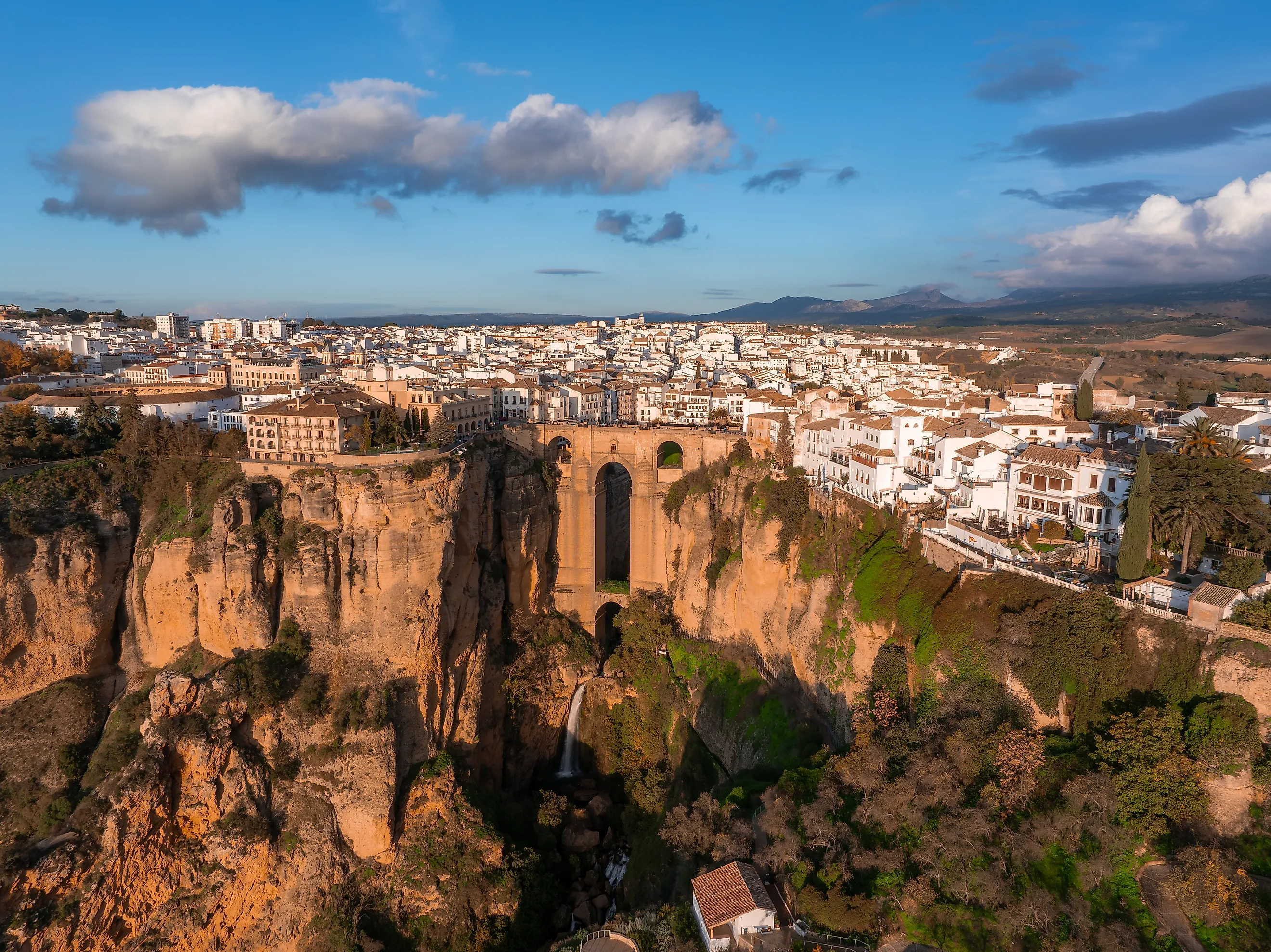
Ronda is built across the lip of the El Tajo Gorge, and the Puente Nuevo bridge soars nearly 120 meters over the canyon floor. Sierra de las Nieves National Park sits immediately south, with marked trails, griffon vultures, and golden eagle sightings any weekend. Modern bullfighting started here: the Royal Cavalry Bullring is one of the oldest in Spain, and the Pedro Romero family established the on-foot bullfighting tradition in the eighteenth century.
The Hospital Serranía de Ronda runs on a "hospital humanization" model, with 152 single-bed rooms in place of traditional wards to give patients more privacy and a less institutional feel. Active retirees handle the cycling, horseback, and balloon-flight options around town. Median home prices around €169 per square foot make Ronda one of the more accessible inland Andalusian options.
Teruel

Teruel is the smallest provincial capital in Spain. Around 35,000 residents live in a city built around UNESCO-listed Mudéjar architecture: ornate brick towers, churches, and historic civic buildings that give Teruel its distinct visual identity. The area carries the unofficial nickname "Dinosaur Country" for the fossil sites in the surrounding province.
Dinópolis, a major paleontological park and museum, anchors the family-and-school tourism side of the local economy. The Teatro Marín runs music, theater, and local arts in a beautifully decorated historic hall. La Vaquilla del Ángel each July fills the streets with peñas (neighborhood-association street parties) for several days running. Median listings around €37 per square foot make Teruel one of the most affordable provincial-capital options on this list.
Soria

Soria balances medieval heritage with the steady student energy of the Campus de Soria (affiliated with the University of Valladolid), which keeps tapas bars and cultural venues lively across the academic year. Las Fiestas de San Juan, rooted in the twelfth century, take over the city each summer with parades, bull-running, and other long-running traditions.
The Palacio de la Audiencia, the cultural centerpiece, hosts theater, concerts, and film screenings on a regular calendar. The Museo Numantino holds an exceptional collection of Celtic and Roman artifacts. The Hospital Universitario Santa Bárbara handles regional healthcare for Castile and León's eastern reaches. Median home prices around €42 per square foot put Soria within reach of most retirement budgets.
Antequera

Antequera sits in the center of Andalusia, about forty-five minutes from Málaga and just over an hour from Córdoba, with the daily feel of a small inland city rather than a tourist hub. The Antequera Dolmens Site is one of the most important Neolithic monuments in Europe and a UNESCO World Heritage site. The Baroque old town holds more listed monuments per capita than almost anywhere in Spain.
El Torcal Natural Park, just outside town, runs marked trails through a karst limestone landscape sculpted into shapes that look engineered. The Fuente de Piedra lagoon is the largest greater flamingo breeding ground on the Iberian Peninsula and the second-largest in Europe. Campo de Golf Antequera, an ecological 18-hole course, runs at the foot of El Torcal. Teatro Municipal Torcal anchors the local performance calendar. Median listings around €132 per square foot.
Where the everyday life happens in Spain
For the daily-rhythm side, see our picks for Spain towns with unforgettable main streets.
Choosing Where to Settle in Spain
The nine inland Spanish towns above sit at different price points and lean toward different daily routines. Teruel and Soria offer the lowest costs and the deepest medieval-architecture footprints. Úbeda and Antequera hold the most UNESCO designations between them. Plasencia and Ronda anchor the river-valley and gorge dramas. Gandia gives full Mediterranean beach access without coastal pricing. Alcázar de San Juan and Puertollano put Madrid within easy rail reach. Each town comes with a regional hospital, a working cultural calendar, and the kind of plazas that fill up at sunset because the heat finally drops.