11 Spain Towns With Unforgettable Main Streets
The whitewashed lane of Carrer Nou in Cadaqués and the porticoed Plaza Mayor of Pedraza, a bull-ring since the 16th century, sit at opposite ends of Spain's small-town spectrum, and yet both share the same gravitational pull: a single street that organizes everything else. The eleven towns below run from a Catalan fishing village on the Mediterranean to an Andalusian hill town above the Atlantic, and each one is best understood by walking its principal artery from one end to the other.
Carrer Nou (Cadaqués, Catalonia)

The blue-trimmed doors, cobbled lanes, and shimmering bay of Cadaqués look much as Salvador Dalí found them when he first summered here as a boy and later built his Portlligat house just over the headland. The town has drawn a rotating cast of artists and writers ever since, and Carrer Nou runs through the busiest section of the historic center as the main commercial spine.
At one end stands the Church of Santa Maria de Cadaqués, whose ornate 17th-century Baroque altarpiece is the town's most ambitious interior work. The Avinguda Víctor Rahola promenade gives a wide view of the historic center from across the bay. Seafood restaurants on and around Carrer Nou include long-established names like Casa Anita and the more contemporary Compartir, the latter run by three veterans of El Bulli.
Carrer Major (Besalú, Catalonia)

Besalú stands at the confluence of two rivers on a plateau that has been fortified since Iberian times. The 12th-century Romanesque bridge over the Fluvià, with its angular seven-arch span and a fortified gateway at midpoint, is the town's signature image. Carrer Major leads from the bridge into the heart of the old town, threading the most important monuments along a cobbled route of stone houses and Gothic façades.
The street opens onto Plaça Major, the central square that has hosted a weekly market since the Middle Ages and still does every Tuesday. The square is framed by the 16th-century Curia Reial, the former courthouse whose Gothic-windowed face is one of the finest examples of civil architecture in the region. The Benedictine Monastery of Sant Pere, founded in the 10th century, stands a short walk from the main street, and the small Circusland circus arts museum occupies its former convent buildings.
Calle Mayor (Hondarribia, Basque Country)

Hondarribia is the last surviving walled town in the province of Gipuzkoa. The medieval quarter sits high behind 15th-century walls, entered through the Puerta de Santa María gateway, and its grid of narrow cobbled streets is among the best-preserved of its kind in northern Spain. Calle Mayor, known in Basque as Kale Nagusia, runs straight through the walled quarter from the Puerta de Santa María toward the main plaza.
The street is lined with the 18th-century Baroque Town Hall with its coats of arms and arched ground floor, the 17th-century Casadevante Palace directly opposite, and the Zuloaga Palace with its ornate stone staircase. At the far end of Calle Mayor, Plaza de Armas opens onto the Gothic Church of Nuestra Señora de la Asunción y del Manzano, whose tower dates from the 18th century, and the Castle of Carlos V, now a parador hotel.
Calle Mayor (Laguardia, Basque Country)

Laguardia is a small town in the wine country of Rioja Alavesa, its medieval walls still intact and its five original town gates still in use. Founded in 1164 by King Sancho VI of Navarre as a defensive outpost on the Castilian frontier, the town has retained its medieval street plan, with three long, narrow streets running the length of the settlement and a series of squares and alleys connecting them.
Calle Mayor runs the full length of the old town, anchored at its two ends by the most significant monuments in Laguardia. To the south stands the Church of San Juan Bautista, Romanesque in origin. To the north, the Church of Santa María de los Reyes preserves one of the most remarkable Gothic portals in Spain, with a fully polychromed doorway carved in the 14th century and painted in the 17th.
In Plaza Mayor, midway along Calle Mayor, an animated carrillón clock performs a short scene from local folklore on the hour. Beneath the street and many of the surrounding houses lies a labyrinth of medieval wine cellars still in use by Rioja producers today.
Calle del Cantón & Calle de Santo Domingo (Santillana del Mar, Cantabria)

Santillana del Mar is one of the most intact medieval villages in northern Spain. Its honey-colored sandstone buildings, cobbled streets, and Renaissance towers have changed little in centuries, and the entire old town is pedestrian-only. The historic core is organized around two streets that branch in a Y-shape from the village entrance.
Calle del Cantón leads toward the religious heart of the settlement, where the Collegiate Church of Santa Juliana stands. Built on the site of an earlier hermitage in the 12th century, it contains a cloister carved with biblical scenes and coiling mythical beasts widely regarded as a masterpiece of Romanesque sculpture. A 17th-century Mexican silver altarpiece donated by an archbishop of Mexico is a surprising piece for a village this size. Calle de Santo Domingo, running parallel, holds the Torre de Don Borja and the Torre del Merino, two squat 14th-century defensive towers whose lower floors now host civic offices and exhibitions.
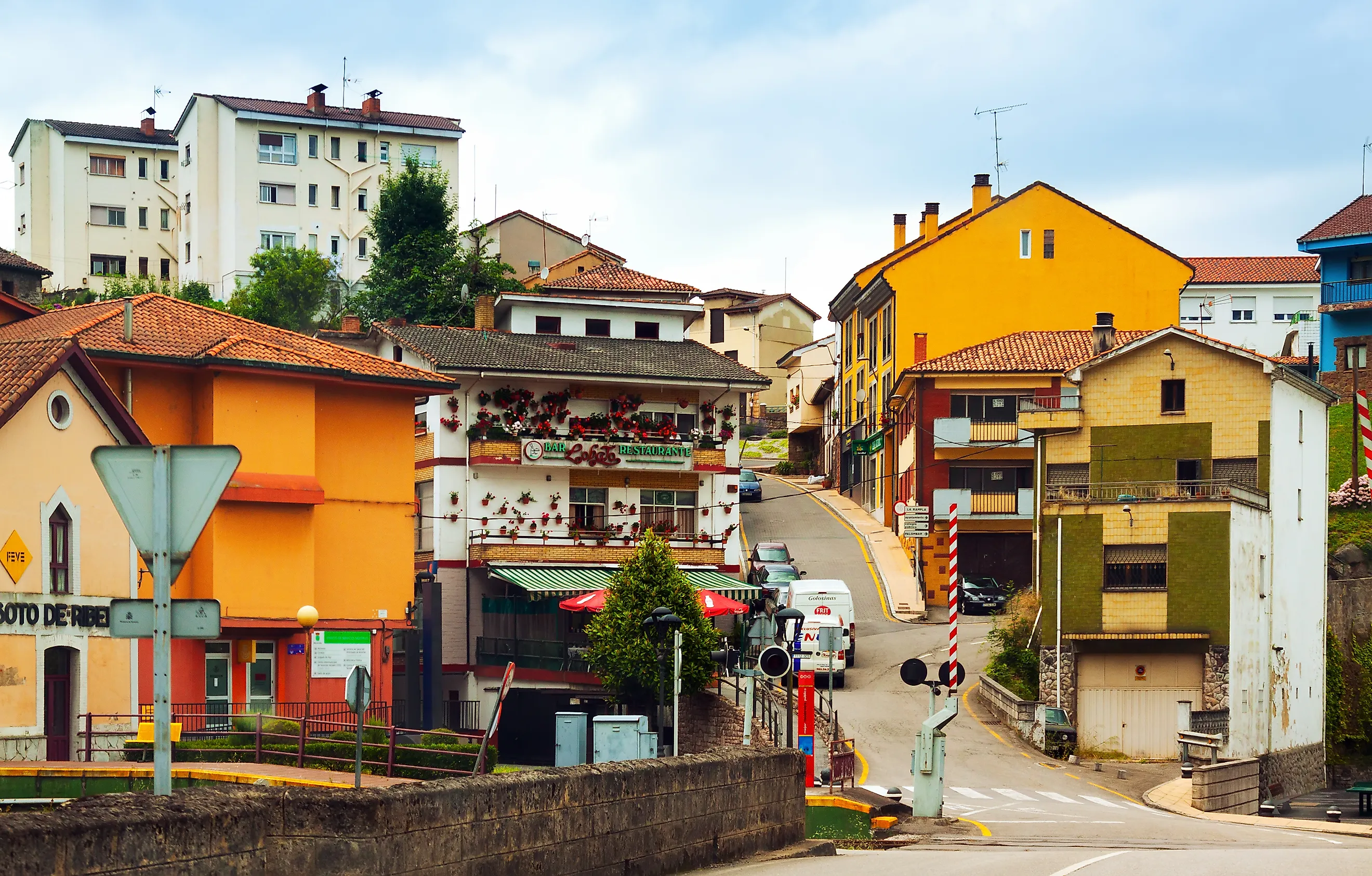
La Rampla (Cudillero, Asturias)

Cudillero is folded into a steep natural inlet on the Asturian coast and is barely visible until you are inside it. Once there, brightly painted houses rise in tiers up the cliffs on every side, forming a near-perfect amphitheater around a small fishing harbor. La Rampla runs down the middle of the village from the upper town to the water's edge and serves as the gathering place locals call the Plaza.
The fish taverns clustered around the harbor square at its foot draw most of the visitors, with the day's catch from the Cantabrian Sea on the menus. The Gothic-era Church of San Pedro sits just above the harbor, with a clear view of the rooftops from the terrace outside. A network of viewpoints — Mirador de la Garita, Mirador del Picu, and Mirador de la Atalaya — threads above the village on both sides, each offering a different angle on how the town fits into its cliff.
Calle de Santiago & Portal de Molina (Albarracín, Aragón)

Albarracín stands on a sharp meander of the Guadalaviar River in the province of Teruel, with medieval walls running the ridge above and red-pink rendered houses giving the entire fabric a warm, almost rust-colored tone. The historic core is entered from the main road via Calle Azagra, which leads to Plaza Mayor, the small central square that has been the hub of local life since the 11th century.
From there, Calle de Santiago climbs steeply uphill, passing the 17th-century Church of Santiago before reaching Portal de Molina, one of the original medieval gateways into the walled fortress above. Below the main street, a riverside path follows the Guadalaviar through the gorge, passing the restored Molino Viejo, a 16th-century mill now adapted as a café and gallery.
Calle Mayor (Pedraza, Castilla y León)

Pedraza was decla