10 Off-The-Grid Indiana Towns To Visit In 2026
Out past Indiana's highway exits are small towns built on Amish farmland, glacial lakes, and old immigrant settlement. Some see few visitors from outside their own counties, and that is much of their appeal. A drive-in open since 1951, a utopian village founded in 1814, and a ballpark from a Hollywood baseball movie all lie a short detour off the main routes. These ten towns spread across the state, all of them well off the usual routes.
Shipshewana

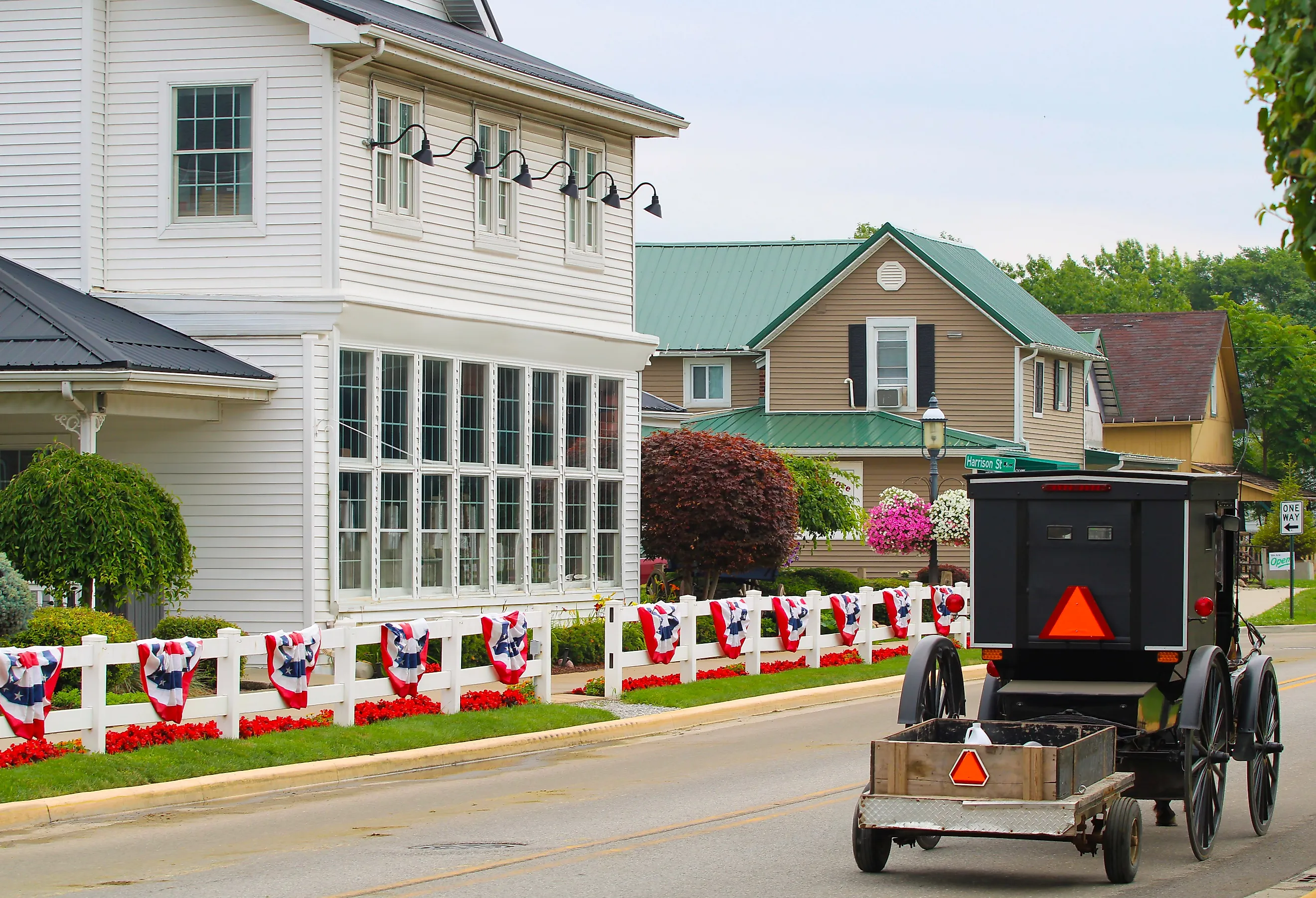
Amish buggy in Shipshewana, Indiana.
Shipshewana lies at the center of the third-largest Amish community in the country, a stretch of LaGrange County where horse-drawn buggies still share the roads with cars. The century-old Shipshewana Flea Market, open Tuesdays and Wednesdays from spring through fall, ranks among the largest in the Midwest. Rise'n Roll, a bakery known for its Amish-style doughnuts, grew from a couple selling baked goods off their front porch into a business with several locations.
The Shipshewana Furniture Company sells hardwood furniture built in nearby Amish workshops, and buggy tours pass through the farmland outside town. The Blue Gate Theatre books touring musicians, tribute acts, and family shows through the year.
Huntingburg

Huntingburg is the only town in the world by that name, and its brick downtown has stood in for small-town America on film. League Stadium, a small ballpark restored for the 1992 movie "A League of Their Own," also appears in "Hard Rain" and HBO's "Soul of the Game." Fans still gather at the same wooden grandstand for local games.
Historic Fourth Street has brick-paved sidewalks and restored 19th-century storefronts, now home to boutiques and cafes. The Huntingburg Event Center hosts antique shows and Opry-style performances at a small scale. A local history museum traces the area's past without the crowds of a larger venue.
Wabash

In 1880, Wabash became the first city in the world lit entirely by electricity, four arc lamps mounted on the county courthouse. The Wabash River that gives the town its name passes right through it, about 45 miles from Fort Wayne. The Honeywell Center downtown is a full-scale arts complex, unusually large for a town this size, with a theater and galleries.
The 13-24 Drive-In, open since 1951 and named for nearby State Roads 13 and 24, still shows films on summer nights. Charley Creek Gardens has formal walking paths, a waterfall, and a hedge maze in a quiet part of town. Paradise Spring Historical Park preserves reconstructed cabins on the site where the Miami and Potawatomi signed treaties with the US in 1826.
Angola

Angola stands at the center of Indiana's northeastern lake country, a corner of Steuben County ringed by more than 100 lakes. Pokagon State Park, north of town, has wooded trails and swimming areas along Lake James. Its toboggan run, the Midwest's only refrigerated track, drops from a 30-foot tower and reaches 42 mph in winter.
The glacial lakes around Angola form a connected chain known as the Lake James chain, with calm water for paddling and fishing. Summer brings boaters and anglers, and winter brings ice fishing shanties onto the same water.
Tell City

Tell City City Hall (and Perry County Courthouse), Tell City, Indiana. Wikimedia Commons.
Swiss immigrants founded Tell City in 1858 and named it for the folk hero William Tell, whose story the town still marks each August at Schweizer Fest. The town spreads along the Ohio River in Perry County, near Indiana's southern edge. Sunset Park, the main riverfront space, has walking paths and views of the tow barges heading downstream, and it connects to the mile-long River Walk Trail.
The Tell City Chair Company, in business from 1865 until 2011, shipped handcrafted hardwood chairs around the world. The Tell City Chair Gallery and Museum now shows the company's history and rare pieces, with a retail space for surviving stock.
New Harmony

New Harmony began in 1814 as a religious commune, built by the Harmony Society, which emigrated from Germany and settled on the Wabash River in Posey County. A second utopian experiment under Robert Owen followed in 1825. Many of the original buildings still stand, which is why the town reads as a preserved 19th-century settlement rather than a reconstruction.
The Harmonist Labyrinth and the stone Cathedral Labyrinth recreate the Harmonists' meditative walks. The Roofless Church, an open-air sanctuary designed by Philip Johnson in 1960, has walls but no roof, by intention. Thrall's Opera House, a converted Harmonist dormitory, still hosts performances.
Winona Lake

A channel leading to Winona Lake, Indiana. Image credit: Darren Sloppy / Flickr
Winona Lake grew up around 1900 as a Chautauqua resort and religious retreat, and the layout of that summer colony still marks the town. The Village at Winona, a walkable district along the water, has galleries, cafes, and restored cottages listed on the National Register of Historic Places.
The Billy Sunday Home and Museum preserves the bungalow of the baseball player turned revival preacher, built in the Arts and Crafts style of the early 1900s. The Winona Lake Heritage Trail threads paved through wetlands and lakefront, and Grace College's art gallery shows regional work at the edge of the village.
Nashville

Nashville is in the wooded hills of Brown County, a pocket of south-central Indiana that became an art colony in 1908 and still counts fewer than 1,500 residents. Locals call Brown County State Park the Little Smokies for the way its ridge trails and overlooks resemble the Great Smoky Mountains. The Brown County Music Center brings touring acts to a rural setting most performers would otherwise skip.
The Brown County Art Guild, in the historic Minor House, shows work by the early painters who built the colony's reputation. The T.C. Steele State Historic Site preserves the home and studio of one of Indiana's most influential painters, on a hillside well off the main road.
Fairmount

Fairmount, a farm town in Grant County, was James Dean's hometown, and it still pulls film fans decades after his death in 1955. His gravesite, childhood home, and former high school remain a pilgrimage for followers of 1950s Hollywood. The James Dean Gallery has photographs, memorabilia, and rotating exhibits on his brief career.
The Fairmount Historical Museum also honors Jim Davis, the Fairmount native who created "Garfield," and fiberglass Garfield statues mark a Garfield Trail across the county. Each fall, the James Dean Festival brings classic cars and live music to the streets, set against the surrounding farmland.
Greencastle

Greencastle, the seat of Putnam County, is a college town wrapped around DePauw University, with a compact downtown of historic buildings, murals, and locally owned shops. Main Street ties the blocks together, and spots like Wasser Brewing Company serve as gathering places for residents and students.
Two arts venues stand on the DePauw campus, more than a town this size usually supports. The Green Center for the Performing Arts hosts concerts, recitals, and lectures, and the Peeler Art Center houses galleries and studios that support regional artists.
Indiana Off the Main Roads
These towns look nothing alike, but all of them lie well back from the interstates. Shipshewana lives on its Amish farm economy, Tell City still marks its Swiss founding each August, and Fairmount tends the memory of a movie star who left at 18. Utopian communes, immigrant colonies, and company towns all left their mark here. What they have in common is that the state's older character survives in them, mostly because the crowds pass by on the highway instead.