This Is The Friendliest Small Town in Indiana
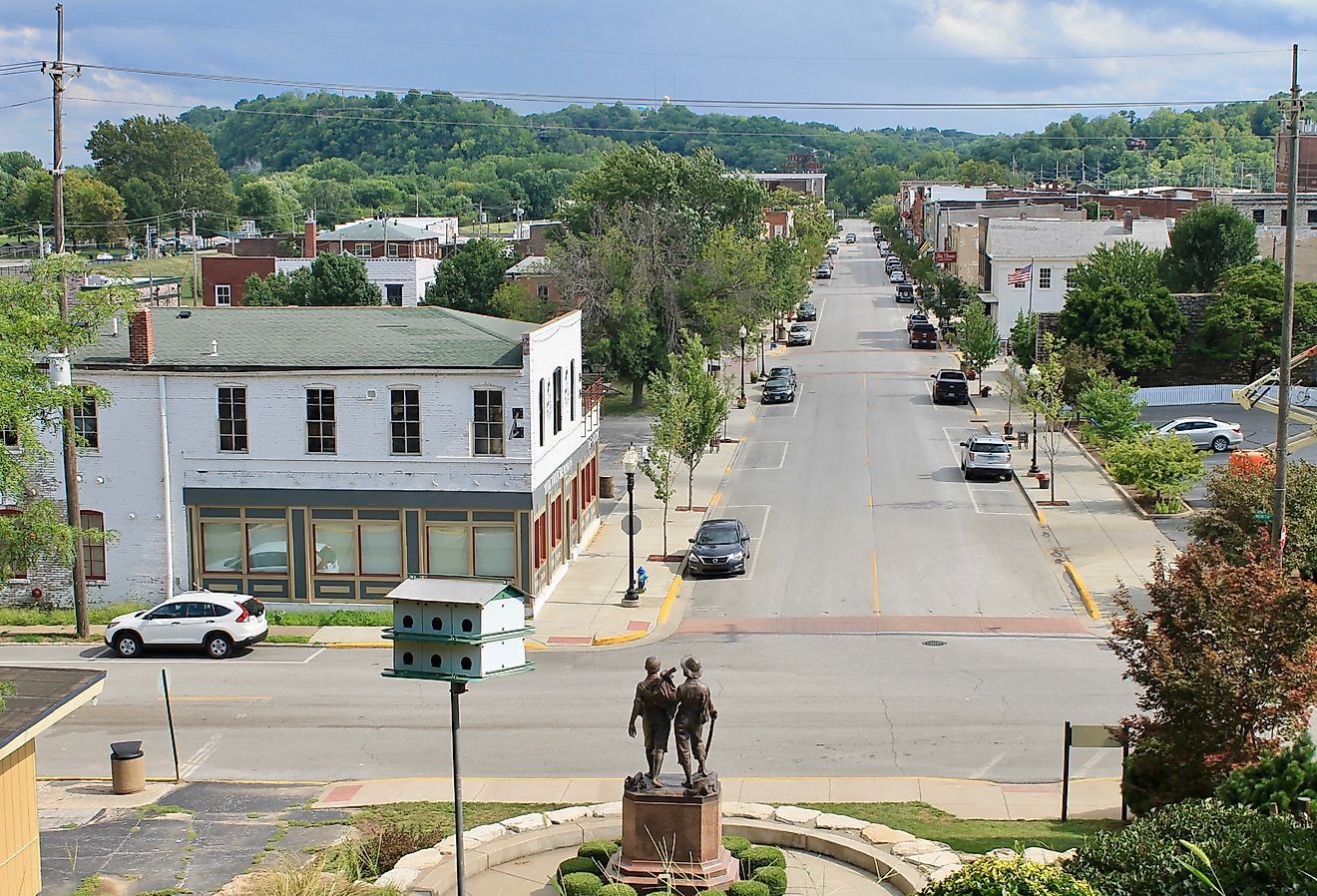
New Harmony, Indiana, was founded in 1814 by a group of utopians who wanted to build a perfect Christian community. Two centuries later, the town still runs on the idealistic roots that shaped it. Today, under 1,000 residents keep that legacy going at places like The Red Door antique shop, the annual Kunstfest German heritage festival, and a meditation labyrinth set right off Main Street. The Roofless Church, the Harmonist-era buildings, and the sculpture gardens across town all trace back to the two utopian experiments that ran here in the 1800s. What follows is a look at what made New Harmony different, and what keeps it on the map today.
Utopian History

What sets New Harmony apart from the rest of Indiana is how it was founded. The settlers who came here in 1814 were not looking for money or farmland. They were trying to build a perfect Christian society to prepare for the Second Coming of Christ.
That first group was the Harmony Society, a community of German Pietist Separatists led by Johann Georg Rapp. Members practiced celibacy, worked communally, and built a remarkably successful agricultural and industrial town, much like the Shakers were doing elsewhere. After about 10 years, the Harmonists sold the land and moved on in 1824, and the town changed hands.

The buyer was Welsh industrialist and social reformer Robert Owen, who also had utopian visions but of a secular kind. Owen's New Harmony, launched in 1825, was one of the earliest attempts at a communal socialist society in the United States, built around equality, universal education, and shared property. His experiment unraveled after about two years, but his descendants stayed, and they have preserved or reconstructed much of the architecture and civic infrastructure that shaped the town under both movements.
Historic Sites And Inspired Spaces

Many of the buildings put up by the Harmonists and Owenites are still standing and open for tours. The Harmonists built almost identical two-story brick houses with gable roofs, and the George Bentel House is one of the better surviving examples. They also built a five-story granary from wood, brick, and sandstone, which was later converted into a geological laboratory for David Dale Owen (son of Robert Owen) in the 1840s and is known today as the Rapp-Owen Granary.
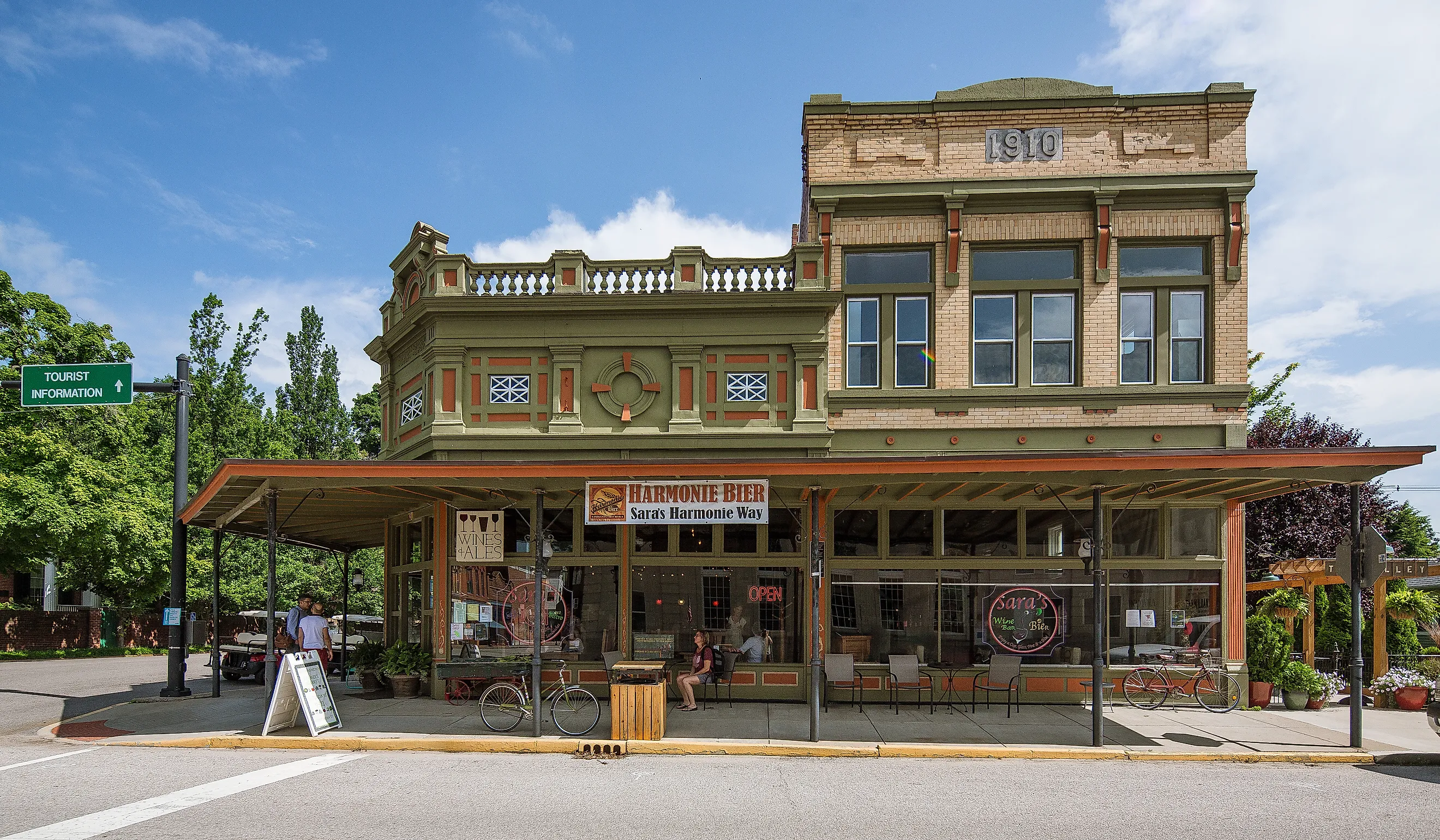
Thrall's Opera House was originally a Harmonist communal home that was converted into an opera house in the mid-19th century and today hosts live performances. Across town, smaller Harmonist dwellings, workshops, and community buildings survive in their original footprints, giving the downtown a genuinely preserved early-1800s character rather than a recreation.

The Harmonist Labyrinth, reconstructed at the entrance to town, is modeled on the original the Harmonists built for meditation. It consists of a privet hedge maze with a small stone chapel at its center. A second labyrinth, the Cathedral Labyrinth downtown, is modeled on the famous medieval labyrinth at Chartres Cathedral in France, with a stylized rose at its center.

The Roofless Church, designed by architect Philip Johnson and dedicated in 1960, is exactly what the name suggests: a walled sanctuary with no roof, intended to connect worshippers with the sky above. It was commissioned by Jane Blaffer Owen, a modern patron who married into the Owen family and spent decades funding New Harmony's preservation and new architectural projects. Her sculpture garden, the Jane Blaffer Owen Sanctuary, includes religious sculptures, fountains, and representations of St. Francis of Assisi.
Parks And Outdoors

New Harmony sits on the Wabash River, and the town has a network of riverfront trails that run along the water. Murphy Park, also downtown, includes a traditional wooden playset and a walking track.
Just outside of town, the Old Dam is worth seeking out. It is a natural rock ledge crossing the Wabash that stays hidden under water most of the year but emerges during low summer flows to form isolated pools and small waterfalls. It is one of the odder natural features along the lower Wabash.
Harmonie State Park, about five minutes south of town, offers hiking, camping, and picnicking across a working state park. The trail network climbs ridges, crosses grassy plateaus, passes small ponds, and ends near a water tower with a view. Mountain biking routes and fishing access on the Wabash and stocked park ponds round out the options.
Community Events
A utopian society needs a strong sense of community, and New Harmony still takes that seriously. The calendar is full of events that tie back to the town's German heritage, its naturalist tradition, and its antique culture.
Every June, Main Street New Harmony fills with the Golden Raintree Antique and Vintage Market, where vendors sell furniture, jewelry, and artwork. Later that month, the Firefly Festival lights up the riverfront trails for evening hikes to see Say's Firefly, a species named after Thomas Say, the pioneering American naturalist who lived in New Harmony and is buried there. The downtown programming during the festival includes glow dance parties, live music, and a historical presentation on the firefly's role in Indiana's natural history.
The town's biggest annual event is Kunstfest, held in September. Unlike a typical Oktoberfest, Kunstfest focuses on German arts and crafts culture rather than beer, featuring food, live demonstrations of traditional crafts the original Harmonists practiced, antiques, music, and entertainment. It is the single best weekend to see New Harmony at full activity.
Shops And Restaurants
New Harmony's shops carry the town's historical personality. Several vintage, antique, and curiosity stores line the downtown. Shoppers can browse for vintage furniture at The Red Door (formerly the Antique Emporium), or pick up town-themed gifts at the Historic New Harmony Museum Gift Shop.
For food, the local scene leans toward small cafes and American-style taverns. The Yellow Tavern serves pizza, shrimp, and steak in a traditional tavern setting. Say's, named after Thomas Say, serves comfort food just a few blocks from the Roofless Church.
Two Hundred Years Of Idealism
The original utopians are long gone, but their legacy shapes New Harmony daily. The architecture of the town, the labyrinths, the Roofless Church, the sculpture gardens, and the preserved Harmonist buildings all trace back to the experiments of Rapp and Owen. So do the Firefly Festival, which honors Thomas Say and the naturalist tradition he represented, and Kunstfest, which carries the town's German heritage forward. New Harmony does not need a large population or a major tourism economy to keep that going. It just needs to keep doing what it has done for more than 200 years, which is to take its history seriously and welcome anyone who wants to see it.