10 Most Idyllic Small Towns in Pennsylvania
Penn's Woods was not a marketing phrase. Pennsylvania is still around 58 percent forest, and the towns that sit inside it tend to have been shaped by something specific: a canal, a gorge, a seam of coal, a religious community that laid out the street grid and then kept it. These ten run across the state, and each one has a reason for looking the way it does.
Ohiopyle

Ohiopyle has fewer than 100 residents and a 20,000-acre state park wrapped around it, which is close to the best ratio in Pennsylvania. The Youghiogheny River drops through the middle of town over Ohiopyle Falls, and the Lower Yough below it is the busiest whitewater run in the eastern United States.

Cucumber Falls drops about 30 feet into a grotto you can walk behind, five minutes from the car. Ferncliff Peninsula is a 100-acre National Natural Landmark where the river loops back on itself, preserving plants more typical of the southern Appalachians. The Great Allegheny Passage runs straight through town on an old rail bed, 150 miles of flat, car-free trail between Pittsburgh and Cumberland, Maryland.
Bellefonte

Bellefonte is built around a spring that pumps millions of gallons a day into a pool in the middle of town, and the town is named for it: a French diplomat is said to have called it la belle fonte, the beautiful fountain. Talleyrand Park wraps the water with paths and a bandstand.
The spring made Bellefonte wealthy early, and the money went into architecture. The town holds one of the denser collections of Victorian buildings in central Pennsylvania, several hundred of them in the historic district, and it produced an improbable number of Pennsylvania governors for a place this size. The restored 1890s Gamble Mill sits beside the water, and State College is fifteen minutes south when you want a university town's calendar.
Lewisburg

Market Street in Lewisburg runs wide and tree-lined past Federal and Victorian storefronts to the Susquehanna, and the Campus Theatre anchors it: a 1941 Art Deco cinema, one of the few surviving unaltered in the country, still showing films under its original neon.

Bucknell University, founded in 1846, sits at the top of the hill and keeps a lecture and concert calendar running through the year. The Lewisburg Farmers Market has operated on Wednesdays since the 1980s and is one of the larger in the region. The whole downtown is a National Register historic district, and the campus gates sit about a twenty-minute walk above the river.
Wellsboro

Wellsboro still lights its main street with gas lamps, which is the detail everyone leads with and for once it is earned. The town sits at the edge of Pine Creek Gorge, the 47-mile cut known as the Grand Canyon of Pennsylvania, which reaches about 1,450 feet deep at its deepest point.
Colton Point State Park holds the west rim and Leonard Harrison the east, each with overlooks a short walk off the parking lot, plus steep trails dropping to the creek for anyone willing to earn the climb back. The Pine Creek Rail Trail runs 62 miles along the bottom on an old rail bed, flat the whole way. In town, the Wellsboro Diner has been serving since 1939 out of an original dining car.
Jim Thorpe

The town was Mauch Chunk until 1954, when it struck a deal with the widow of the Olympian Jim Thorpe to take his remains and his name in exchange for a memorial and the attention that came with it. What draws people now is the setting: Victorian streets stacked up the walls of a narrow Lehigh gorge, steep enough that the sidewalks have handrails.

The Asa Packer Mansion, completed in 1861 for the man who built the Lehigh Valley Railroad, still holds its original furnishings. The Mauch Chunk Opera House opened in 1881 and is among the oldest vaudeville houses in the country still booking live music. The Switchback Gravity Railroad that once ran here was an ancestor of the roller coaster, and its route is now a trail.
Stroudsburg

Stroudsburg is the main street of the Poconos and has held onto its independent businesses better than most towns sitting this close to an interstate. The 1890s Monroe County Courthouse anchors the block in Romanesque Revival stone.

The Sherman Theater, a restored 1920s movie house, books national touring acts into a town of 6,000, which gives the place a music calendar out of proportion to its size. The Quiet Valley Living Historical Farm interprets German farm life in the 1800s with costumed staff, and the Delaware Water Gap is fifteen minutes east when you want the river.
New Hope

New Hope sits on the Delaware opposite Lambertville, with a walking bridge between them, so you can cover two states on foot in an afternoon. It has been an artists' colony since the early 1900s, and that is why a town of 2,600 carries this many galleries.

The Bucks County Playhouse occupies a 1790 grist mill on the riverbank and has staged work since 1939, with Grace Kelly and Robert Redford among those who passed through. The Parry Mansion, built in 1784 for a lumber mill owner, is furnished room by room to show 125 years of changing taste rather than one frozen moment. The towpath of the Delaware Canal runs flat and shaded through town.
Doylestown

One man gave Doylestown three castles. Henry Chapman Mercer, an archaeologist and tile maker, built Fonthill between 1908 and 1912 as his own home, then the Mercer Museum as a six-storey concrete keep to hold the pre-industrial hand tools he feared were about to vanish, and the Moravian Pottery and Tile Works alongside. All three are poured concrete, all three are open, and nothing else in America looks like them.

The Michener Art Museum, in a former county jail, holds the best collection of Pennsylvania Impressionists anywhere. The town takes its name from William Doyle's 18th-century tavern at the crossroads, and the borough is a walkable grid of brick and stone an hour north of Philadelphia.
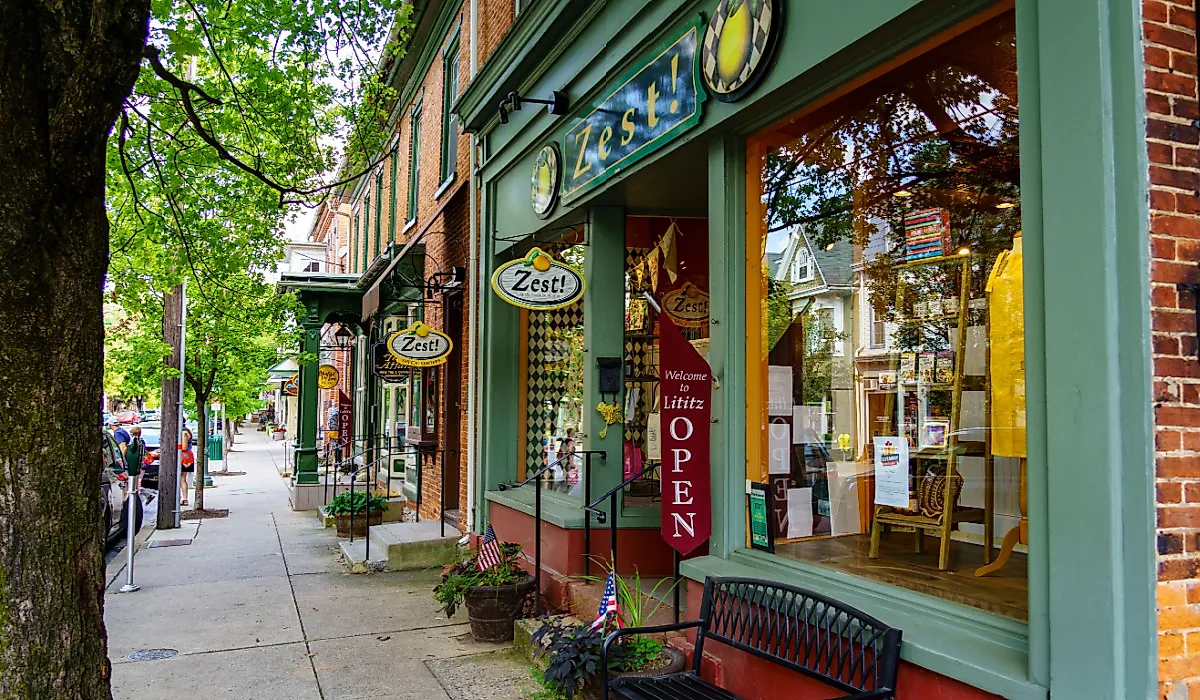
Lititz

Moravian settlers laid Lititz out in 1756, and for its first century you could only live here if you belonged to the church, which is why the stone houses along East Main survived so intact. Linden Hall, founded in 1746, is the oldest girls' boarding school in the United States and still operating.

Julius Sturgis opened the first commercial pretzel bakery in America on Main Street in 1861, and the building still runs twisting lessons. The former Wilbur Chocolate factory, whose Wilbur Buds predate the Hershey Kiss, is now a hotel and food hall. Lititz Springs Park holds the spring that drew the Moravians here in the first place.
Gettysburg

The largest battle ever fought in North America took place around this town of 2,400 over three days in July 1863. What is easy to forget is that the fighting came first and the words came after: Lincoln delivered the Gettysburg Address on 19 November 1863, more than four months later, at the dedication of the Soldiers' National Cemetery. He spoke for about two minutes and was not the main speaker.

He wrote the final draft the night before in the David Wills House on the square, which is open to visitors. Gettysburg National Military Park covers 6,000 acres with more than 1,300 monuments, and the auto tour or a licensed guide is the way to make sense of it. The town itself kept its 19th-century main street, and the Jennie Wade House marks the only civilian killed during the battle.
What Shaped Them
None of these towns is pretty by accident. Lititz looks the way it does because a church controlled who could live there for a hundred years. Bellefonte got rich off a spring and spent the money on architecture. Jim Thorpe is stacked up a gorge wall because there was nowhere flat to build, and Ohiopyle stayed at 100 people because a state park surrounds it on every side. Doylestown has three concrete castles because one man was worried about what industry would erase. Wellsboro kept its gas lamps, New Hope kept its artists, and Gettysburg kept a battlefield it never asked for. Go for the setting, but the reason behind it is usually the better story.