10 Most Charming Town Squares In Hawaii
Hawaii's town squares reflect the unique communities that have been using them as gathering places for generations. King Kalakaua dedicated the square at the center of Hilo around 1877, and Kalakaua Park still holds the same ground under the same banyan tree. Dole Park in Lanai City and Hofgaard Park in Waimea are proper greens with statues and shade, while Wailuku's Market Street and the plantation storefronts of Old Koloa Town put their own spin on a typical commercial district. Kahului pushes the definition with a 110-acre regional park standing in for a town common. Across four islands, these are the places where Hawaiian towns stage their annual parades, run their Saturday market, drape their monuments in lei, and honor the true spirit of Aloha.
Hilo

Kalakaua Park has been the central square of Hilo, on the island of Hawaii, since 1877. The park is named for King Kalakaua, the last king of Hawaii, whose reign ran between 1874 and 1891. A bronze statue of the king by sculptor Henry Bianchini was dedicated here in 1988, seated beneath a banyan tree that Sheriff Luther Severance planted in 1882. Known as the "Merrie Monarch" for his jovial nature, Kalakaua is also remembered for popularizing the ukulele and hula in the late 19th century, and the annual competitions at the Merrie Monarch Festival in Hilo each spring carry his nickname.
Stop in to the Airhouse, the aerial circus studio and event space run by Aerial Arts Hawaii at the top of the square on Kalakaua Street. Visit the Pacific Tsunami Museum, a block away, to learn about the 1946 and 1960 tsunamis that reshaped the town. Around the corner, grab some popcorn at the Palace Theater, a Beaux-Arts movie house that opened in 1925 and reopened as an art house in 1998, with regular screenings of independent films alongside concerts and live events.
Kahului

Keopuolani Regional Park in Kahului on the island of Maui serves as a central town square, though it is a rather large one at 110 acres, reflecting the more spread-out nature of this part of the Hawaiian Islands. It is the largest public park in Maui County and the island's main site for public recreation and gathering. The Maui Arts & Cultural Center sits adjacent to the grounds and features an outdoor amphitheater with concerts and unique offerings such as Starry Night Cinema, all open to the public. The five-acre Maui Nui Botanical Gardens fills out the park's Kanaloa Avenue side, growing native Hawaiian and Polynesian-introduced plants in an old coastal dune system, and the War Memorial Complex sits directly across the street. The University of Hawaii Maui College is a short walk away across Kaahumanu Avenue. The park is also popular with joggers and pedestrians who visit daily to exercise on miles of paved sidewalks and manicured landscapes.
Lihue

The Kaua'i Community Market turns the green at Kaua'i Community College into the closest thing Lihue has to a weekly town square, on the Puhi campus just outside town on Kaumuali'i Highway. The farmers market runs Saturday mornings between 9:30 and 1:00, held in partnership with the Kauai County Farm Bureau, with college farming students selling produce grown on the grounds alongside island growers. Kaua'i Motorsports, the island's Harley-Davidson dealer, sits a few minutes east on the same highway, where you can rent a motorcycle and use the area as a base.
Head down toward the coast for a run of favorite scenic spots like Kalapaki Beach and the Ninini Lighthouse. When you get back, grab some lunch at Mama Lucy's Kitchen, the popular local Filipino diner a short drive up Puhi Road. Lu'au Kalamaku, a little farther along Kaumuali'i Highway, is a popular dinner-theater Polynesian performance experience at the Kilohana Plantation, which also runs narrated train tours of its 105 acres on the Kauai Plantation Railway.
Koloa

About twenty minutes southwest of Lihue, the Old Koloa Town center serves a village near Kaua'i's south shore. The approach from the north runs through the Tree Tunnel, a stretch of Maluhia Road lined with roughly 500 eucalyptus trees that close overhead into a canopy. Koloa has a rightful claim as the site of Hawaii's first commercially successful sugarcane plantation, founded in 1835 by Ladd & Company, and the ruins of the Old Sugar Mill of Koloa still stand at Maluhia and Koloa Roads as a National Historic Landmark.
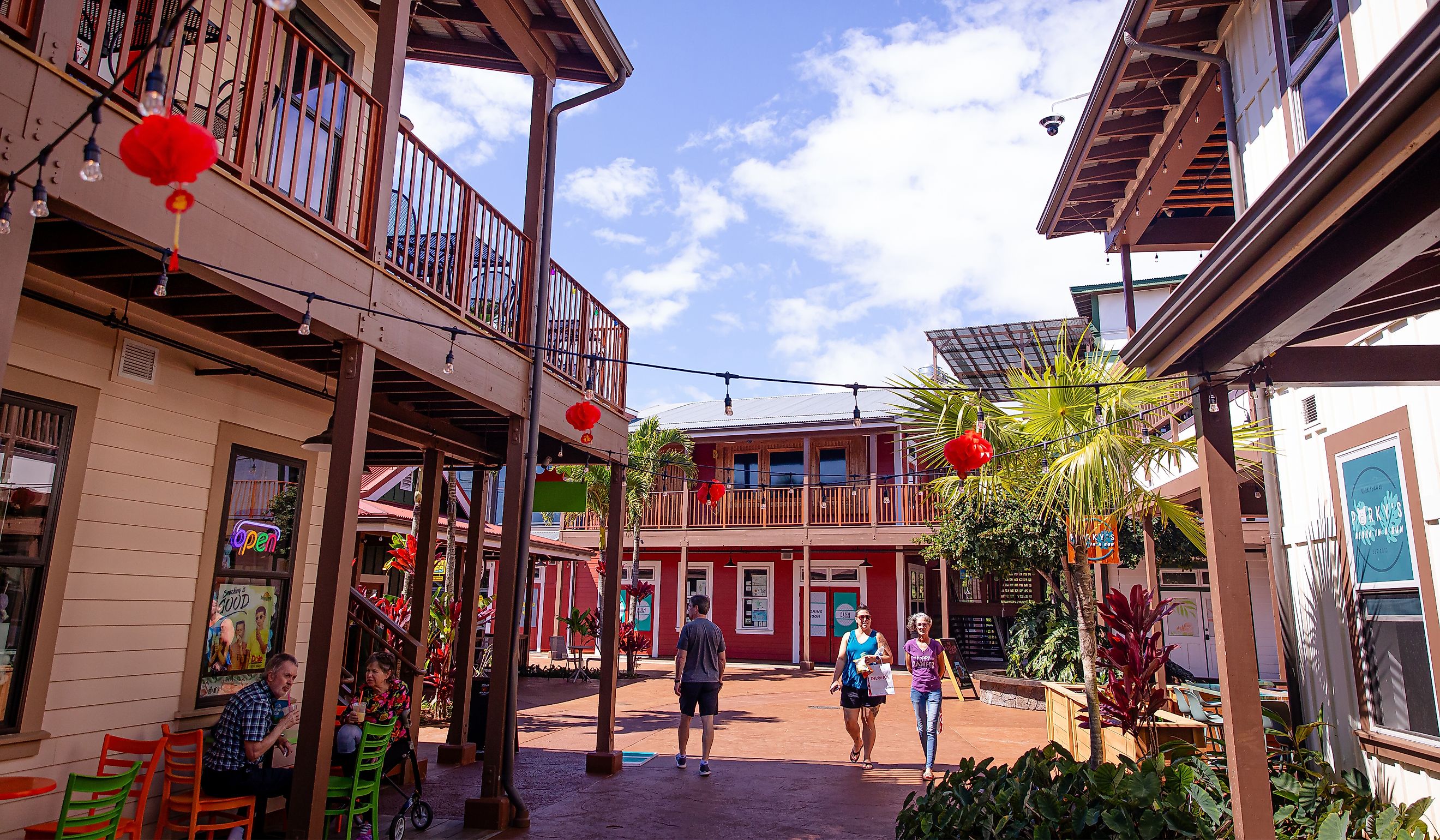
In the business district, the restored Nishita and Kawamoto Buildings carry the town's plantation-era commercial history, the latter best known as the shop where barber Tadao Kawamoto cut hair for 51 years. Visit some of the old shopfronts in Old Town, shaded by monkeypod trees, such as the Yamamoto Store, built in 1898 and long the oldest commercial building in Koloa. Plan a visit during Koloa Plantation Days, a ten-day celebration held every July, or the town-sponsored Southside Music & Arts Festival, and walk the Koloa Heritage Trail, which links fourteen historical, cultural, and geological sites between Old Koloa Town and Po'ipu.
Lanai City

Dole Park is the grassy heart of Lanai City, ringed by towering Cook pines and by most of the island's shops and restaurants. Lanai is known as the "Pineapple Island" for good reason: at the industry's peak, the plantation here grew roughly three-quarters of the world's pineapple under James Dole's company, later Dole Food Company. Try to make it over for the Lanai Pineapple Festival, held in Dole Park each June. Many visitors take the Expeditions ferry from Maalaea Harbor on Maui to Manele Harbor for a day trip, a crossing of about an hour and ten minutes. While there, make a point of checking out the Lanai Cat Sanctuary, an open-air sanctuary home to more than 700 cats. The Blue Ginger Cafe on Seventh Street has been a favorite bakery and diner for breakfast and lunch since 1991.
Waimea

Hofgaard Park, a narrow green between Kaumuali'i Highway and Waimea Road on Kauai, lies at the heart of the town's commercial district and serves as its center for gatherings and holiday celebrations. The statue of Captain Cook standing in the park is a replica of the original in Whitby, England, and it marks his arrival in January 1778, when his two ships anchored off the mouth of the Waimea River; the landing site is believed to be what is now Lucy Wright Park. Da Booze Shop is a local joint just off the square where you can get BBQ plates, burgers, chicken, mahi, and fries during a quick lunch.
The Waimea State Recreational Pier is a couple of blocks away, a roughly 600-foot pier where anglers cast straight off the planks. And if you need some guidance, contact Hooked on Kauai, an island-wide shoreline fishing guide service that teaches the local methods of "whipping" and "dunking," nuanced approaches of casting and weighting lines for the best results with local fish like ulua (trevally), o'io (bonefish), and moi (Pacific threadfin). The beach beside the pier has a dark, almost black sand, from silt carried down by the Waimea River, and the sunsets over Niihau are the reason people linger.
Kapa'a

Old Kapa'a Town is ground zero for business, shopping, history, and social gatherings in this coastal village on the eastern side of Kaua'i, about ten miles north of Lihue. The Kamoa Ukulele Company is a great duck-in for a local souvenir or to learn about the evolution of the ukulele as a Hawaiian musical tradition. The brand is built in-house by Kamoa, the multi-generational family business behind Larry's Music, which dates to 1952.
First Saturday Art Walk, run by the Kapa'a Business Association, is a great way to explore the sights and creative energy of the area. In addition to art, this monthly evening gathering features live music, locally made crafts, and the Ho'olaulea Multi-Cultural Event, a celebration of diversity in a town formed by many different peoples that was folded into First Saturday in 2023. For a fantastic dinner, go by the Lava Lava Beach Club, on the sand at Kauai Shores just south of Old Town, where they also offer games on the lawn and easy access to beach walks.
Wailuku

The central district of Wailuku, on the island of Maui, is the sector around historic Market Street, which offers a truly local experience apart from larger tourist areas. This town sits at the mouth of Iao Valley, below the West Maui Mountains, in a valley that Maui's chiefs set aside as a burial ground for ali'i in the late 15th century. Rife with old wooden shopfronts and a nostalgic feel, a great way to get into this town is by taking the Rediscover Wailuku Walking Tour developed by the Wailuku Main Street Association, which covers 23 historic locations in this sector of town. Among them are the Iao Theater, a Spanish Mission Revival movie and vaudeville house that opened in 1928 and is now home to the Maui OnStage company, and the Hale Hoʻikeʻike at the Bailey House, a museum of Hawaiian art, history, and culture. Try the Wailuku Coffee Company at its original flagship location on North Market Street for some locally roasted java in a popular meet-up spot.
Kapa'au

Not to be mistaken for Kapa'a over on Kauai, Kapa'au is another small town on the island of Hawaii. In the central green in front of the old courthouse stands an original statue of King Kamehameha I, cast by sculptor Thomas Ridgeway Gould in 1880. The casting was lost at sea on its way from Europe, later salvaged, and installed near the king's Kohala birthplace in 1883, before being moved to the courthouse lawn in 1912. Over the years, it has become a tradition to paint the statue in vivid colors, and on Kamehameha Day each June 11, it is draped in a long lei.
Take some time to look over the Kohala District Courthouse right behind the green, built in 1889 for the Kingdom of Hawaii in the style of a Hawaiian plantation house, wide lanai and all. It heard cases until 1975 and now serves the community as a civic and senior center. Kapa'au is also known for its active art community. Book a class with Hot Glass Hawaii on Akoni Pule Highway to get a firsthand look at glass blowing and hands-on training with local artisans, who also run workshops, camps, and private events. The North Kohala Artists' Co-op keeps a studio and gallery of local work at Kenji's House, two blocks west of the statue.
Makawao

Cowboys do exist in Hawaii, alongside its famous surfers, and they are especially associated with the town of Makawao, a living remnant of a ranching tradition that dates to the 1800s in this part of upland Maui. The town center at the historic crossroads of Baldwin and Makawao Avenues hosts the annual gathering of paniolo (Hawaiian cowboys) during the Makawao Stampede, a multi-day event over the Fourth of July weekend that brings out a good portion of this town of 7,297 residents and many more visitors. Watch the Makawao Parade of horses and riders proceed down Baldwin Avenue on the Saturday before Independence Day. Women riders, known as pa'u riders, dress in traditional costume, adding a lot of color and pizazz.
The action then moves up Olinda Road to the Oskie Rice Event Center, where the Makawao Rodeo runs as Hawaii's largest paniolo competition, a tradition Kaonoulu Ranch manager Harold "Oskie" Rice started in the mid-1950s. Makawao also has a vibrant art scene, and the Hui Noʻeau Visual Arts Center runs classes, exhibitions, and self-guided tours across the 25-acre Kaluanui Estate just below town on Baldwin Avenue. Stand in line for a renowned cream puff, some malasadas (Portuguese doughnuts), or Long Johns (glazed doughnut sticks) at the historic T. Komoda Store & Bakery, a fixture on Baldwin Avenue since 1916 that closes Wednesdays and Sundays and often sells out by mid-morning.
Still The Center Of Town
The clearest test of a town square is whether anyone still uses it. By that measure, Hilo's Kalakaua Park, which fills for Merrie Monarch every spring, and Dole Park, which fills for the Pineapple Festival every June, are doing better than plenty of greens their size on the mainland. The plantation-era squares offer something a bit different. Old Koloa Town and Wailuku's Market Street kept their buildings and handed the storefronts to new tenants, so the shape of the place outlasted the industry that built it. Kapa'au makes the point most plainly of all, where a courthouse that stopped hearing cases in 1975 became a community center, and the lawn out front is still where North Kohala drapes its king in lei.