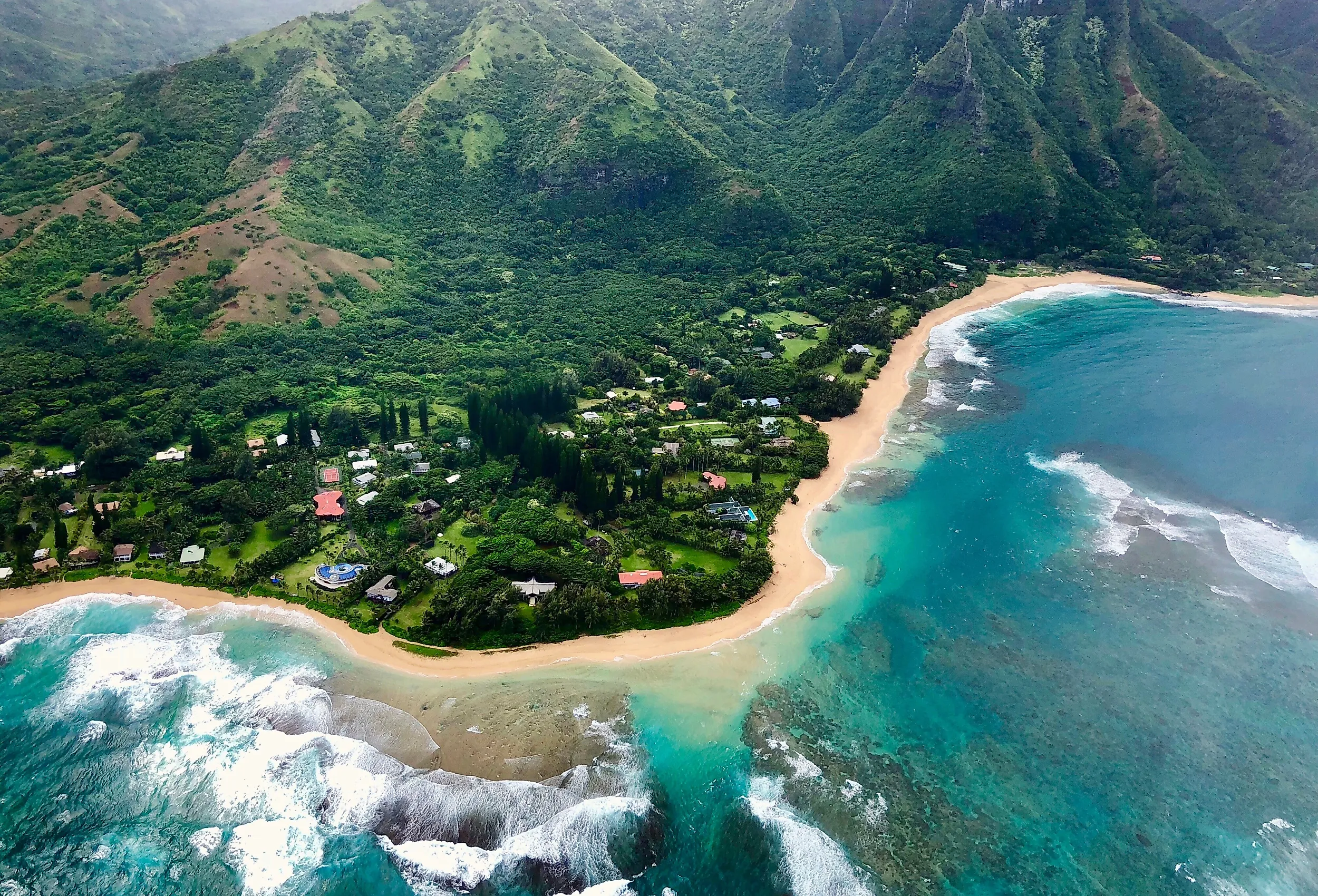
8 Best Small Towns In Hawaii For A Crowd-Free Summer
Hawaii's high season concentrates in a handful of resort coasts, and the eight towns below sit well outside them. Each carries a working local identity through the busy months. Summer arrives slowly on the Hawaiian Islands and ends without ever feeling like a high season. The pattern holds across all of them. These are the islands' quieter corners.
Hana, Maui

Hana lies at the eastern tip of Maui at the end of the 52-mile Hana Highway, with a 2020 census population of 1,526. The town receives a steady stream of day-trippers on the famous drive. Most turn around by mid-afternoon, and the town itself stays distinctly quiet after the last tour van leaves. The Hana-Maui Resort, a 66-room property on 75 acres above Hana Bay, hosts most overnight visitors and keeps a low profile relative to the resort strips on the west side of the island. Kaihalulu (Red Sand) Beach, reached on a half-mile trail off Uakea Road near the Hana Community Center, is a striking pocket cove backed by a crumbling cinder cone with cooler-water access during the summer trade-wind months. Up the road, Waianapanapa State Park's black sand beach (Pa'iloa Beach) requires advance reservations for non-residents but remains one of the most photographed coastal landscapes in the state. Hasegawa General Store, on Hana Highway and founded in 1910, anchors the town's small commercial strip and still serves as the local meeting place.
Hawi, Big Island

Hawi occupies the green northern tip of the Big Island at 580 feet of elevation, an hour's drive north of Kailua-Kona on Highway 270, with a 2020 census population of 2,268. The town was built on sugar, and when the Kohala Sugar Company closed its mill in 1973, the old storefronts were taken over by artists and restaurateurs rather than being boarded up. Today, the main street is lined with galleries, boutiques, and casual island eateries, and the pace stays unhurried even in July. Hawi works as a launch point for two of the Big Island's best drives. Eight miles northeast on Highway 270, the Pololu Valley Lookout opens onto a chain of green sea cliffs and a black sand beach reached by a steep 1.2-mile round-trip trail. The original bronze Kamehameha statue stands three miles east in Kapaau, the sister town to Hawi. Sculpted by Thomas Ridgeway Gould in 1880, it was lost in a shipwreck near the Falkland Islands, later recovered, and installed in Kapaau in 1883.
Honokaa, Big Island

Honokaa, a Hamakua Coast plantation town of 2,699 (2020 census), is 42 miles north of Hilo and 14 miles east of Waimea on Highway 19. Mamane Street, the historic main drag, retains the wooden facades of its early-20th-century sugar boom. The 1930 Honokaa People's Theatre still operates as a live music and film venue. Down the block, the Hamakua Harvest Farmers Market gathers every Saturday morning at the corner of Highway 19 and Mamane Street, with local farmers, food vendors, and live entertainment in support of regional agriculture. Eight miles west, the Waipio Valley Lookout overlooks a six-mile-long valley enclosed by 2,000-foot near-vertical walls, with a black sand beach and Hiilawe Falls (the Big Island's tallest waterfall, with a cumulative drop of roughly 1,450 feet) visible from the rim. The road into the valley has been closed to non-resident traffic since February 2022 under an active emergency rule, so the lookout is the available viewpoint. Tex Drive-In on Mamane Street has been selling hot Portuguese malasadas (square, sugar-dusted donuts) fresh from the fryer since 1969.
Waimea (Kamuela), Big Island

Waimea, also known as Kamuela to distinguish it from Waimea on Kauai, lies at 2,670 feet of elevation in the upcountry of the Kohala District, with a 2020 census population of 9,904. The cool, often misty climate runs several degrees lower than coastal towns. Trade-wind summer afternoons stay comfortable in the 70s. Parker Ranch, founded in 1847 and one of the oldest and largest cattle operations in the country at roughly 130,000 acres, defines the local culture and economy. The Parker Ranch Rodeo, held on July 4 and again over Labor Day weekend, draws paniolo (Hawaiian cowboys) from across the islands for steer roping and barrel racing. Imiola Church on Church Row, built of koa wood in 1857 and designed by Lorenzo Lyons (composer of the Hawaiian-language hymn "Hawai'i Aloha"), is the only known church in Hawaii to use koa for both structural and decorative members. The Waimea Farmers Market, held every Saturday morning at the Parker School, is the practical meeting point for the area's small farms and ranchers.
Hanapepe, Kauai

Hanapepe, on Kauai's south-west coast about 18 miles west of Lihue Airport, has a 2020 population of 2,678 and bills itself as "Kauai's Biggest Little Town." The half-mile of Hanapepe Road is genuinely sleepy six days a week. Friday Art Night, every week from 5 pm to 9 pm, fills it with open galleries, food trucks, and local musicians, drawing both residents and visitors without ever feeling crowded by mainland standards. The Hanapepe Swinging Bridge, originally built in 1911 and rebuilt in 1996 after Hurricane Iniki severely damaged it in 1992, crosses the Hanapepe River on cables and wooden planks behind Banana Patch Studio. Talk Story Bookstore, the westernmost bookstore in the United States, recently relocated from Hanapepe Road to nearby Kaumakani but remains a short drive west on the Kaumualii Highway and stocks a deep selection of Hawaiiana titles. Five minutes south of town, Salt Pond Beach Park provides one of the safest summer swimming beaches on the south shore, with a reef-protected lagoon and the last remaining traditional Hawaiian salt-making operation in the clay pans next door, worked by local families during the dry summer months.
Kaunakakai, Molokai

Kaunakakai is the main town of Molokai, the least-visited of the major Hawaiian Islands, with a 2020 census population of 3,419. The island has no traffic lights, no big-box stores, and no buildings taller than a coconut palm by long-standing local convention. Kaunakakai operates accordingly. The newly revived Molokai Farmers Market, returning every Saturday morning at the Molokai Public Library grounds beginning in November 2025, restores a long-standing community tradition that closed during the pandemic. Kanemitsu's Bakery on Ala Malama Avenue is famous for hot Molokai sweet bread, with locals lining up at the back door after hours for the daily fresh loaves. Just west of town, the Kapuaiwa Coconut Grove preserves several hundred palms (originally 1,000) on a 10-acre beachfront site planted in the 1860s for King Kamehameha V, according to local tradition, one tree for each warrior in his army. Kaunakakai Wharf at the foot of Ala Malama is the longest pier in Hawaii and the main fishing point for residents.
Paia, Maui

Paia rests five miles east of Kahului Airport at the start of the Hana Highway, with a 2020 census population of 2,724. Its colorful main street of pastel-painted plantation storefronts dates to the 1930s sugar era, rebuilt after a 1930s fire and the 1946 tsunami, and the last sugar mill closed in 2000. The main street is now lined with surf shops, organic cafes, and boutiques that cater to the windsurf and yoga crowds drawn to the North Shore. Hoʻokipa Beach Park, two miles east of town, is known globally as the Windsurfing Capital of the World. Summer is the calmer season here, with smaller waves, making it a good spectator spot and a safer place to watch the green sea turtles haul out on the sand. Baldwin Beach Park, one mile west of town, has a protected inner cove called Baby Beach with calm lagoon water that suits families and children through the summer months. Mana Foods on Baldwin Avenue is the local center of gravity for groceries and prepared organic food.
Waialua, Oahu

Waialua, a former sugar plantation town on the western edge of Oahu's North Shore with a 2020 population of 4,062, is the quieter neighbor of Haleiwa and a useful base for the summer side of North Shore life. The North Shore is best known for the winter big-wave season at Pipeline and Sunset Beach. In summer, those same beaches turn flat and calm, ideal for swimming and snorkeling, and the crowds shift away from this part of the island. The Waialua Sugar Mill, abandoned in 1996 after 130 years of cane production, is now an artisan complex housing the North Shore Soap Factory, Island X Hawaii, the Waialua Estate Coffee tasting room, and several surfboard shapers. Mokuleia Beach Park, three miles west of town along Farrington Highway, is a low-key stretch of sand where Hawaiian green sea turtles outnumber visitors most mornings, with reef-protected swimming on the inner side. Haleiwa is six minutes east when the local pace wears off, and a shave ice from Matsumoto's becomes worth the short drive.
Planning a Summer Visit
These eight towns sort cleanly by island. The three Big Island picks (Hawi, Honokaa, and Waimea, linked by the Hamakua and Kohala drives) cluster on the cooler north and east of the island and pair well as a three-day loop based out of Hilo or Waimea itself. Hana and Paia anchor the two ends of Maui's Hana Highway and reward the slowest possible pace, with the road itself the main attraction between them. Hanapepe on Kauai, Kaunakakai on Molokai, and Waialua on Oahu are each strong enough to anchor a full island visit, and Molokai in particular rewards travelers willing to give up resort amenities for genuine quiet. Across all eight, the principle is the same. Stay long enough to fall into the local rhythm, and the high-season crowds of the resort coasts become someone else's problem.