10 Mississippi Towns With Unforgettable Main Streets
William Faulkner's writing desk still sits in his house a short walk off Oxford's courthouse square. Coca-Cola went into its first bottle on Washington Street in Vicksburg in 1894. Robert Johnson supposedly traded his soul at a Clarksdale crossroads for the gift of the blues. These are the small histories a Mississippi main street hands you between the diner and the antique shop. The ten downtowns below reward anyone willing to slow down and read a town one block at a time.
Natchez

High above the Mississippi River in the state's southwestern corner, Natchez grew rich on river trade, steamboat traffic, and a cotton economy built on enslaved labor, and Main Street still reflects that prosperity. Italianate storefronts, Victorian commercial blocks, and Greek Revival landmarks line the downtown corridor, with their cast-iron details and preserved façades recalling a time when Natchez ranked among the wealthiest cities in the South. Start the morning with hearty biscuits and gravy at a downtown diner before wandering beneath the blocks of remarkably preserved architecture, listening for the sound of church bells from nearby St. Mary Basilica, a Gothic Revival marvel whose stained-glass windows, vaulted interior, and twin spires make it one of downtown's most striking sights.
Stanton Hall, among the largest and grandest Greek Revival mansions in America, occupies an entire city block just off Main Street. Its soaring Corinthian columns, marble mantels, chandeliers, and sweeping staircase offer a glimpse into the extraordinary wealth that flowed through Natchez during the cotton era. The Natchez Museum of African American Culture and History sits a few doors down and explores key moments in the city's history. Housed in a historic post office building, the museum contains exhibits on the Forks of the Road slave market, Natchez-born author Richard Wright, and the city's devastating 1940 Rhythm Night Club fire. After a lunch of Mississippi River catfish or a "meat and three" plate at a local lunch counter, follow Main Street to Bluff Park, where the brick-paved sidewalks open to wide views of the Mississippi River, where you can watch long barges still navigating the waterway that helped build the city's fortune.
Ocean Springs

On Mississippi's Gulf Coast, just east of Biloxi Bay, Ocean Springs combines beaches, maritime history, and one of the state's most celebrated arts communities. Government Street serves as the town's main artery, shaded by ancient live oaks whose branches stretch over sidewalks lined with galleries, boutiques, cafés, and historic buildings. Dine at a table beneath the oaks before or after exploring some of the town's best-known cultural landmarks, like the Mary C. O'Keefe Cultural Arts Center, housed in the former 1927 Ocean Springs Public School.
A short stroll away, the Walter Anderson Museum of Art preserves the work of Mississippi's most famous artist, including his Gulf Coast paintings and the remarkable "Little Room" murals. But Government Street reaches its most colorful expression during the annual Peter Anderson Arts & Crafts Festival, when each autumn, artists, craftspeople, musicians, and food vendors fill the live-oak-shaded streets of downtown, transforming the district into an outdoor gallery. Named for renowned potter Peter Anderson, the festival draws visitors from across the South. On those lively weekends, live music mingles with conversations between artists and shoppers while the aromas of Gulf seafood and festival treats waft through the streets.
Bay St. Louis

Along Mississippi's Gulf Coast, where St. Louis Bay meets the Mississippi Sound, Bay St. Louis has built one of the state's most inviting and artistic waterfront downtowns. Main Street runs through the heart of Old Town, a walkable district of galleries, boutiques, cafés, and restaurants housed in colorful historic buildings just a few blocks from the harbor. Sea breezes cool off the corridor by day, and nights bring the sound of live music from open pub doorways. Plan to make your day on Main a slow one, with plenty of time to explore the many galleries and antique shops occupying spaces that have helped make Bay St. Louis a favorite among artists and creatives.
A favorite spot is the Alice Moseley Folk Art Museum, which preserves more than 100 original paintings by the beloved self-taught artist, whose whimsical depictions of Southern life earned national recognition. Nearby, the historic L&N Train Depot, a Mission-style Mississippi Landmark, houses the Bay St. Louis Mardi Gras Museum, where elaborate costumes and parade memorabilia celebrate one of the Gulf Coast's most colorful traditions. As the afternoon winds down, pick up a shrimp po'boy or a basket of fresh Gulf shrimp to enjoy at the harbor. From a bench overlooking Bay St. Louis, watch sailboats, shrimp boats, and pleasure crafts cross the water while waiting for the sun to set over the Gulf.
Vicksburg

Many travelers arrive in Vicksburg to explore Vicksburg National Military Park, which preserves the site of the 47-day Siege of Vicksburg, one of the Civil War's most decisive and devastating campaigns. Yet after touring the battlefield, monuments, and the restored USS Cairo ironclad, downtown Washington Street proves that the city offers far more than military history.
The street makes its way through the heart of Vicksburg, climbing and descending the bluffs above the Mississippi River. Brick commercial buildings, cast-iron storefronts, and ornate cornices reflect the city's years as one of the South's busiest river ports, and today the aromas of roasting coffee and barbecue smoke drift from downtown restaurants just as they did more than a century and a half ago. Pick up a brisket sandwich and stroll to a bench overlooking the Mississippi, where towboats still push long strings of barges along the river below.
Afterward, step inside the Old Courthouse Museum, an 1858 landmark crowned by a copper dome. Its galleries contain Civil War artifacts, period furnishings, Jefferson Davis memorabilia, and one of the South's largest collections of historical objects related to the conflict. A few blocks away, the Biedenharn Coca-Cola Museum occupies the site where Coca-Cola was first bottled in 1894. After examining antique bottling equipment and early advertising displays, reward yourself with a bottled Coca-Cola or an old-fashioned Coke float.
Laurel

Many travelers arrive in Laurel after watching the city's revival featured on HGTV's Home Town. Yet the appeal of Central Avenue began long before television cameras arrived. The wealth generated by the yellow pine industry is still visible along Central Avenue, where transom windows and detailed antique storefronts create one of Mississippi's most distinctive streetscapes. Start the morning with a Southern breakfast at a neighborly café before setting out along blocks lined with buildings that once housed lumber companies, banks, mercantile stores, and professional offices. Spend a few minutes looking up; the intricate brickwork, decorative metal details, and upper-story windows reveal the ambitions of the businessmen who helped transform Laurel into a booming timber center.
Laurel Mercantile Co. is the community-minded general store that became a symbol of the city's revival. A few blocks away, Scotsman General Store & Woodshop showcases furniture and goods inspired by Mississippi traditions. Art lovers will want to set aside plenty of time for the Lauren Rogers Museum of Art, whose galleries showcase American paintings, Native American baskets, and Japanese woodblock prints. Afterward, return to Central Avenue for a hearty Southern meal in one of the atmospheric structures that made Laurel famous long before television crews arrived. And if you're here in October for the annual Laurel Main Street Festival, also known as the Cannon Motors Loblolly Festival, you'll join thousands of musicians, artists, food vendors, and craftspeople who fill downtown in celebration of the community that brought it back to life.
Corinth

Northeastern Mississippi draws many history buffs to Shiloh National Military Park in nearby Tennessee, where one of the Civil War's bloodiest battles unfolded in April 1862. Yet just a short drive away, Corinth offers a downtown experience that deserves a place on every battlefield itinerary. The city became a strategic Civil War prize because it sat at the intersection of two major railroads, and that railroad legacy still shapes Fillmore Street, the heart of downtown Corinth. Train horns still interrupt conversations, while restored buildings recall the railroad boom years.
Make your way to the Corinth Depot, where soldiers, merchants, and travelers once arrived at one of the South's busiest rail junctions. Today, the depot houses the Crossroads Museum, which explores the city's railroad and Civil War heritage. History enthusiasts should also make time for the nearby Corinth Civil War Interpretive Center. Afterward, grab a famous "slugburger." The famous patty combines beef or pork with potato or meal filler, and it's so beloved that Corinth has hosted an annual Slugburger Festival since 1988. After lunch, spend some time browsing the antique stores and locally owned shops that occupy many of the same buildings that witnessed troop movements, military occupation, and the city's postwar recovery. By day's end, the distant rumble of a passing freight train provides a fitting reminder that Corinth's story has always been tied to the rails that built it.
Oxford

Among the rolling hills of north Mississippi, Oxford is known around the world as the home of William Faulkner, and a short drive from downtown, Rowan Oak preserves the home where William Faulkner wrote many of his greatest works. But the town's historic Square is a character all its own. Centered on the stately Lafayette County Courthouse, the district is lined with nineteenth-century buildings whose upper stories feature decorative cornices, tall windows, and architectural details, and today is filled with independent bookstores, galleries, cafés, and boutiques. The Square reflects both the town's literary reputation and the influence of the nearby University of Mississippi.
Book lovers inevitably find their way to Square Books, one of the nation's most celebrated independent bookstores, where shelves overflow with Southern literature, regional history, and signed editions from visiting authors. Just around the corner, Bottletree Bakery has become a local institution, drawing crowds with fresh pastries, artisan breads, and hearty breakfasts. Nearby, Neilson's Department Store, founded in 1839 and recognized as the South's oldest continuously operating department store, continues to welcome shoppers from its historic location. And if your visit coincides with the annual Double Decker Arts Festival, you'll find the Square a bustle of artists, musicians, food vendors, and thousands of visitors celebrating one of Mississippi's premier cultural events.
Greenwood

In the heart of the Mississippi Delta, where the Tallahatchie and Yalobusha rivers join to form the Yazoo, Greenwood grew wealthy on cotton and became one of the region's most important commercial centers. Howard Street remains the backbone of downtown, lined with former banks, churches, hotels, and whole commercial blocks that reflect the prosperity of the Delta's cotton era. Many travelers arrive in Greenwood seeking blues history, Delta culture, and legendary Southern food, and Howard Street puts all three within easy reach. All tell the story of a city that once stood at the center of one of the world's most productive cotton-growing regions.
The restored Alluvian Hotel occupies the former Hotel Irving, a 1917 landmark rescued from decades of neglect. Nearby, the Gothic Revival Episcopal Church of the Nativity rises above downtown with pointed arches and colorful stained-glass windows that have welcomed worshippers since the nineteenth century. By noon, it's time to follow the locals in search of one of the Delta's signature foods: hot tamales. Greenwood sits on Mississippi's famous Hot Tamale Trail, and few experiences feel more authentic than enjoying a paper-wrapped bundle of the spicy treat before continuing your exploration of the street. Allow a good while to browse the shelves at TurnRow Book Company, one of Mississippi's most beloved independent bookstores, known for Southern literature, regional history, and author events. Just off Howard Street, the Greenwood Blues Heritage Museum explores the musicians, juke joints, and recordings that helped shape the sound of the Delta.
Yazoo City

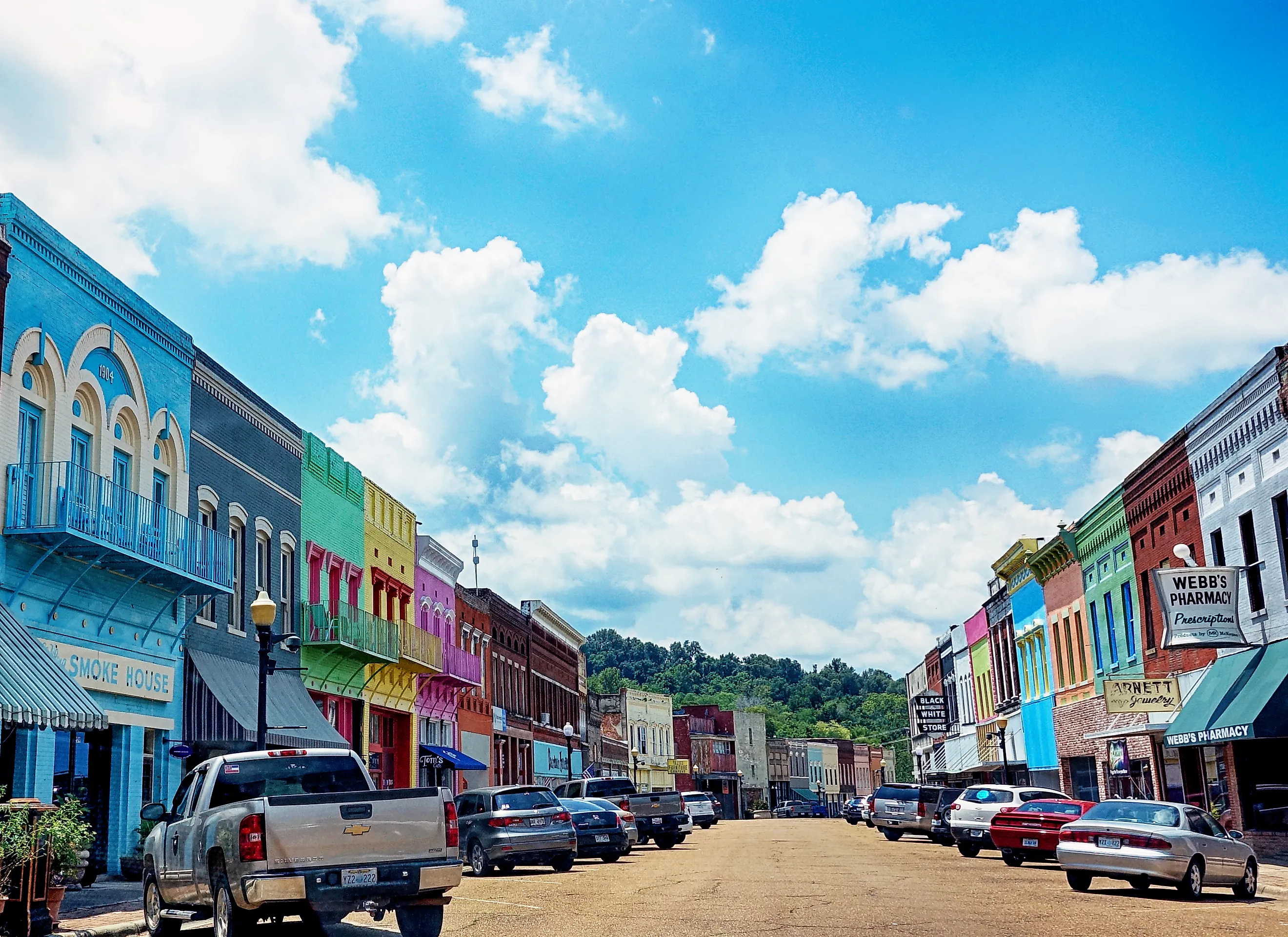
Where the Mississippi Delta meets the loess bluffs, near the banks of the Yazoo River, Yazoo City has one of the most recognizable Main Streets in the state, and the reason is a coat of paint. A fire on May 25, 1904, burned most of downtown to the ground, and the brick stores that went up in 1905 and 1906 to replace it, now listed on the National Register of Historic Places, stand shoulder to shoulder in a rare unbroken row from a single moment. In the early 2000s, with the storefronts fading and vacancies spreading, business owners and the county's tourism office painted the whole run in bright pastels, and the result is a downtown that looks like nowhere else in Mississippi. From late November into early January, the buildings are outlined in holiday lights that carry the color into the dark.
Local legend blames the 1904 fire on the Witch of Yazoo, a story the writer Willie Morris, who grew up here, set down in his 1971 book Good Old Boy. The grave said to be hers sits wrapped in chains in the historic section of Glenwood Cemetery, which dates to at least 1856; Morris himself is buried about thirteen paces south of it. Back downtown, the north end of Main Street opens onto a triangular block that locals simply call the Triangle, where the old 1904 Main Street School now serves as the Triangle Cultural Center. Inside are the Sam Olden Yazoo Historical Society Museum and, in the basement, the William Duke Carter Collection of Antique Tools. For lunch, follow the autographs on the wall to Ubon's Barbeque, a fifth-generation family operation whose sauce has traveled the competition circuit far beyond the county line.
Clarksdale

Surrounded by the flat farmland of the Mississippi Delta, Clarksdale occupies a special place in American music history. Delta Avenue forms the heart of downtown, where early twentieth-century storefronts stand beneath painted signs, faded advertisements, and brightly colored murals celebrating the city's blues heritage. The district retains the feel of a Delta crossroads town, with record stores, galleries, restaurants, and music venues occupying many of its historic buildings. The Delta Blues Museum is central to the downtown experience. Its collections include photographs, instruments, recordings, and the modest cabin where Muddy Waters lived before becoming one of the most influential musicians of the twentieth century.
Just a few blocks away, Cat Head Delta Blues & Folk Art has become a pilgrimage site for music lovers, its shelves packed with blues records, regional books, folk art, and memorabilia. The crossroads of Highways 61 and 49 lies just beyond downtown. According to local folklore, this is where blues marvel Robert Johnson met the devil and exchanged his soul for his extraordinary musical talent. The story remains one of the most enduring legends in American music, and a roadside marker now stands at the spot where the deal is said to have been made. Back on Delta Avenue, local restaurants serve Delta hot tamales, barbecue, and Southern favorites before the evening crowd gathers at Ground Zero Blues Club, one of the town's best-known music venues. Those wanting a glimpse of an older Delta tradition can continue on to Red's Lounge, a legendary juke joint. And during the annual Juke Joint Festival, musicians, artists, vendors, and blues fans fill Delta Avenue and the surrounding streets in celebration of the culture that made Clarksdale famous.
Mississippi Main Streets
What these downtowns share is not architecture or river views but the fact that their best stories are still told by the people behind the counters. The slugburger recipe in Corinth predates the festival that celebrates it. The hot tamale in Greenwood carries a century of Delta history in its corn husk. The blues records at Cat Head sit a few hundred yards from the crossroads that made them. A franchised strip could never hold any of that. A Mississippi main street earns a second look because the history is local, specific, and usually available for the price of lunch.