10 Main Streets Where Portugal Comes Alive
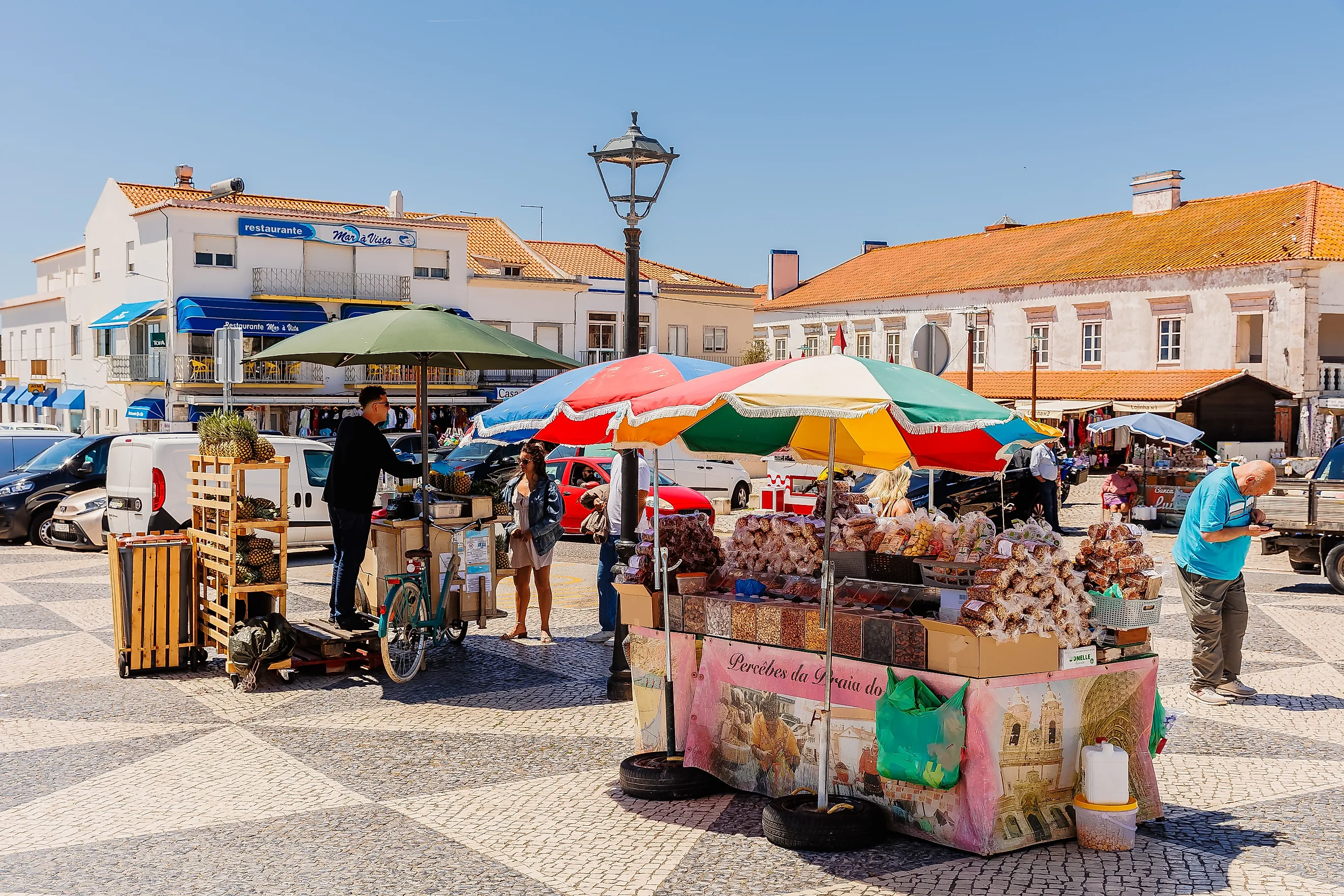
Several of Portugal's small-town main streets grew up in the shadow of a castle, a fortress, or a cliffside pilgrim chapel. Today, they are where towns come together, filled with outdoor dining terraces, bakeries, and taverns. In Óbidos, whitewashed buildings trimmed in bright blue and yellow line Rua Direita, where small shops sell ginjinha in edible chocolate cups. Tomar's Rua Serpa Pinto, which locals call A Corredoura, mixes ornate tiled facades and wrought-iron balconies with cafes serving fatias de Tomar egg pastries. In Nazaré, stalls selling dried fruits and nuts fill Rua D. Fuas Roupinho on its way to a lookout more than 100 meters above the sea. Costa Nova's Avenida José Estêvão follows the Aveiro Lagoon past palheiros, the striped wooden houses where fishermen once stored their nets. These 10 main streets show where Portugal comes alive, in walled hill towns, river towns, Algarve ports, and Atlantic fishing villages.
Rua Direita, Óbidos

Óbidos is a historic walled town about 50 miles north of Lisbon. It has been Portuguese since 1148, when it was taken from the Moors. Rua Direita is the primary pedestrian street, lined with cobblestones, whitewashed stone buildings with bright blue and yellow trim, and small shops selling local crafts and ginjinha, a sour cherry liqueur served in edible chocolate cups. Rua Direita has carried its name since the 14th century, meaning "direct street," as it was built to serve as the most direct route from the town's main gate to Óbidos Castle. Further down Rua Direita, visitors will pass the Church of Santa Maria, a Renaissance structure featuring 17th-century tilework. The road eventually ends at Óbidos Castle, a 12th-century fortification that offers sweeping views of the surrounding countryside and the town's intact walls.
Rua 5 de Outubro, Albufeira

Located in the southern Algarve, Albufeira was originally a Roman settlement and later became a fortified Moorish port known as Al-Buhera during the 8th century. Its main street, Rua 5 de Outubro, cuts through the historic center and was largely rebuilt from rubble following the devastating 1755 earthquake. Today, the street features a lively mix of outdoor dining terraces, seafood restaurants serving regional cataplana stew, and specialty boutiques selling leather goods. History buffs can explore the Municipal Museum of Archaeology, which showcases artifacts spanning from the prehistoric era through the Islamic period. At the southern end of the street, the walkway winds into a tunnel carved directly through the coastal rock, opening onto scenic views of Praia do Peneco and the Atlantic Ocean.
Rua da Liberdade, Tavira

Tavira sits along the Gilão River in the eastern Algarve. The town developed into a prominent trading hub during the 15th and 16th centuries. Rua da Liberdade, its main pedestrian thoroughfare, was largely developed during the 18th century as the area was rebuilt after the major earthquake of 1755. Lined with traditional tiled facades and shops offering local crafts such as ceramics and fine linens, the area invites visitors to stroll to the nearby Ponte Romana, a seven-arched pedestrian bridge spanning the river. As for the ruins of Tavira Castle, they lie just a short climb up a set of steps off the main street, where elevated gardens sit within the old stone fortifications.
Rua 25 de Abril, Lagos

Further west in the Algarve is Lagos, an ancient maritime town. It served as the primary launching point for many 15th-century West African voyages organized under Prince Henry the Navigator. Once named for dictator António de Oliveira Salazar, the central pedestrian street was renamed Rua 25 de Abril days after the 1974 Carnation Revolution. During this time, democracy was restored to Portugal. The main street runs within the town's original medieval walls, filled with open-air cafes, pastry shops serving almond sweets, and boutiques with hand-painted pottery. A block away stands the Church of Saint Anthony, famous for its elaborate Baroque interior with golden woodwork. Nearby, visitors can visit the Slave Market Museum (Mercado de Escravos), or follow the street down to the waterfront where the 17th-century Fort of Ponta da Bandeira guards the harbor entrance.
Rua Serpa Pinto, Tomar

The quiet medieval town of Tomar sits on the Nabão River in central Portugal. Rua Serpa Pinto, known to locals as A Corredoura, is a wide main street laid out in a grid layout during a 15th-century urban reorganization overseen by Prince Henry the Navigator. There, visitors can feast their eyes on ornate tiled facades and wrought-iron balconies, while perusing cozy cafes serving local fatias de Tomar egg pastries. Tomar's history dates back to 1160, when it was established as the headquarters for the Knights Templar in Portugal. The settlement began with a fortified castle and the iconic round Charola church, which later expanded into the UNESCO-listed Convent of Christ overlooking the main street from the hill above.
Praça da República / Jogo da Bola, Ericeira

Ericeira is a coastal town that evolved from a traditional fishing village into Europe's first World Surfing Reserve. Its central square, Praça da República, served for generations as a community gathering spot where locals met to play ball games, earning it the nickname Jogo da Bola. Today, coffee stalls, surf shops, seafood eateries, and bakeries selling local ouriços pastries line the square and its surrounding lanes. The square is also home to the World Surfing Reserve Interpretation Centre, which is combined with the town's tourism office. The reserve was designated in 2011 and stretches along about 2.5 miles of coastline, taking in seven surf breaks, including Ribeira d'Ilhas and Coxos. A brief walk from the square brings visitors to a viewpoint above Praia do Norte, where huge ocean swells crash against the rocky shore.
Avenida José Estêvão, Costa Nova

Costa Nova, a small coastal village, sits on a narrow sandbar between the Atlantic Ocean and the Aveiro Lagoon. Originating as a 19th-century fishing community, its main strip, Avenida José Estêvão, runs directly parallel to the lagoon. The avenue is famous for its palheiros, brightly painted, candy-striped wooden buildings originally used by fishermen to store their nets. Today, these structures have been converted into homes painted in vivid red, blue, green, and yellow stripes. Along the waterfront, visitors can explore fresh fish markets, dine on fresh sardines, or rent bicycles to cruise the flat paths that border the lagoon, dunes, and ocean beaches.
Rua Direita, Monsaraz

Monsaraz is a tiny hilltop village enclosed by medieval walls. Situated near the Spanish border, it is one of the oldest inhabited settlements in southern Portugal. Rua Direita, the main street, has maintained its original layout since 1232, when King Sancho II entrusted the town to the Knights Templar. The street is lined with whitewashed schist and limestone cottages, classic stone staircases, art galleries, and traditional taverns serving Alentejo wine and regional sheep's cheese. Key sights along the path include the Parish Church of Nossa Senhora da Lagoa, home to a 14th-century marble tomb, and Monsaraz Castle, which offers scenic courtyard views out over the Alqueva Reservoir.
Rua D. Fuas Roupinho / Sítio de Nazaré, Nazaré

Perched on a cliff high above the coastal town of Nazaré lies the historic neighborhood of Sítio de Nazaré and its central corridor, Rua D. Fuas Roupinho. The street developed around a 12th-century pilgrimage site after Dom Fuas Roupinho built a small chapel on the cliffside following his legendary rescue from falling off the edge while hunting. As pilgrims flooded the clifftop over the centuries, the street grew to accommodate all their needs. The avenue today is lined with stalls selling dried fruits, nuts, and traditional handicrafts, leading to the main square and the Sanctuary of Our Lady of Nazaré, founded in the 14th century. The street ends at the dramatic Suberco Lookout, a platform standing over 100 meters above the Atlantic Ocean. North of the headland, Praia do Norte is where the Guinness record for the largest wave surfed, 86 feet, was set in 2020.
Rua do Espírito Santo, Marvão

Marvão is a mountaintop village situated 865 meters above sea level in the Serra de São Mamede mountains. The fortified village was established as a military outpost in the 9th century by the Islamic warrior Ibn Marwan. Rua do Espírito Santo developed during the Middle Ages as the village's main residential road, named for the 16th-century Church of the Holy Spirit built along its path. The cobblestone lane winds through the walled town, where visitors can admire whitewashed cottages, historic Gothic arches, and the 17th-century Governor's House. The street eventually leads up to Marvão Castle, a well-preserved medieval fortress perched on the ridge with sweeping views across the Alentejo plains toward Spain.
Portugal's Vibrant Small-Town Streets
From mountain fortresses in the Alentejo to coastal promenades in the Algarve and riverside towns in the central regions, each main street on this list serves as a community hub. As these small towns remain well-preserved, they maintain their historic architecture, slower pace of life, and local traditions far better than some larger cities that may undergo rapid modernization. For travelers interested in experiencing authentic small-town life, these ten streets offer a well-rounded look into Portugal's rich heritage, architectural legacy, and traditions that will certainly endure for centuries more.