10 Best Lakeside Towns in Michigan
With four Great Lakes to lean on, plus some sizable subsidiaries, Michigan is all about scenic waterfront towns. The state's Lower Peninsula favors classic beach getaways, where sunny days are greeted with freshwater splashing and concession stand snacking. Charlevoix delivers that classic Lower Peninsula charm, with its storybook Mushroom Houses and quick walks that always seem to end at a Lake Michigan beach. The Upper Peninsula, on the other hand, injects a bit of history and raw wilderness into the mix, while still ensuring plenty of everyday activities for committed travelers. Marquette brings the Upper Peninsula’s livelier side into the mix, pairing ore-dock history and a college-town food scene with rugged Lake Superior shorelines and the cliff-ringed trails of Presque Isle Park. All told, Michigan fosters a wide array of lakeside towns, and these are ten of its best.
Lower Peninsula
Charlevoix

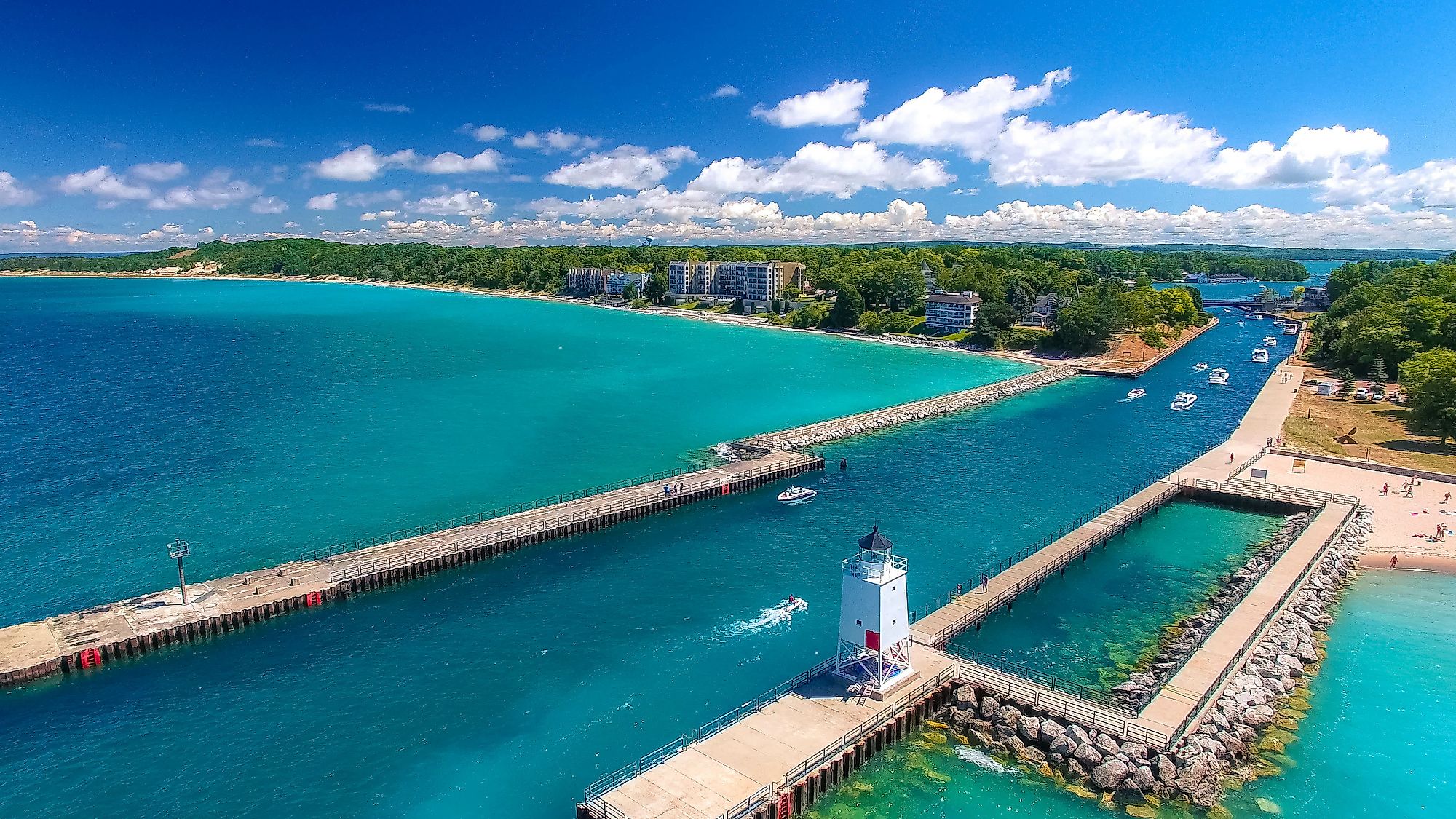
The small and quirky city of Charlevoix is situated on a modest isthmus between three lakes, making it an ideal starting point for our watery tour. As US Route 31 approaches the top of the Lower Peninsula, it slows to become Bridge Street — Charlevoix's commercial thoroughfare. To the east, you'll see boats coming and going from the sheltered marina on Round Lake, which then proceeds to blossom into the much larger Lake Charlevoix, harboring its own yacht club and two beach parks.

Following the Round Lake Channel west beneath the draw bridge, or by simply walking through Charlevoix's Earl Young Local Historic District (where you'll find the famous "Mushroom Houses"), Lake Michigan unfurls in all its glory. Michigan Beach Park offers another opportunity to dig one's toes into the sand, while the adjacent, solid red South Pier Lighthouse is eternally emblematic of Michigan's shorelines and provides a platform to wade further into the blue beauty without ever leaving dry land.
Saugatuck

Another example of a colorful community wedged between a Great and a secondary lake is Saugatuck. Sitting on the east side of Kalamazoo Lake (a bulbous portion of the Kalamazoo River), this Allegan County enclave enjoys a waterfront vibe without facing the occasional brunt of Lake Michigan's moods. Water Street and Butler Street harbor a variety of bespoke shops and constitute much of Saugatuck's Social District. So you might find that your lakeside-charm meter is fully charged after experiencing this section of town, but if you're craving more waterfront adventures, then make the short drive to Oval Beach.

Backdropped by grassy dunes, Oval Beach has a secretive feel to it — save for the regular summer crowds (sorry, the secret's out). When passing through in the spring, you might luck out by experiencing an unimpeded beach walk. However, at that time, it isn't exactly swimming weather (there are always trade-offs). Nonetheless, at any time of year, you can always hike into the sandy, forested trails of Mount Baldhead Park to find serenity and elevated scenery. From atop the namesake mound, you'll gain a fresh vantage point of where the journey began on the Kalamazoo River and Water Street.
South Haven

South Haven has one lake, but three distinct tourist areas. At the center of town, the two main streets (i.e., Phoenix and Center) form a pedestrian-friendly shopping and dining district well-suited for pre-beach coffee and breakfast or post-sun perusing. The north end of Center Street unveils South Haven's Old Harbor Village, full of additional shops, restaurants, and riverside watering holes within anachronistic maritime facades. Opposite the Black River, you'll spot private boats parked at the municipal marina, Cruisin' Tikis tour boats, and the various novelty vessels operated by the Michigan Maritime Museum.

Saving the best for last, visitors can work their way up Water Street to South Beach, or meander through the northside neighborhoods to North Beach. Both Lake Michigan beaches feature soft sand and nostalgic concessions. And, of course, at the mouth of the Black River, a Michigan-red lighthouse stands atop the beach-dividing pier.
Empire

Another defining characteristic of Michigan's shoreline is its extensive sand dune system. The largest of these post-glacier, windswept landforms can be found along Sleeping Bear Dunes National Lakeshore. Here, on the northwestern edge of the Lower Peninsula, the 19th-century (former) logging village of Empire acts as base camp. After registering at the Philip A. Hart Visitor Center, take some time to peruse this lakeside community. Front Street is lined with historic buildings, delightfully random shops, and a tavern or two, and ultimately leads toward Empire Beach. Fixed between South Bar Lake and Lake Michigan, this slim, sandy strip culminates at the Robert H. Manning Memorial Lighthouse but also showcases the namesake Sleeping Bear Dune (all 450 feet of it) further up the shoreline.

For an even better view of the titular dune, consider hiking the 1.5-mile Empire Bluff Trail. The panoramic view pops at the turnaround point, but the walk in and out through the beech-maple forest is enjoyable in its own right.
Leland

Having pushed north from Empire and explored all 65 scenic miles of Sleeping Bear Dunes National Lakeshore, a fresh perspective on Lake Michigan awaits at the historic fishing village of Leland. Sitting at the base of the Leelanau Peninsula (known for its small but bountiful wine region), sandwiched between the Great Lakes and Lake Leelanau, it makes sense that Leland has leveraged its watery assets.
Here, ferries can be boarded for the Manitou Islands — two lesser-known landforms that feed the Indigenous Sleeping Bear legend, while also promoting wilder hikes and authentic camping. Back in Leland proper, you'll find the mouth of the Leland River lined with weathered docks, old shanties, smokehouses, seafood markets, and tasty tourist shops, all comprising Historic Fishtown.
Grand Haven

Before leaving the Lower Peninsula, we have to highlight at least one of Michigan's classic, fun-loving beach towns. Grand Haven enjoys immediate access to Lake Michigan and the quintessential sandy beaches it supports. Up top, you've got North Beach Park and its corresponding North Ottawa Dunes. And on the south side of the Grand River, Grand Haven State Park Beach and Grand Haven City Beach happily greet the summer crowds.

Stretching out from the Grand River is the circa-1839 Grand Haven South Pier, which boasts not just one, but two freshly-painted red lighthouses. Following the waterway inland, pedestrians will enjoy the Grand River Boardwalk, which leads not only into the commercial core of town, but also the Grand Haven Musical Fountain (quite the lightshow after dark), while paddlers of all sorts will appreciate the emergent network of slow-moving bayous and low-key lakes.
Upper Peninsula
Mackinac Island

This Victorian time-capsule floats between the Lower and Upper Peninsulas, though it slightly favors the latter. Similarly, Mackinac Island marks the transition between Lake Michigan and Lake Huron, again favoring the latter somewhat (though, given that it's all the same water, the distinction is somewhat arbitrary). However you spin it, all 8+ miles of the island's shoreline are immersed in the Great Lake experience.

Mackinac Island refers to the small, south-situated community (mostly a tourist attraction, with about 600 permanent residents), as well as the rest of the scenic rock, protected by Mackinac Island State Park. Since no cars are allowed anywhere on Mackinac Island, this place is made for strolling. With that said, dockside bike rental agencies provide an alternative way to explore the island's Indigenous and military heritage, limestone landmarks, shoreline paths, and hilltop nature trails. Or, if you really want to sink into the 19th-century spell, horse-drawn carriages can be hired all up and down Lake Shore Drive.
Eagle Harbor

In some respects, Eagle Harbor qualifies as a quick stopover on the scenic road to Copper Harbor. However, its cluster of charming hotels and trifecta of lakeside attractions also make Eagle Harbor an overlooked weekend getaway, especially for introverts. Having left US Route 41 for the Lake Superior-hugging M-26, consider pulling over at Eagle River, with its waterfall and Keweenaw National Historical Park sites, or the subsequent collection of dune-centric nature preserves before rolling into our target destination.

Eagle Harbor enjoys the wild expanse of the world's largest freshwater lake, but also the repose of its namesake water body. On the western precipice, the red-brick Eagle Harbor Light Station marks another key Keweenaw Heritage Site. But over on the harbor's eastern peninsula, the Life Saving Station and Museum also contributes to the area's rich maritime lore (in fact, the Life Saving Service was a precursor to the US Coast Guard). Between the two historical landmarks, Eagle Harbor Beach offers a cozy spot to set up shop for an afternoon.
Marquette

Marquette is, by far, the liveliest of the Upper Peninsula's lake towns. Once an ore shipping powerhouse and currently home to Northern Michigan University, Marquette is well-developed and culturally equipped. But since we're here for the water, I would encourage you to head east on Washington Street (which trends encouragingly downhill), making note of the eccentric eateries and distilleries en route to the harbor. Once on Lake Superior's shore, you'll spot the imposing Lower Harbor Ore Dock, but also the multi-use path that leads to a number of Lakeshore Boulevard's natural and cultural attractions (i.e., a beach, lighthouse, theater, memorials, and more).

While in town, a hike around Presque Isle Park is a must. This forested peninsula sits a few miles up the road, but introduces first-timers to the Upper Harbor Ore Dock, the aptly-named "Black Rocks," and all sorts of hidden coves and Superior lookout spots.
Copper Harbor

Michigan's northernmost community stands alone at the apex of the Keweenaw Peninsula, bisecting the southern half of Lake Superior in the process. Cruising to the end of US Route 41, which becomes Gratiot Street in the heart of town, aberrant motorists pass between Copper Harbor (the namesake water body) to the north and the cylindrical Lake Fanny Hooe to the south. Plenty of other small lakes dot the landscape, acting as little treasures for hikers and mountain bikers, feeding the network of streams, and supporting the second-growth as well as some stands of old-growth pines.

For more of the sweeping Lake Superior experience, boot up Brockway Mountain, which looms large over the west side of town and reveals the enormity of blue and green. Or, to capitalize on Copper Harbor's role as a gateway to Isle Royale, consider taking the 4-hour cruise out to one of the most overlooked and purposely underdeveloped national parks in the contiguous United States.
The Beach Is That Way
With one of the country's longest freshwater shorelines, no state can rival Michigan's selection of lakeside towns. Popular beach-lined hubs surround the Lower Peninsula, while smaller communities across its Upper Peninsula introduce new waterways and unadulterated aesthetics. It's tough to know where to begin, but this bottom-to-top highlight reel should give you a great idea of what Michigan has to offer.