8 Coolest Towns in The Rockies for a Summer Vacation
Summer in the lowlands gets hot. The Rockies do not. The eight towns ahead sit high enough that July and August settle into the 70s by day and drop into the 40s and 50s overnight with a national park or wilderness area minutes from the edge of town. Banff runs glacial lakes inside Canada's oldest national park while Stanley holds a hundred-some residents in the Sawtooth Valley. Jackson and Whitefish sit at the gates of the country's most-visited wild country. Each town earns the spot because the summer infrastructure matches the scenery and the daytime temperature stays comfortable in shorts.
Banff, Alberta

Banff sits inside Canada's oldest national park, established on November 25, 1885 as a 10-square-mile reserve around the hot springs at Cave and Basin and expanded in 1887 to 260 square miles under the Rocky Mountains Park Act. Banff National Park now covers 2,564 square miles, holds UNESCO World Heritage status, and ranks as the third national park ever established in North America after Yellowstone (1872) and Mackinac (1875, since transferred to the state of Michigan). The Fairmont Banff Springs Hotel, built by the Canadian Pacific Railway in 1888 in Scottish Baronial style, has dominated the valley skyline for more than a century.
Summer in town runs cool. Daytime highs in July and August settle around 72°F, with overnight lows in the 40s. Most visitors work through Lake Minnewanka, Bow Lake, Moraine Lake, and Lake Louise (all glacial), then ride the Banff Gondola up Sulphur Mountain for the view back down the Bow Valley. The Cave and Basin National Historic Site, where the park began, sits a short walk from downtown. Banff Avenue runs north toward Cascade Mountain and holds the bulk of the restaurants and shops.
Durango, Colorado

Steam locomotives still run the original 1881-1882 grade of the Durango and Silverton Narrow Gauge Railroad, a 45-mile rail line through the San Juan Mountains between Durango and the old silver-mining town of Silverton. The round trip takes about nine hours with the Silverton layover. The train is the centerpiece of Durango's summer tourism, and reservations book months ahead for July and August.
Beyond the rails, the town sits at the confluence of the Animas River and the San Juan National Forest. Whitewater rafting, kayaking, and tubing run right through downtown along the river. Mesa Verde National Park, with the largest concentration of Ancestral Puebloan cliff dwellings in the country, is 35 miles west via US Highway 160. Lake Nighthorse, on the southwestern edge of town, opened to public recreation in 2018 with swimming, paddling, and fishing. Durango sits at 6,512 feet, which keeps summer highs in the upper 80s during the warmest weeks and overnight lows in the 50s.
Stanley, Idaho

Stanley had a population of 116 at the 2020 census, which makes it one of the smallest incorporated places in Idaho. The town sits at 6,290 feet in the Sawtooth Valley, with the Sawtooth Range to the west and the White Cloud Mountains to the east. Stanley frequently records the coldest overnight temperatures in the contiguous United States in winter and rolls into July and August with daytime highs in the mid-70s and overnight lows in the 30s and 40s.
The Sawtooth National Recreation Area, established in 1972, covers 756,000 acres around the town. Redfish Lake, named for the sockeye salmon that historically spawned there and have been reintroduced through a federal program, anchors the recreation side with paddling, swimming, and the working historic Redfish Lake Lodge that has operated since 1929. Stanley Lake, six miles northwest, draws smaller crowds. The headwaters of the Salmon River, the "River of No Return," run through the valley with floatable stretches downstream and Class III-IV whitewater rafting through outfitters in town.
Glenwood Springs, Colorado

Doc Holliday died of tuberculosis on November 8, 1887, at age 36 in Glenwood Springs, where he had moved hoping the mineral springs would slow the disease. He is buried in Pioneer (Linwood) Cemetery on a hillside above town, and the half-mile walking trail to the gravesite is one of the town's signature visits. The Glenwood Hot Springs Pool opened the following year in 1888. At 405 feet long and fed by the Yampah Spring at 3.5 million gallons of mineral water a day, it ranks as the world's largest hot springs pool.
Glenwood Caverns Adventure Park, on the ridge above town, combines a cave tour with an amusement park reachable by gondola lift. The 16-mile Glenwood Canyon Recreational Trail follows the Colorado River through Glenwood Canyon for biking, walking, and river access. Hanging Lake, six miles east of town, requires a permit reservation that books months ahead through the summer. Daytime temperatures in July and August hit the upper 80s, but the river and the pool both run cold enough to use as cooling stations.
Estes Park, Colorado

The Stanley Hotel opened on July 4, 1909, on a hill above Estes Park, a white Colonial Revival structure built by F.O. Stanley of the Stanley Steamer automobile company. Stephen King and his wife Tabitha stayed in room 217 on October 30, 1974, the only guests in the closing hotel that night, and the experience became the source material for "The Shining" published in 1977. The hotel now runs year-round ghost tours that lean into the association.
Estes Park is the principal eastern gateway to Rocky Mountain National Park, established January 26, 1915 and now drawing roughly 4.4 million visitors a year. Trail Ridge Road runs 48 miles through the park, peaks at 12,183 feet, and ranks as the highest continuous paved road in the United States. Lake Estes on the eastern edge of town has fishing, paddling, and a paved loop trail of about four miles. The town sits at 7,522 feet, and elk wander downtown during the fall rut in a stretch the town markets as Elktober.
Ouray, Colorado

San Juan peaks rising above 13,000 feet wrap Ouray on three sides, which makes the town look like it sits at the bottom of an amphitheater. The combination of peaks and Victorian-era mining-town architecture earned it the nickname "Switzerland of America" by the late nineteenth century, and the name has stuck. The population sits around 1,000. The Ouray Hot Springs Pool downtown has operated continuously since 1927, fed by sulfur-free natural springs.
Box Canyon Falls, on the southern edge of town, drops 285 feet through a slot canyon reached by a short walking trail and a steel suspension bridge. The 5.6-mile Ouray Perimeter Trail loops the town with views of multiple waterfalls. The Ouray Via Ferrata, opened in 2020, runs a fixed-cable climbing route through the canyon walls and books out fast in summer. The Million Dollar Highway (US 550) south to Silverton has been called one of the most photographed mountain roads in North America. Ouray sits at 7,792 feet with summer highs holding around 80°F.
Jackson, Wyoming

Four arches built from elk antlers shed at the National Elk Refuge mark the corners of Town Square in Jackson. The first arch went up in 1953 with the Jackson Hole Rotary Club, and the other three followed by the late 1960s. Each arch uses around 2,000 antlers weighing thousands of pounds collectively, all gathered each spring by Boy Scouts from the refuge and auctioned at ElkFest in May to fund the next round of replacements.
Jackson is the gateway to Grand Teton National Park (established February 26, 1929) and to Yellowstone National Park, established March 1, 1872 as the first national park in the world. Grand Teton runs 250 miles of hiking trails, Jenny Lake and Jackson Lake for paddling, and the Cathedral Group of peaks (Grand Teton, Mount Owen, and Teewinot) rising sharply behind String Lake. Yellowstone, an hour north, holds Old Faithful, the Grand Canyon of the Yellowstone, and Lake Yellowstone. The National Museum of Wildlife Art on the northern edge of town runs a sculpture trail through 51 acres of grounds.
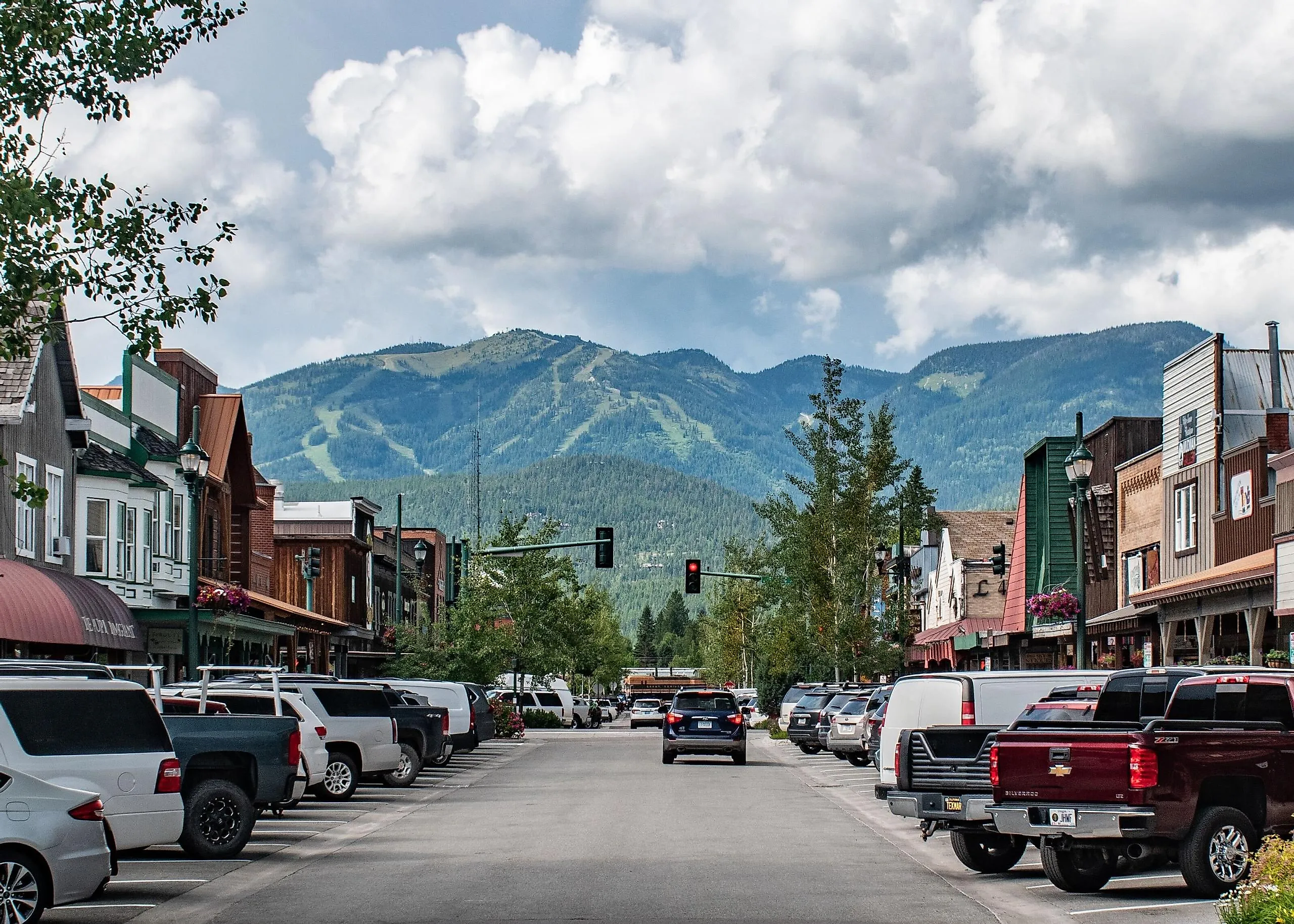
Whitefish, Montana

Amtrak's Empire Builder, the daily train between Chicago and the Pacific Northwest, stops at Whitefish. The town grew up around the Great Northern Railway at the start of the twentieth century when James J. Hill's railroad pushed through Marias Pass on its run to the Pacific. The 1928 Whitefish Depot, designed by Thomas D'Arcy McMahon in Tudor Revival style to match the Glacier-area lodges, still serves as the working Amtrak station and houses the Stumptown Historical Society Museum upstairs.
Whitefish is the western base for Glacier National Park, established May 11, 1910, with the West Glacier entrance about 25 miles east of downtown. The Going-to-the-Sun Road across the park, 50 miles long and opened in 1933, ranks as one of the most famous mountain roads in North America. Whitefish Lake on the northwest side of town has six miles of shoreline open to swimming, paddling, and fishing. The 47-mile Whitefish Trail network on town-protected land runs through Whitefish Mountain Resort terrain that converts to mountain biking and chairlift sightseeing in summer.
What These Towns Share
Each of the eight grew up around one dominant feature in the late nineteenth or early twentieth century. Banff and Glenwood Springs anchor on hot springs. Durango and Whitefish trace back to railroads. Estes Park, Jackson, and Whitefish run as gateway towns for the country's largest national park complexes. Stanley and Ouray protect the opposite end of the curve with small populations and quieter settings. The shared trait is elevation: high enough that summer days stay cool, with public lands within minutes of every downtown. The trade-off in July and August is crowding, which hits Banff and Estes Park hardest and Stanley and Ouray least, so the timing of a trip matters as much as the destination.