10 Best Illinois Towns For Remote Workers
A remote worker sizing up a town asks three things: will the connection hold, is there somewhere to work that is not the kitchen table, and can the paycheck stretch further here than it did in the city. These ten Illinois towns clear all three. A few offer a converted-warehouse coworking floor with keys at any hour; others lean on a cafe that shelves books or a library that lends wifi hotspots by the day. Homes run anywhere from a third to four-fifths of the statewide benchmark, so the spare bedroom for a desk is actually in reach. And the broadband, the part that makes or breaks the whole arrangement, tends to be locally owned here, wired by a farmer's cooperative, a city utility, or a library that raised its own building from donations. That last detail is the quiet advantage: a connection that answers to the people using it does not vanish when a corporate map gets redrawn.
Freeport, Illinois

Freeport gives a remote worker a backstop most towns do not. When the main line drops, JCWIFI is a town-owned wireless fallback, run by Computer Dynamics, an IT firm on South Street. Federal mapping through the end of 2025 puts every housing unit in the city inside 100 Mbps coverage, and the Freeport Public Library stays open to 8 p.m. Monday through Thursday, where staff will even hold a document sent from a home computer until someone collects it. The numbers make the case: a typical Stephenson County home ran $129,297 in June 2026, less than half the $298,871 Illinois benchmark, and the drive to Chicago Rockford International is 34 minutes. Off the clock, Tutty's Crossing Trailhead marks where the Pecatonica River bends through downtown and has linked the Jane Addams and Pecatonica Prairie trails since 2015, while Krape Park keeps a 44-foot limestone waterfall and a carousel running since 1959. They call it Pretzel City, and one April 216 residents bit into pretzels at the same moment to kick off the Great Pretzel Bite.
Dixon, Illinois

RiverWorks Coworking took over a converted building on East Everett Street, a block off downtown, and hands monthly members keys for any hour of the day. Flex desks, dedicated desks, and private offices rent by the month, with a full-color printer and shipping supplies on site. Comcast reaches effectively every Dixon address at 100 Mbps or better, and the Rockford airport is a 48-minute drive, close enough for a morning departure without an overnight. A typical Lee County house was worth $181,757 in June 2026, roughly 39% below the statewide figure. Downtown opens onto the Rock River at Heritage Crossing Riverfront Plaza, with trails, a performance space, and lawns running to the water. A weeknight habit tells a newcomer more than any annual festival, and the Dixon City Market runs that same riverfront on Wednesday evenings through summer.
Ottawa, Illinois

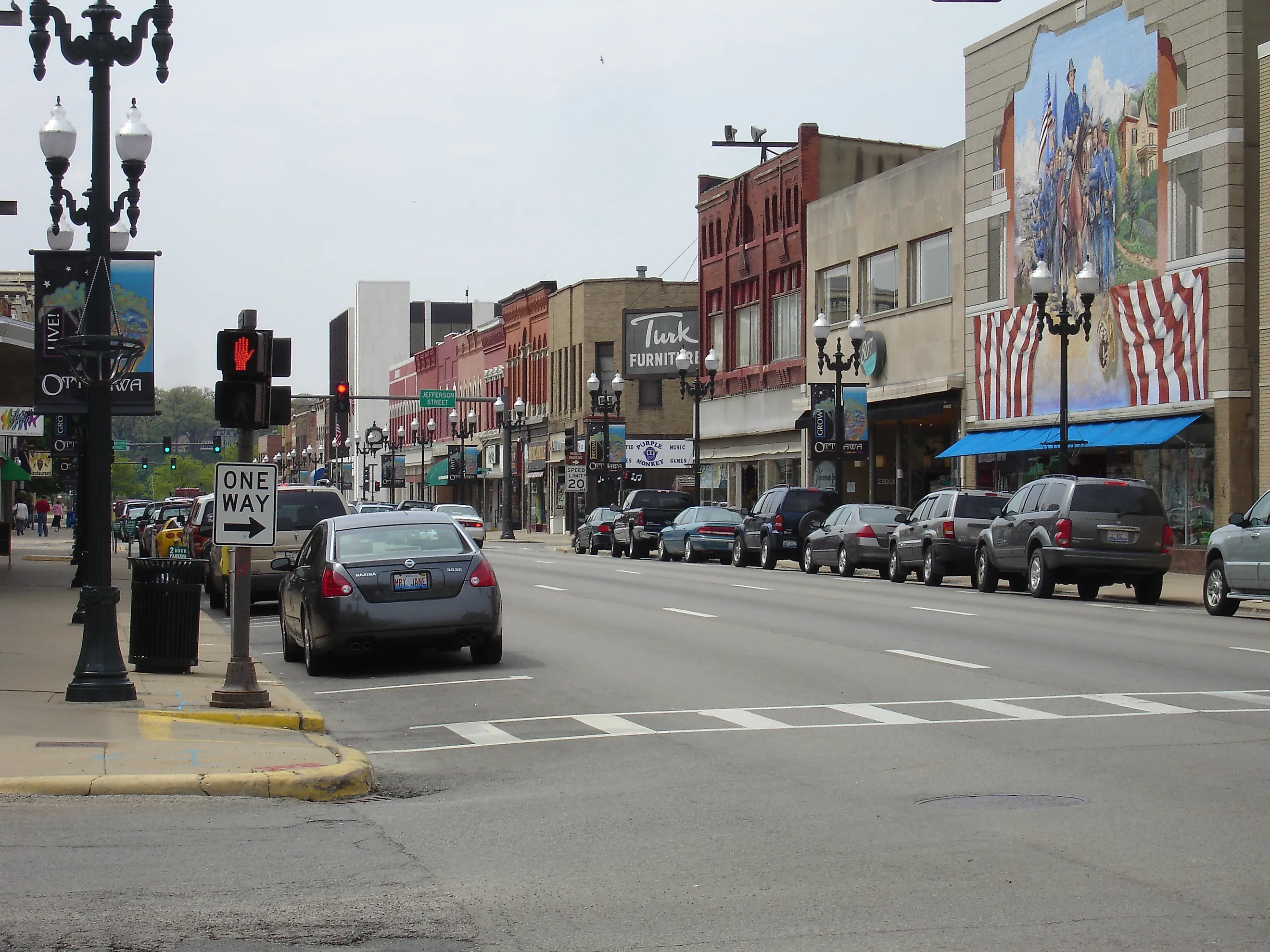
In Ottawa, an outage is an inconvenience rather than a missed deadline, because Reddick Library lends portable wifi hotspots to cardholders and pairs them with Chromebooks on three-day loans. Four study rooms book two hours at a time, and the free wifi stays on around the clock without a card. Every unit in town registers above 100 Mbps on the federal map, and Chicago Midway International sits 80 minutes away. A typical house came to $214,364 in June 2026, about 28% under Illinois overall and the narrowest gap among these northern entries. Downtown centers on Washington Square, with a fountain and bronze statues of the debaters, and the Ottawa Riverwalk runs from the end of East Jefferson Street along the Fox River to the towpath of the Illinois and Michigan Canal. This is where LaSalle County's two rivers meet, the Fox emptying into the Illinois, and Starved Rock State Park is a short drive off.
Geneseo, Illinois

Geneseo Communications built fiber through the city on a $5 million Connect Illinois award in 2020, then pushed the work into neighboring towns with county backing. The Geneseo Public Library District fills the gaps, open four nights a week to 8 p.m., with wifi that reaches past the walls at any hour, and the whole $2.5 million building was paid for entirely by private donations. Quad Cities International is 20 minutes away, the shortest airport run on this list. A typical Henry County home was worth $249,381 in June 2026, roughly 17% beneath the state number and the closest to it here. Downtown retail lines State Street, the Hennepin Canal State Trail runs past the edge of town toward Colona with a National Register listing for its full length, and Saturday's farmers market moves indoors to the Moose lodge rather than closing when the weather turns.
Galesburg, Illinois

The coworking here has a pedigree: incUspace opened a second Galesburg address in 2026 on the third floor of the Hill Arcade, after four years in the nearby Bondi Building. Both take floors of 1920s downtown buildings, and the newer renovation stripped 50 years of dropped ceilings back to plaster and concrete. Coverage above 100 Mbps reaches the whole city, and Knox County prices are the lowest on the list at $107,348 in June 2026, near a third of the statewide benchmark. Three blocks of independent shops and restaurants along Seminary Street wrap both workspaces, and Knox College hosted the fifth Lincoln-Douglas debate on the east front of Old Main in 1858. Lake Storey has a public beach and wooded paths, and the Galesburg Railroad Museum stands on Seminary Street. Peoria's General Wayne A. Downing airport is 46 minutes off, but the better link is East South Street, where four Amtrak routes call and the Illinois Zephyr reaches Chicago by mid-morning and carries riders home the same night.
Monmouth, Illinois

Martin House Cafe on First Avenue pours coffee, serves lunch, and shelves books from 7 a.m., opened by someone who wanted a place people could sit and work. Comcast feeds nearly every Monmouth address past 100 Mbps, and McDonough Telephone Cooperative, member-owned since 1951 with more than 3,700 members, is extending fiber toward Warren County. The Warren County Public Library on the square picks up once the cafe closes at two, with branches in Alexis, Kirkwood, and Roseville. The Quad Cities airport is a 54-minute drive, and Galesburg lies about 17 miles northeast, near enough that the two share a labor market. Public Square is a park set inside a roundabout, ringed by the 1895 courthouse and brick storefronts, and Monmouth College runs a community concert series in its chapel. A typical house cost $108,501 in June 2026, close to 36% of the statewide figure, which buys the spare room for a desk.
Quincy, Illinois

Adams Telephone Co-Operative runs fiber to nearly every address in Quincy and answers to its members, not shareholders. Formed in 1952, it elects its board by exchange district and has carried fiber to every home across all of its exchanges. For a trial run, Quincy Worx sells a single day pass, so a newcomer can test the town for one Tuesday before committing to anything, and Quincy Regional Airport is 20 minutes out with daily flights to Chicago O'Hare. The city sits on limestone bluffs above the Mississippi River, and four National Register districts cover it; the largest, the East End Historic District, holds 493 contributing buildings across 250 acres. A June 2026 value of $182,838 buys into that stock at 39% under the statewide measure. Downtown, Washington Park anchors The District, with a Saturday farmers market and free Blues in the District concerts on the second and fourth Fridays of summer.
Effingham, Illinois

The workspace called XCHNG opens its main floor at 7:45 a.m. on work days, early enough to clear an East Coast inbox first. It fills three floors of a former bank on West Jefferson Avenue, with a phone booth for private calls, a conference room for ten, and a podcasting studio, and memberships scale by days used per month rather than by lease. Wabash Communications, owned by its members since 1952, has laid fiber across south-central Illinois for close to two decades and reaches most of the city. University of Illinois Willard Airport is 67 minutes north, and Effingham County homes ran $238,374 in June 2026, around 20% below the state level. Lake Sara covers the outdoor side, northwest of town under the Effingham Water Authority, where a local fund bought back the beach lease in 2017, returned the property to public control, and began rebuilding 30 acres as a park.
Highland, Illinois

Highland wired itself. Highland Communication Services, set up in 2010, laid fiber to the premises as a municipal utility, so the household connection answers to the city rather than a distant operator, and federal data shows every address covered. The Louis Latzer Memorial Public Library, built by the Latzer family and given to the town in 1929, stays open into the evening midweek, and Michael's Coffee Shop opens at 6 a.m. on weekdays on Broadway. St. Louis Lambert International is a 45-minute run south. Madison County housing costs the most among these ten and still undercuts the state, $278,064 in June 2026 against $298,871. The downtown Square keeps a fountain, a gazebo, and free city-band concerts on Friday evenings through the summer, Swiss settlers laid the town out, and the Square still works the way they drew it.
Marion, Illinois

The workspace named ethOs, short for Entrepreneurial and Technical Opportunities, charges nothing for a community membership, a low bar for testing whether it suits before money changes hands. Students get their own rate, monthly members reach the floor around the clock, and it runs out of a second floor at Tower Square Plaza, with the Marion Cultural and Civic Center at the far end and 600 free parking spaces within two blocks. Citywide coverage clears 100 Mbps, and Veterans Airport of Southern Illinois is an 11-minute drive with 12 round trips a week to O'Hare, by far the shortest airport leg here. Williamson County homes hit $185,960 in June 2026, nearly 38% under Illinois generally, in one of the few towns on this list that grew between 2020 and 2025. Downtown also holds the Marion Carnegie Library, and Crab Orchard National Wildlife Refuge spreads across 43,890 acres five miles west, a mix of hardwood forest, lake, and designated wilderness.
What The Connection Says About The Town
On paper, every town here answers the broadband question the same way: 100 Mbps or better to essentially every address. What sets them apart is who put it there. A cooperative that elects its board by exchange district, a city utility that dug through its own streets, a telephone company a century into the work, a library district that raised its building from donations. A connection owned by the people who depend on it does not vanish when a corporate map gets redrawn, and for anyone whose living now runs over that line, ownership is worth as much as speed.