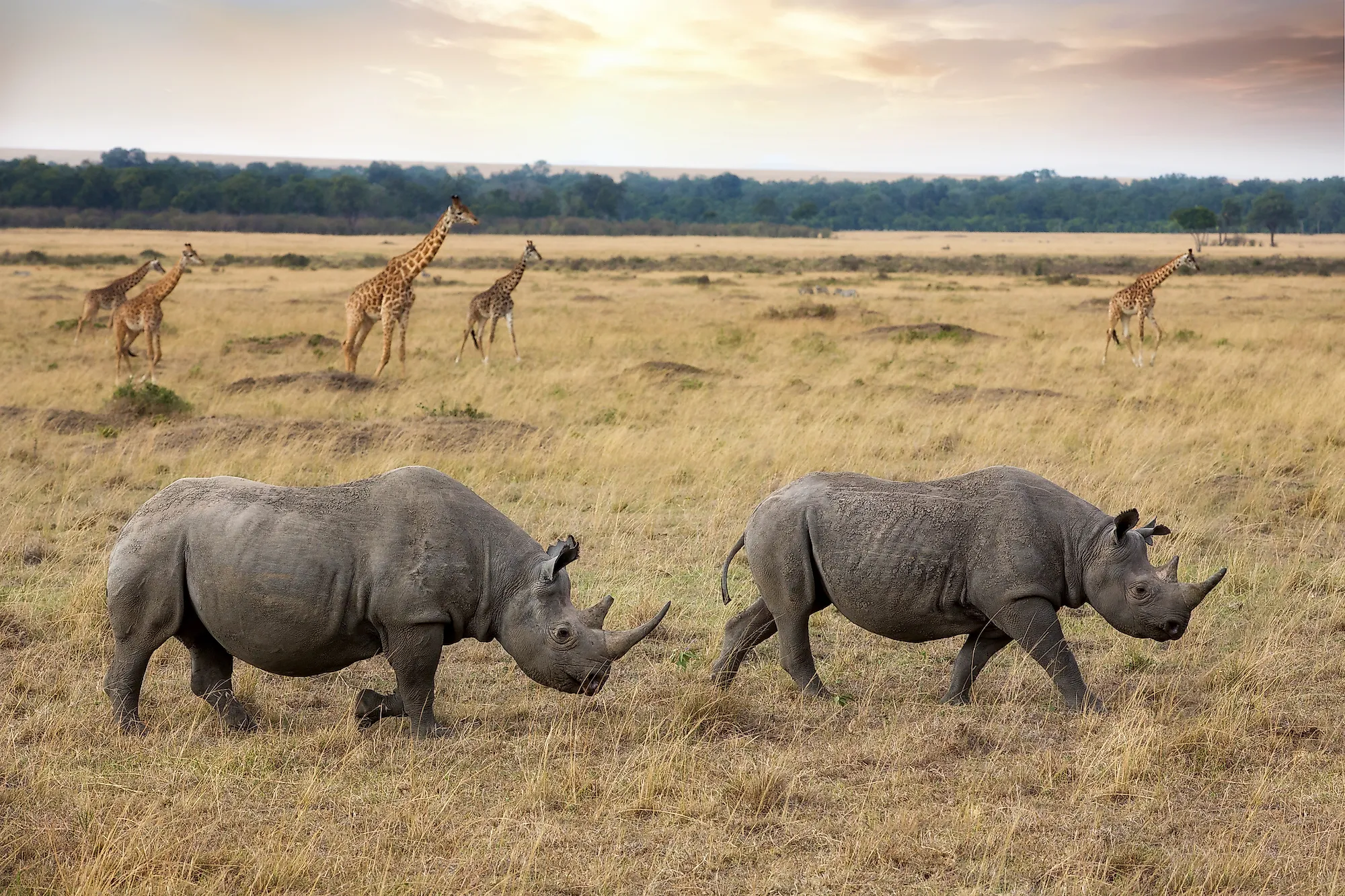
Rhinoceros
Alongside elephants, rhinoceroses are one of the few megafauna (large land animals) left in the world. With some species weighing 2 tons or more, these creatures, with their vast size and powerful horns, deter most predators. If they don't die from sickness, human activity, or fights between themselves, rhinos can live up to 50 years in the wild. Although they used to be found on almost every continent, today there are around 27,000 rhinos in the wild, mainly due to poaching and habitat destruction. They are limited to pockets in Africa, Asia, and zoos around the world. There are a few different types of rhinos, each with slightly different sizes, diets, and behaviors.
Species

Today, five living species of rhinos occupy different ecosystems, with two species in Africa and three in Asia. The white rhino has the most members, with 15,752 spread throughout Africa, especially South Africa. They primarily live in the grass savannahs. Despite the name, the black rhino is not black but does tend to cover itself in black soil more than its cousin, the white rhino. It also has a hooked upper lip as opposed to the square lip of the white rhino. They can be found in South Africa and Eastern Africa and flourish not just in the grasslands but also in tropical bush regions. There are around 6,788 known individuals in the wild.
Asian rhinos are far rarer than their African counterparts. The greater one-horned rhino, found in Northern India and Nepal, gets its name from its single large horn. There are only an estimated 34 to 47 Sumatran rhinos remaining in the wild, all in Indonesia, and roughly 50 to 75 Javan rhinos, primarily in Ujung Kulon National Park on Java. Both species are critically endangered.
Physical characteristics

Rhinos vary widely in size depending on the species. Total body length ranges from about 7 to 13 feet, while shoulder height generally spans 3 to 6.5 feet. The Sumatran rhino is the smallest living species, measuring roughly 7 to 8 feet long and 3.3 to 5 feet at the shoulder, while the greater one-horned rhino, the largest living species, reaches 10 to 13 feet in length and 5 to 6.5 feet at the shoulder. Their weight also varies: Sumatran rhinos typically weigh between 1,320 and 2,090 pounds, while greater one-horned rhinos can weigh up to 6,000 pounds.
Rhinos are born without horns, but they slowly begin to grow at 2 months old and never stop growing them for the rest of their lives. This is because horns are made of keratin, the same protein found in human fingernails. The horn starts as a cylinder, but due to sunlight damage and the scraping of horns against rocks, the horn gradually gains its conical shape. Rhinos use this horn to compete for mates, fight predators, or dig for food.
The Sumatran rhino is covered in long, shaggy hair, while the greater one-horned rhino has thick, armor-like skin folds across its body. All rhinos have thick skin, but their blood vessels are very close to the surface, making them very sensitive and easy to scar. This is why rhinos roll in the mud or dust to protect against sunburns and pests. Rhinos have poor eyesight and can only see clearly at short distances, roughly around 90 feet, but they compensate with keen hearing and a strong sense of smell that helps them detect other rhinos, food, or threats.
Diet

Despite their intimidating size and horns, all rhinos are herbivores. They just have to eat a lot to maintain their size and energy, which is why they are called mega herbivores. Greater one-horned rhinos and white rhinos are grazers that primarily eat grass. Unlike cows, which chew the cud — regurgitating partially digested food to chew it again — rhinos ferment their food in their intestines to extract nutrients. Black rhinos, Javan, and Sumatran rhinos are also known as browsers. They primarily eat leaves, twigs, and fruit that they find within range of their heads. Because of this, browsing rhinos have a pointed lip that can grasp fruit and twigs to eat and grazing rhinos have square lips for eating a lot of grass at once.
Mating

Rhino maturation varies by species and sex, with males often reaching breeding age later than females. Female black rhinos mature at 4 to 6 years, while males mature at 7 to 9 years but usually begin breeding at 10 to 12 years, once they can defend a territory. White rhino females mature at 6 to 7 years, and males at 8 to 10 years, breeding at 10 to 12 years.
Among Asian rhinos, greater one-horned females mature at 5 to 7 years and males at 7 to 8 years, with breeding often starting around age 10. Sumatran and Javan rhinos follow a similar pattern, with females maturing at 5 to 7 years and males starting to breed around 10. These ages are based on observed behaviors and may vary depending on individual development and environmental conditions. In addition, female rhinos may only enter estrus when not constantly alongside their mothers, ensuring they are ready to mate independently.
Rhino mating can be quite a violent ordeal. When males pick up an ovulating female's scent, they will fight each other with their tusks, which can lead to severe injuries or even death. When one male emerges as the victor, the female will start following the male, and the two will engage in aggressive wrestling, biting, and headbutting. While rare, there have been occasional reports of male rhinos dying during such contests. Pregnant rhinos have a gestational period of 15 months to 18 months and give birth to one baby at a time.
Social behavior

Rhinos are primarily solitary creatures, as females only live with one infant at a time. When a mother rhino prepares for a new birth, she will typically drive away her older calf to ensure the newborn's safety and undivided care; these displaced siblings, especially among social white rhinos, often seek out other adult females or peer groups for companionship. Males live alone in territories, which they mark with urine or dung.
Despite this lifestyle, rhinos have many tools for communication, such as growls, grunts, bellows, and, of course, their horns. Rhinos can be quite aggressive and may suddenly charge if they feel threatened. This is due in part to their poor eyesight — but also because aggression is a natural defense mechanism. Black rhinos are the most aggressive of all the rhino subspecies, whereas Javan and Sumatran rhinos are more even-tempered.
White rhinos are the exception to the solitary rule, as they can travel in groups of up to 15 rhinos. They primarily do this for safety, as they position themselves to monitor their surroundings and protect the younger rhinos, which stay in the middle of the group. They also have the widest range of vocalizations — and research suggests they can tell the difference between ages, sexes, and social statuses based on these vocalizations.
Threats

Rhinos are so large that they have no major predators, but their young are vulnerable to crocodiles, lions, and other large carnivores. Because of this, calves stay close to their mother for protection, especially during their first few years.
However, the biggest threat to rhinos isn't from other animals; it's from humans. Rhino horns are highly valued for their alleged medicinal properties, which is why poachers commonly hunt rhinos to cut off their horns. These networks of poachers will track rhinos in protected areas, kill them, and smuggle their horns to potential buyers, including those with an interest in traditional medicine or simply as a status symbol.
Human activity can also threaten rhinos via habitat destruction. Logging, agriculture, and settlement directly threaten the habitats and ecosystems of rhinos. This is why the rhino has gone extinct in multiple countries in both Asia and Africa. As rhinos have such long gestational periods and violent mating rituals, these threats can quickly spiral into a catastrophe for rhinos.
Conservation

There are many different efforts to save rhinos, especially the critically endangered Sumatran and Javan rhinos. The International Rhino Foundation has raised more than $20 million for research, anti-poaching efforts, and the creation of protected habitats for rhinos. This foundation has seen great success in countries like Zimbabwe, which has helped severely restrict the poaching of black rhinos in the country. It also works through captive breeding programs to help gradually increase the population of rhinos in impacted areas. One of its most recent efforts to bear fruit is the Sumatran Rhino Sanctuary in Indonesia, which celebrated the birth of a male calf in 2023.
Protecting the Giants

In their own environments, rhinos don't need protection, other than for their young. However, due to habitat destruction and opportunistic poachers, it falls on humans to protect these giants. In many cases, that conservation effort has been successful, with 27,000 rhinos still in the wild, and others in captivity. However, their situation is still very fragile, especially with the critically endangered Javan and Sumatran rhinos. For conservationists, remaining vigilant and proactive is their best tactic to ensure these rhinos continue to roam and thrive.