Stonefish
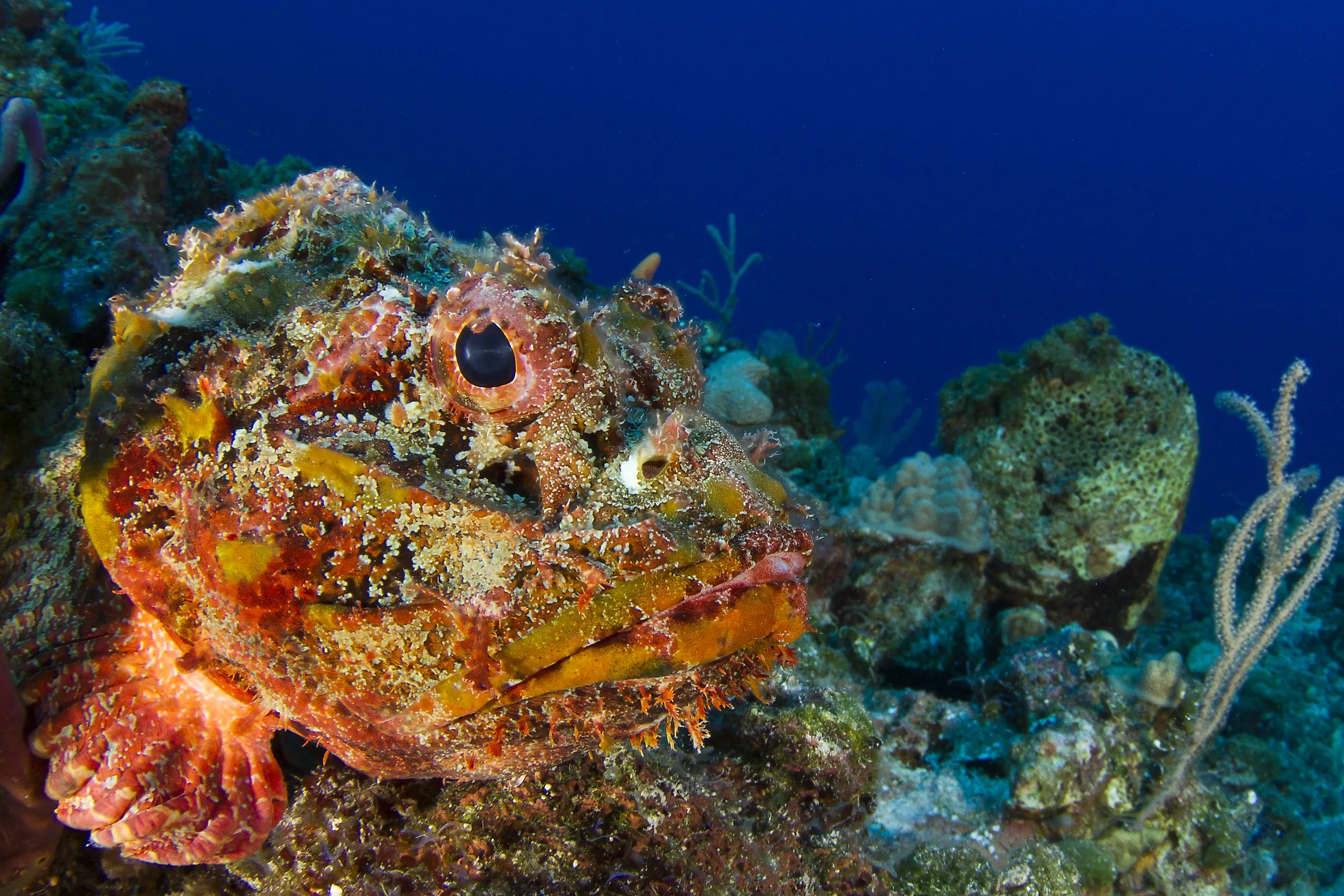
To explore the oceans of the world is to spot some of the strangest-looking creatures on planet Earth. But even shallow tropical waters have their own unusual residents, and one of them is hiding in plain sight. Masters of disguise, the Synanceia, more commonly known as the stonefish, is famous for its ability to blend almost perfectly into rocks, coral reefs, and the seafloor. This remarkable camouflage not only helps stonefish avoid predators but also allows them to ambush unsuspecting prey.
Despite their motionless appearance, stonefish are widely regarded as among the most venomous fish in the world due to the venom delivered through their dorsal spines. At the same time, they also play an important role in marine ecosystems and are even considered a delicacy in some parts of Asia when prepared correctly. Read on to discover more about this fascinating species.
Taxonomic Classification

Stonefish belong to the genus Synanceia, established by Bloch and Schneider in 1801. Their classification has changed over time, and scientists still debate whether stonefish should be placed within the family Scorpaenidae or recognized separately as the family Synanceiidae. The name “stonefish” refers to their exceptional camouflage, which allows them to resemble rocks or coral-covered stones on the seafloor. Several species exist within the genus, including the reef stonefish (Synanceia verrucosa) and the Red Sea stonefish (Synanceia nana).
Habitat and Range

As their name would suggest, stonefish are bottom-dwelling fish that commonly inhabit coral reefs, rocky seabeds, coral rubble, and sandy or muddy substrates. Many species are found in shallow tropical Indo-Pacific waters, although some, such as the estuarine stonefish (Synanceia horrida), can also tolerate brackish estuaries and mangrove habitats. The distribution of stonefish varies by species. For example, the estuarine stonefish occurs throughout parts of the Indo-West Pacific, including areas near Southeast Asia, Papua New Guinea, and northern Australia. The Red Sea stonefish (Synanceia nana) inhabits the Red Sea and nearby waters, while the reef stonefish (Synanceia verrucosa) is widespread throughout the Indo-Pacific region.
Food

Stonefish are closely related to scorpionfish and lionfish, insofar as they are carnivores and ambush predators. Their diet differs somewhat, however, as stonefish primarily feed on nearby fish, shrimp, and other crustaceans. The added layer of being ambush predators means these fish are more stationary predators rather than active hunters stalking the waters. They will blend in with their surroundings and let their food come to them. And it's certainly an effective strategy, as even for humans, they can be very difficult to spot.
Physical Description

Describing a stonefish is a little tricky, primarily because these fish are so good at camouflaging themselves with their surroundings. Some may even rest near seagrass or coral rubble for additional concealment. As a result, the color of a stonefish can vary widely depending on where it is resting. Some resemble stones or pieces of coral, while others may appear brown or gray with patches of orange, red, or yellow. Sedentary individuals can even accumulate algae or other marine growth on their skin.
Nevertheless, several physical characteristics are consistent across stonefish species, including a series of dorsal spines and soft rays along the back. Stonefish are generally stout-bodied and can grow up to 16 inches (40 centimeters) in length. Their rough, wart-like skin helps enhance their camouflage, and their dorsal spines are connected to glands that deliver a powerful defensive venom.
Behavior

Being a passive predator and solitary fish, stonefish have the personality of, well, a stone. As sedentary creatures, they often use their pectoral fins to scoop out sand or sediment and partially bury themselves while waiting for prey to approach. Much of what researchers and the public know about stonefish centers on their venomous defense mechanisms. Stonefish are widely regarded as among the most venomous fish in the world due to the powerful venom delivered through their dorsal spines. Although the exact amount of venom released by each spine is not fully understood, stings in humans can cause intense pain, swelling, respiratory distress, cardiovascular complications, convulsions, paralysis, and, in rare cases, death. If a sting occurs, immediate medical attention is important, as symptoms can develop rapidly. Even small amounts of venom can cause severe pain, which victims often describe as excruciating. Fortunately, fatalities are uncommon when medical treatment is received quickly.
Most stonefish stings occur when a person accidentally steps on the fish, causing the dorsal spines to penetrate the skin as a defensive response. Because stonefish are difficult to spot, caution is strongly advised in areas where they are known to live. Protective footwear is often recommended when walking through shallow coastal waters, tide pools, reef flats, or nearby shoreline areas. Stonefish can survive out of water for limited periods, though estimates vary depending on environmental conditions.
Reproduction

Stonefish reproduce through external fertilization, a process common among many marine fish species. Spawning typically occurs during warmer periods of the year, when females release gelatinous egg masses onto the seafloor. Male stonefish then release sperm over the eggs, fertilizing them externally. After spawning, adult stonefish generally return to their usual solitary behavior, while the eggs develop and hatch without parental care. Like many fish species, newly hatched stonefish are independent from birth. Lifespan estimates for stonefish vary by species, but many are thought to live for several years in the wild.
Importance to the World

As predators, stonefish help regulate populations of smaller fish and crustaceans within the ecosystems they inhabit, contributing to the balance of local marine food webs. Despite their venomous spines, stonefish are also eaten in some parts of the world, such as Asia. The venom glands are associated primarily with the dorsal spines, which are removed before preparation, and the protein-based venom becomes inactive when thoroughly cooked and prepared properly. Stonefish are considered a delicacy in several regions, including parts of Japan, southern China, Hong Kong, and Vietnam. While the meat may sometimes be served as sashimi, stonefish are also commonly prepared in soups and other cooked dishes, often with ginger and light broths.
Threats

One other aspect of stonefish worth mentioning is that these fish are not strong or fast swimmers. Instead of relying on speed, they depend primarily on camouflage and their venomous spines for protection. Although adult stonefish have relatively few natural predators due to these defenses, larger marine animals such as sharks and moray eels may occasionally prey on them if they are detected. Stonefish are generally more vulnerable when they are younger, as juvenile fish face greater predation risks on coral reefs, where predators such as groupers and snappers commonly hunt.
Although stonefish are often feared because of their venom, they are far more than just dangerous marine animals. Their camouflage, hunting strategies, and adaptations make them uniquely suited to life on coral reefs and shallow tropical seabeds. As both predators and prey, they contribute to the balance of marine ecosystems while also demonstrating how specialized survival can become in the ocean. Whether viewed as masters of disguise, venomous defenders, or unusual culinary delicacies, stonefish remain one of the most remarkable fish species found in tropical waters.