Hyena
When we think of hyenas, we typically think of dog-like scavengers with a wicked laugh picking away at the leftovers from another animal’s kill. While the hyena has a reputation as a pest and scavenger, it actually feeds on its own kills more often than not. It's also more closely related to felines than canines.
As one of Africa’s most common large carnivores — and with one of the strongest jaws among similar species — the hyena plays a vital role in maintaining the delicate ecosystems of their habitats and that of the animals they prey on. (See the "Critical Importance" section below.) Here are the details about one of the most misunderstood carnivores in the animal kingdom.
Taxonomic Classification

The taxonomic classification of hyenas includes mammalia (class), carnivora (order), and feliformia (suborder). This means that hyenas are considered mammals, or warm-blooded vertebrates. Carnivora is the biological order that includes hyenas and other primarily meat-eating mammals such as cats, dogs, and bears. Feliformia means that, biologically and developmentally, they are most similar to felines. However, a hyena’s behavioral traits and outward morphology can make them appear more similar to dogs from an outside perspective.
Physical Description

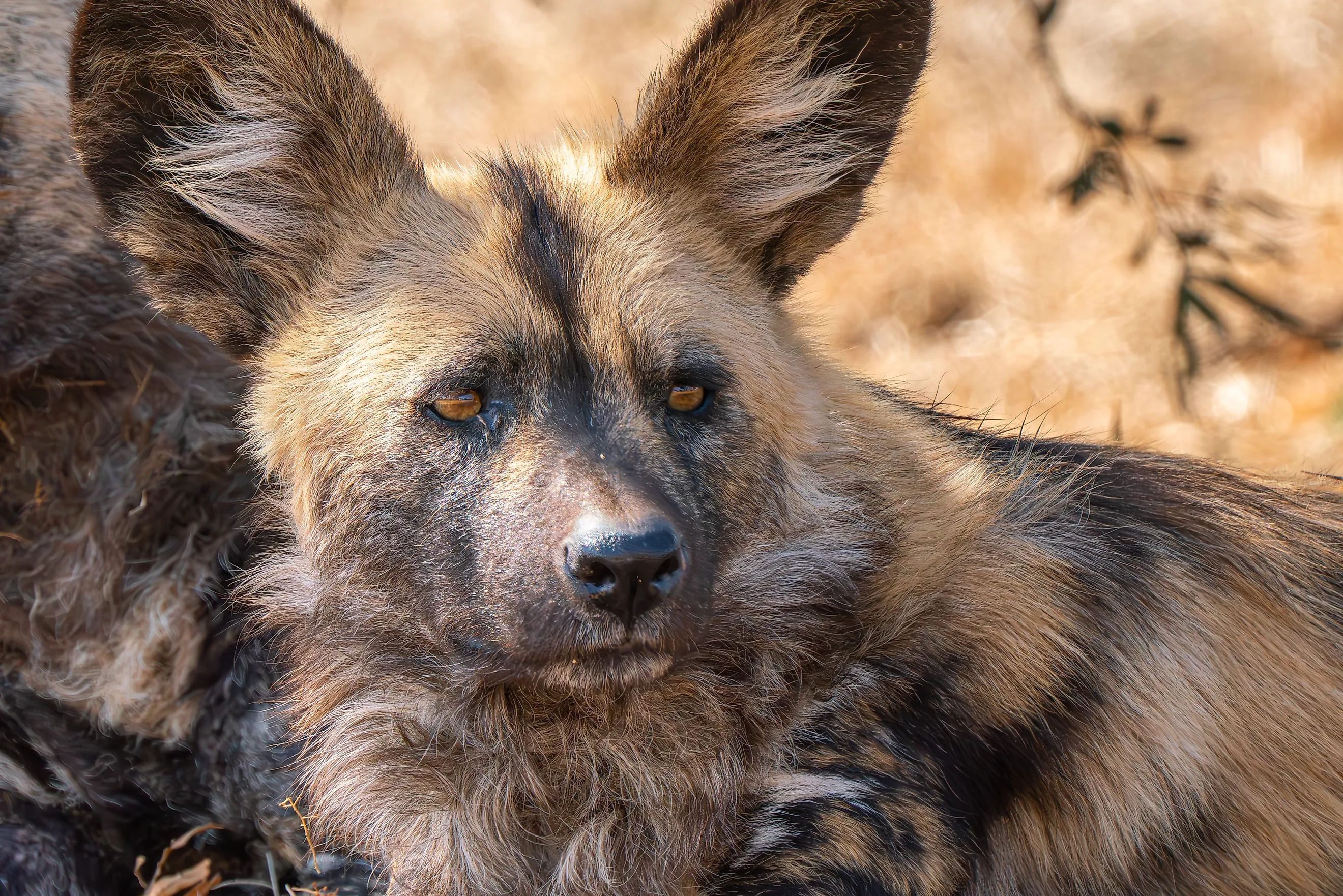
Hyenas have a large build featuring short torsos with lower hindquarters and sloping backs. Their average weight ranges from 80 pounds to as much as 180 pounds, and their size ranges from around 37 inches to 60 inches in length. A hyena’s jaw is considered among the strongest of any mammal of a similar size, able to easily chew through the bones of their prey as well as the carcasses of larger animals.
There are four extant species of hyena: the spotted hyena, brown hyena, striped hyena, and aardwolf, which differ in size, diet, and coat patterns. Spotted hyenas are the largest of the four species, with their average weight appearing on the larger end of the spectrum. In fact, spotted hyenas are among the most widespread and abundant large carnivores in sub-Saharan Africa.
Range, Habitat, Behavior

While most hyena species are native to Africa, their family footprint extends across a wide variety of environments — ranging from savannas, woodlands, and subdeserts to the rocky scrublands of the Middle East and India. Hyenas are highly adaptable and can even make their homes in mountainous terrains up to 13,000 feet.
Regardless of whether a species is solitary or lives in a large clan, all hyenas utilize dens as essential, protected sanctuaries for raising their young. For social species like the spotted hyena, these communal dens also serve as the central hub where clan members interact and form bonds.
Hyenas are fiercely territorial animals that patrol their home ranges and mark boundaries with scent glands to keep competitors at bay. Because of the dangers present in the wild, vulnerable cubs are rarely left entirely unprotected. In large clans, adults will cooperatively take turns "babysitting" at the den while others are away hunting, ensuring the next generation remains safe from predators.
They establish specific areas known as latrines along the borders of their territory, using communal defecation and scent-marking to outline their boundaries. While traveling across their territory, hyenas utilize a variety of vocalizations to coordinate movements or signal to other clan members. These vocalizations can be heard from up to three miles away and include grunts, long-distance whoops, and the iconic “laughter” — a high-pitched giggle that actually signals stress or excitement during social disputes over food
Food

Hyenas are primarily carnivores, meaning their diet consists mostly of meat, though they will occasionally eat fruits and insects. Hyenas hunt within their clans, with hunts typically taking them across their territory wherever prey moves. A common misconception characterizes hyenas as scavengers. In reality, approximately 70% of their diet consists of direct kills.
This misconception comes from the fact that hyenas are not picky eaters. The animals can digest and obtain nutrients from the skin, meat, and bones of their prey, making them a vital part of the “clean-up crew,” as they will often eat the parts of animal carcasses that are left behind by other predators.
Hyenas predominantly eat at the site of their hunt and leave nothing behind of their prey, so it is rare for food to be brought back to their dens. Hyenas are not able to digest the hair, horns, or hooves of their prey. If they ingest these parts of the animal, they will compress the materials and regurgitate them in a tube-like pellet, much like an owl casting a pellet.
Reproduction

Spotted hyena mom and her in the Maasai Mara National Reserve, Kenya. Image credit: Marie Lemerle/Shutterstock.com
As mammals, hyenas reproduce sexually, with live births occurring after a gestation period lasting between 90 days and 110 days. Hyena mothers usually give birth to litters of one or two cubs. The mothers feed their cubs with milk produced by their mammary glands. The cubs are able to begin eating meat at around five months post birth; however, they largely rely on their mother’s milk for the first 12 months to 18 months of their lives.
Because hyenas typically hunt across their territory, food is rarely brought back for the cubs to eat. Cubs are left safely inside the narrow tunnels of the den while the adults are away on hunts. Hyena cubs, especially in social species like the spotted hyena, are raised in dens where they are protected by the mother and often by the broader clan. They rely heavily on their mother’s nutrient-rich milk for many months, with weaning gradually occurring as they begin to consume meat.
Critical Importance

Hyenas play a vital role in maintaining the ecosystems they live in. As hunters, hyenas prey on sick and weak animals, which helps to prevent the spread of diseases within their prey species. Predation by hyenas can influence prey populations by removing some individuals, including vulnerable ones; this process may play an evolutionary role in affecting population dynamics over time.
Hyenas also play some important roles acting as scavengers. Their scavenging behaviors help to balance the food web among other predator species, as the hyenas are happy to consume the dense bone and carcass remains left behind by others, rather than leaving those resources to waste. While helping with cleaning up after a kill, hyenas are also ensuring that animal carcasses are not left to rot for long periods of time, where they could potentially begin to spread dangerous diseases like anthrax or tuberculosis.
As both hunters and scavengers, hyenas play an integral role in maintaining the ecosystems that they are a part of, restoring balance and maintaining a healthy environment for both predator and prey species
Threat

The biggest threat to hyenas is humans. The easiest way for hyenas to access a large amount of prey is to attack livestock, which is often congregated into a small area. Due to their reputation for preying on livestock, farmers will often act in retaliation, setting up traps, shooting at hunting hyenas on sight, or using deadly poisons on carcasses. Habitat loss and wire snares set by bushmeat poachers are also a major threat to hyenas, as human settlements expand directly into wild environments.
Hyenas are known to kill livestock and prey on weaker animals. But they also play an important ecological role as both predators and scavengers, helping regulate prey populations and recycle nutrients within ecosystems. While the evolutionary effects of predation are complex and do not directly ensure that only the “strongest” individuals reproduce, they do contribute to the maintenance of their ecosystem and the long-term health of their environment.