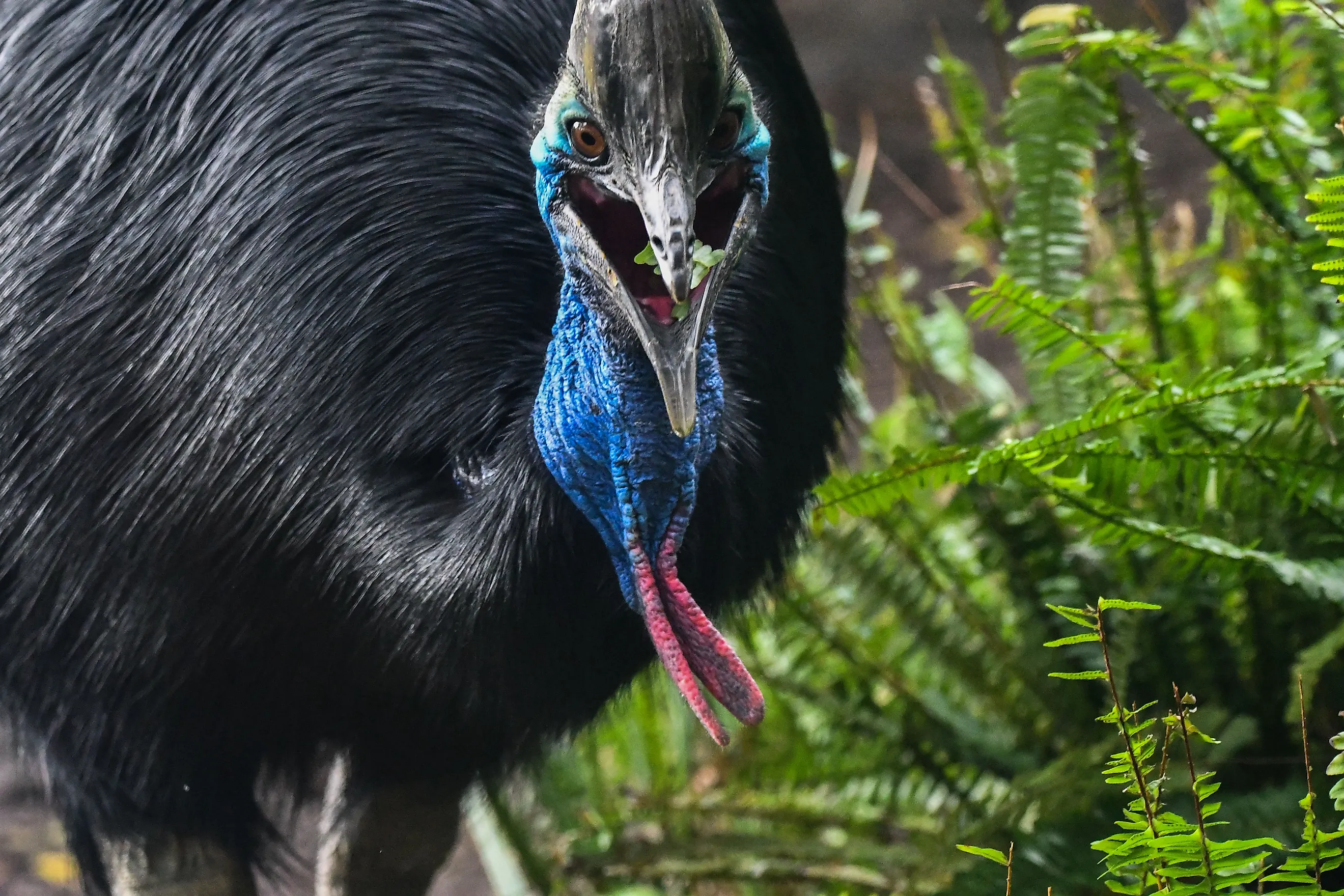
Cassowary
The phrase, "world's most dangerous bird", in reference to the cassowary, is no laughing matter. While these majestic, flightless avians are capable of inflicting serious, life-threatening wounds, they're generally quite shy. Much of this bird's current reputation draws upon its especially dinosaur-like appearance, resulting in a somewhat undeserved reputation. The cassowary stands eye to eye with most human beings at 5-6 feet (1.52 to 1.83 meters), and their middle toe, which happens to be a razor-sharp talon, is typically 5 inches (12.7 cm) in length. Moreover, males typically weigh in at around 130 pounds (around 59 kg) while females can reach 187 pounds (87 kg) and are capable of running at speeds of up to 31 mph (or 50 km/h). While these birds typically only exhibit aggression when defending themselves or their young, admire them from a distance. Read on to learn why these beautiful birds are actually one of Oceania's most valuable guardians.
Taxonomic Classification
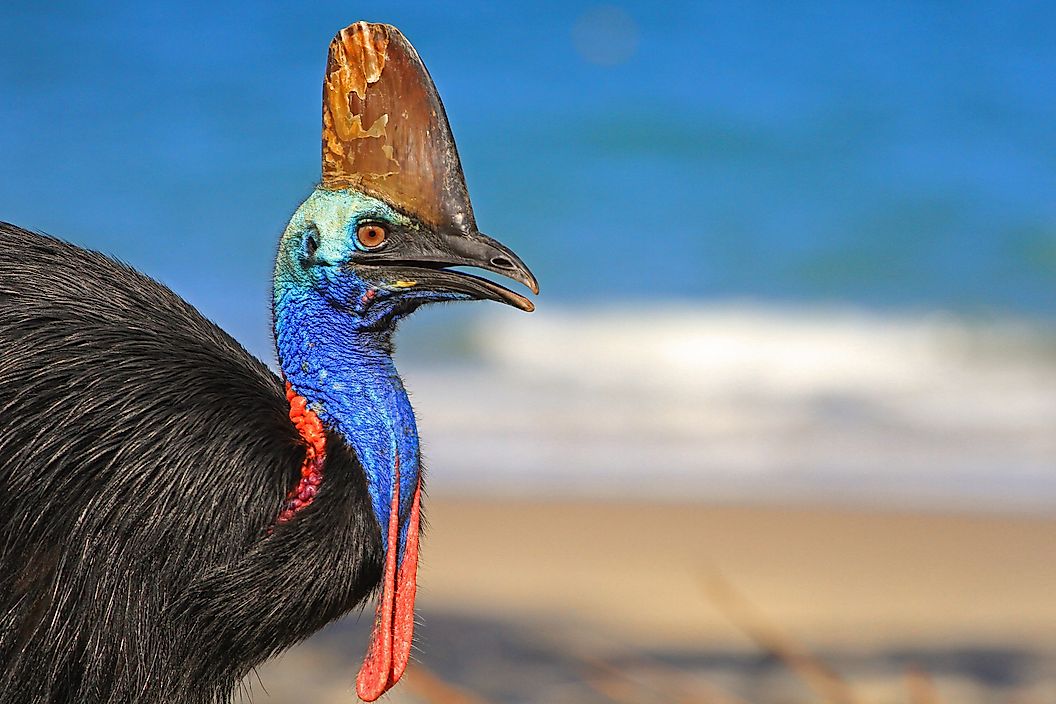
Taxonomically, cassowaries belong to the genus Casuarius. Three extant cassowary species have survived the ages: the southern, northern, and dwarf varieties. The southern cassowary is the only type found in Australia, and can also be found in parts of New Guinea and Indonesia, while the other two (northern and dwarf) typically inhabit New Guinea. The dwarf cassowary (aka Bennett's cassowary) is particularly interesting in its overall elusiveness and is often found in high-altitude forests of New Guinea and New Britain. Since they are fairly large and considered to be flightless, this raises some interesting questions concerning their ancient migrational patterns.
The cassowary's ancient lineage is visible in its anatomy. The three-toed feet, scale-covered legs, and respiratory structures it shares with theropod dinosaurs make it look less like a modern bird than something that wandered out of the Cretaceous. All birds are technically avian dinosaurs, but few wear it as visibly as the cassowary, whose general body plan has changed remarkably little over millions of years. Its swimming ability, which likely carried it to remote islands, is another unusual trait for a flightless bird and suggests a range of ancient dispersal that researchers are still piecing together.
Range And Habitat

Cassowaries are found in the tropical rainforests and coastal woodlands of Papua New Guinea, northeastern Australia, and surrounding islands. Each adult cassowary is generally solitary and typically needs its own territory of no less than 100 hectares (100 hectares is equal to 1 square kilometer and approximately 0.386 square miles). They are also frugivores, thriving mostly or entirely on fruit for survival. Their reliance on the fallen fruit of over 150 different rainforest plants makes them something like rainforest gardeners or farmers, dispersing plant seeds over large tracts of land. Access to clean, fresh water also serves a dual purpose apart from sustenance concerns: bathing. Cassowaries will typically bathe multiple times a day, helping to maintain body temperature in scorching environments and increasing the general health of their plumage by removing dust, dander, and parasites.
Dietary Peculiarities

Cassowaries are largely considered to be frugivores; however, it has been observed that while cleaning itself in various bodies of water, it will sometimes snack on the small insects which have become caught in its feathers. Specifically, they will consume laurels, palms, quandongs, cassowary plums, as well as apples and bananas, swallowing these fruits whole. Additionally, forest fungi and fallen flowers are also on their menu, as well as insects, snails, frogs, fish, rodents, lizards, and smaller birds, in order to balance their protein intake requirements.
Physical Description
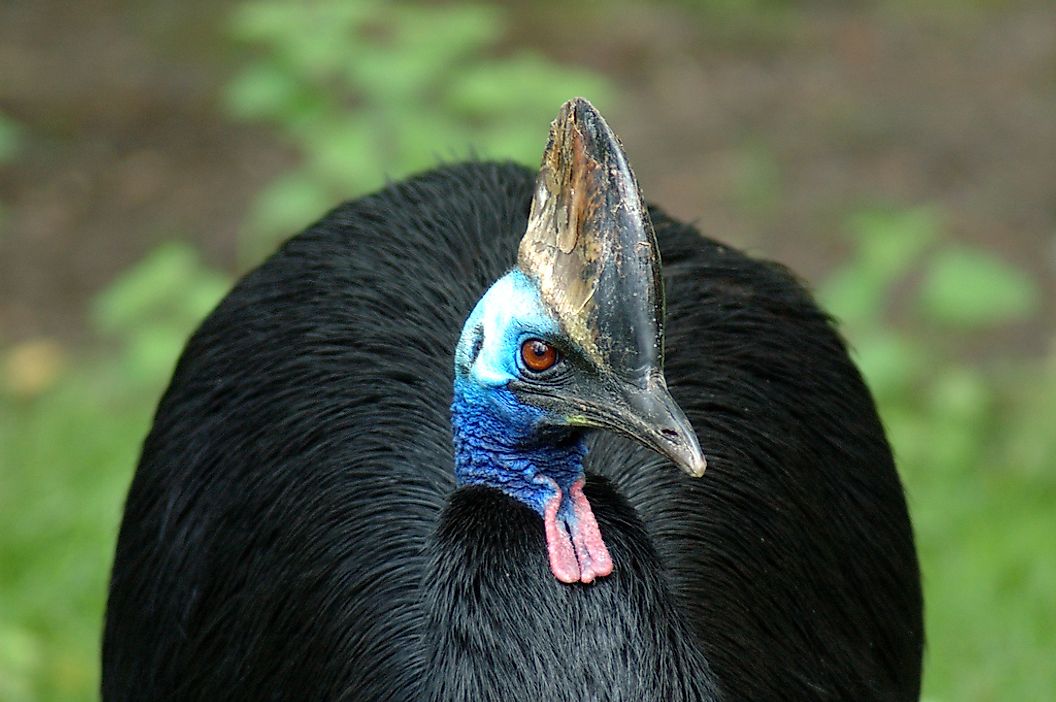
Cassowaries can be intimidating when one is physically in their presence. Their glossy, hair-like black plumage and brightly colored neck topped with a bony head casque serve as visual warnings to keep one's distance. Standing 5 to 6 feet (1.5 to 1.8 meters) tall, the females are typically larger than the males. Southern Cassowaries are double-wattled, the Northerns are single-wattled, while dwarf cassowaries are obviously smaller in stature, with no wattle, but pink and purple spots on their cheeks.
The casque deserves particular attention. This hollow, keratinous helmet grows throughout the bird's life and can reach several inches in height. Scientists have proposed multiple functions for it: the leading hypothesis is that it acts as a thermal radiator, releasing excess body heat during the hottest parts of the day. Others have suggested it may play a role in low-frequency sound communication, or simply in pushing through dense undergrowth. No single explanation has been settled on. Worth noting too is that the cassowary ranks as the third-tallest and second-heaviest bird on Earth, outranked in both categories only by the ostrich, with the emu edging it out slightly in height.
Behavior & Reproduction

Curiously, the cassowary engages in somewhat of a reproductive role reversal. Instead of the mother being the caretaker of the nest, it is the male who will incubate the eggs (around 50 days). He becomes a single parent soon thereafter and fiercely guards the little striped chicks (for around nine months). In true fatherly fashion, he will practice tough love when they come of age, eventually running them off to find their own territory.
While the cassowary can be lethal to humans, tales of its aggression are greatly overhyped. Attacks are rare, with only two instances of lethality recorded to date, (one in Australia in 1926 and the other in Florida by a captive bird). However, attacks are almost always tied to protecting a food source, defending their chicks, or not knowing exactly how to react to humans who might be attempting to feed them. In truth, despite their rather Jurassic appearance, cassowaries should not be considered a threat to humans, with proper precautions taken.
The eggs themselves are among the more striking sights in the bird world: large, pea-green or olive-green, rough-textured, quite unlike the eggs of most birds. The male incubates them alone for roughly 50 days, and becomes more territorial when doing so. Cassowaries can jump and deliver powerful kicks with both feet simultaneously, a move that gets called a drop kick with some justification. The inner toe carries a dagger-like claw, and when combined with legs strong enough to drive a bird through dense jungle at 31 mph, constitutes a formidable defense. That makes the male's solo vigil over his chicks all the more remarkable to observe, from a safe distance.
Importance To The World

Cassowaries are considered to be vital seed dispersers in their native rainforests. In fact, they will "swallow large fruits whole and excrete the intact seeds kilometers away", effectively preventing flora overcrowding while simultaneously outrunning predators and curating the genetic diversity of over 200 plant species. Not only does this bird-based dispersal provide a type of ready-made fertilizer, but studies have shown that seeds passing through the gut of these large bipeds actually improve overall germination rates (by some 90% compared to just 4% for uneaten seeds). Moreover, according to scientists at the San Diego zoo, they are "one of the only animals large enough to swallow massive, toxic, or heavily armored fruits, such as the blue cassowary plum, without choking or being poisoned."
Beyond ecological relevance, the cassowary is also culturally significant. It has been traded for over 500 years, and artifacts dating back 9000 years have been found in indigenous communities, demonstrating a different relationship to these regal creatures than what popular culture has fixated upon.
Threats

Sadly, endangerment is a reality for the Southern Cassowary. According to the Australian DCCEEW, "fewer than 4,500 Southern cassowaries are currently surviving in the Australian wild, and they are officially listed as Endangered under federal law." The source of this issue seems to stem from loss of habitat, vehicle strikes, dog attacks, and general human interaction. Vehicular impacts seem to be the leading threat, with some studies attributing vehicle strikes to more than 55% of documented cassowary deaths.
The Australian government has already begun to implement a recovery strategy for the Southern Cassowary, which includes measures such as mapping essential cassowary habitats and identifying protected areas, rehabilitation and relocation efforts, and monitoring programs to assist birds in need.
A Wary Position
The cassowary occupies a strange position in the natural world. It is ancient enough in form to seem prehistoric, yet its survival depends entirely on the health of ecosystems that are shrinking. It is feared widely but understood poorly, its reputation for violence far outpacing the reality of two recorded human fatalities in nearly a century. And it is ecologically indispensable in ways that only became clear once its populations began to decline.
The southern cassowary's status as an endangered species in Australia is not an abstract concern. Lose the cassowary and you lose the primary dispersal mechanism for hundreds of rainforest plant species, many of which have no meaningful backup. The forests of northeastern Queensland and New Guinea did not develop around this bird by accident. The relationship runs deep, and the plants show it, producing fruits too large, too toxic, or too heavily armored for almost any other animal to handle.
Recovery efforts are underway, but habitat loss, vehicle strikes, and human encroachment continue to take a toll. The cassowary has survived in some form for millions of years. Whether it survives the next hundred depends less on its own formidable biology than on decisions being made right now about land use, road design, and how seriously the word "endangered" is taken.