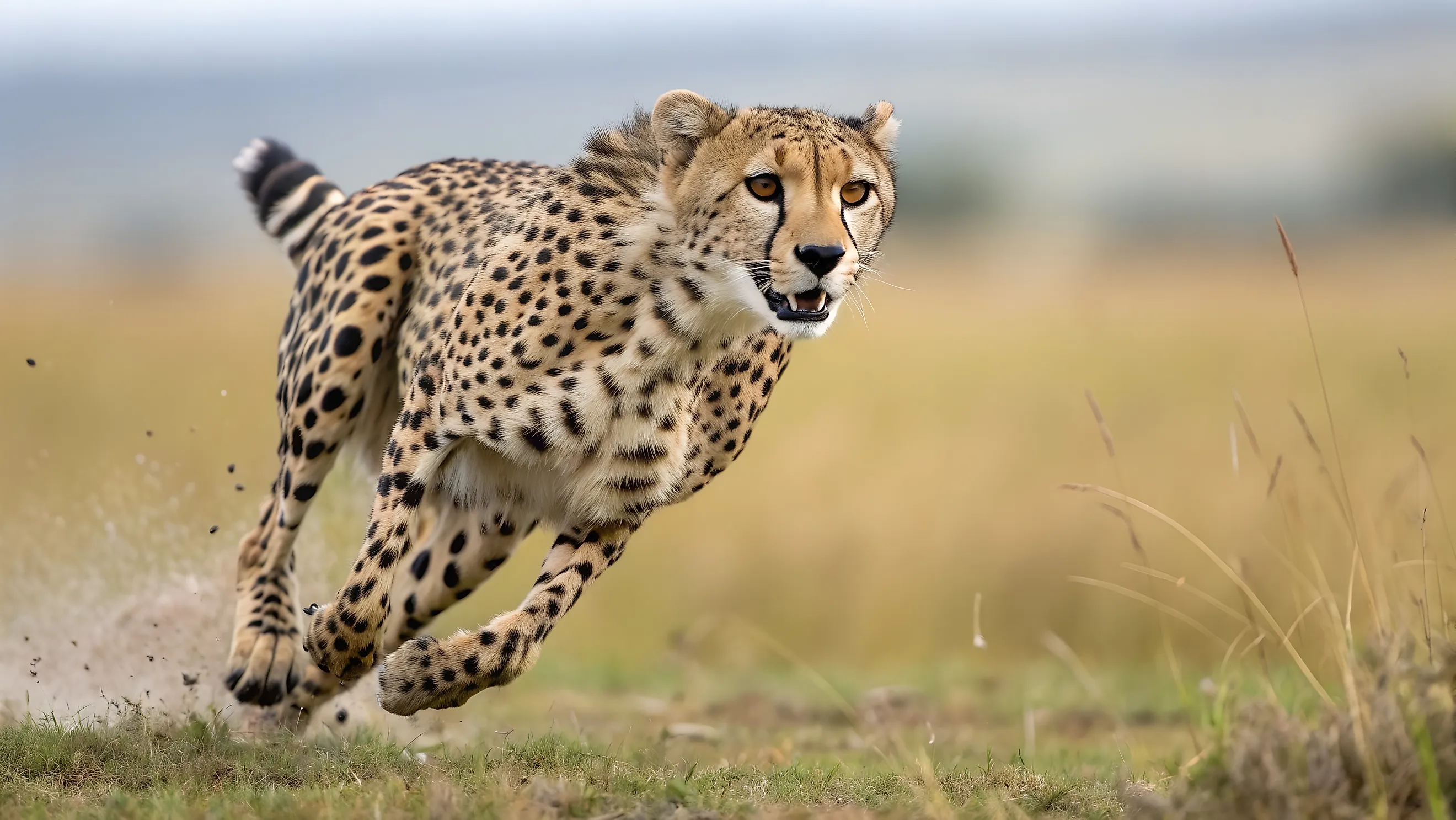
Cheetah
The cheetah (Acinonyx jubatus) is the fastest land animal on earth, reaching top speeds of up to 70 miles per hour when it goes dashing after prey. With such terrifying speed and power, and a beautiful coat valued on the black market, the cheetah has been vulnerable to farmers and hunters for centuries. The cheetah leads a difficult life, hiding its young from hyenas, lions, and other predators, while searching for its next meal from herds of antelope or other animals. Despite its speed, it is a timid creature, preferring to avoid contact with humans and even its own species, except in special circumstances such as mating or forming small hunting coalitions. Find out more about this elusive speed demon with us.
Subspecies and Habitat Range

Most authorities recognize four living cheetah subspecies worldwide, including the Asiatic cheetah in Iran and three African subspecies.
The Saharan cheetah survives in small numbers across parts of the Sahara Desert, with roughly 250 individuals remaining in the wild. The East African cheetah lives in the savannas of Kenya, Tanzania, Uganda, and Somalia, where several thousand individuals still survive. The Northeast African cheetah occurs mainly in Ethiopia and South Sudan, but its population is small and poorly documented.
The Southeast African cheetah inhabits southern Africa, including South Africa, Namibia, Botswana, and Zimbabwe. South Africa alone supports roughly 1,300 to 1,500 cheetahs and is considered one of the species’ most important strongholds. Four individuals from this subspecies were reintroduced to Kuno National Park in India as part of an effort to restore cheetahs to the region.
Appearance

Cheetahs are large cats, although not as large as tigers or lions. They typically are 44 to 56 inches long, with a 26 to 33-inch tail, and weigh 75 to 140 pounds. Like many big cats, male cheetahs are slightly larger than females.
The most striking feature of the cheetah is its marks. The name cheetah itself comes from the Sanskrit language of India and Pakistan, meaning painted. It has small black spots on both its fur and skin, which measure between 0.5 and 1 inch in diameter. Its muscular tail stands out both for its length and for the black rings around it, with a white or black tuft.
On its face, there are long black lines that look like tear marks or mascara. These marks serve a very important purpose of keeping the sun's glare out of their eyes so they can focus on hunting, especially in hot desert or savannah climates. The cheetah's hair is much longer on its back to the base of its tail. This is called its mantle, which allows it to blend into tall savannah grass while crouched.
Built for Speed

Much of the cheetah's physical features serve specific purposes: helping it run more efficiently and hunt. For example, its claws don't fully retract like other cats. Instead, it uses its claws for traction when running. It also has harder paw pads for better traction. Its long, flat tail both keeps the cheetah balanced and helps it control its movement while running.
Their speed, of course, is their most famous attribute, as they can run up to 60 to 70 miles per hour and accelerate from 0 to 45 miles per hour in 2.5 seconds. A single stride can take them up to 23 feet, and they can complete as many as four strides per second. The cat's organs and bone structure help achieve this tremendous speed, with its large lungs for taking in air quickly and a large heart and adrenal glands that enable it to leap into action as soon as it spots prey.
Their bones are light, with particularly small collarbones, detached shoulder blades, and hips that can easily swivel and contribute to the aerodynamic nature of the cheetah. It also has a highly flexible spine and flat ribcage. With these features, a cheetah is built for speed, but not strength or endurance. It can only run for up to 30 seconds before resting. With its light bones, this cat will lose if it gets into a fight with a stronger animal.
Hunting

When the cheetah hunts, it is looking to sneak up on its prey and finish it off as efficiently as possible. That's why it will aim its sharp jaws at the animal's windpipe. It will jump on the animal, biting down and bringing it to the ground. It typically goes after smaller mammals such as antelopes, impalas, and gazelles, but braver cheetahs might target warthogs or sables.
Cheetahs can be solitary creatures, but not exclusively. For example, males may form small groups known as coalitions. These are often brothers or half-brothers who stick together to defend a small territory. They may let in a non-relative male, but only after this male proves that he can withstand repeated attacks from the other males.
As for females, they tend to travel alone or with their cubs. They are semi-nomadic and will travel over long distances, sometimes up to 320 square miles. Solo males will either form small territories outside the coalitions or lead fully nomadic lifestyles (especially when they are adolescents).
Reproduction

Cheetahs can breed year-round. Females will urinate on a bush to attract potential males, who may be solitary or part of a coalition. Once a male detects the smell, he will begin yelping to find the female, who will respond in kind. A pregnant female cheetah can give birth to as many as 8 cubs in a litter, although many do not survive to adulthood due to predation by lions or hyenas, illness, or malnutrition. Cubs stay with their mother until they are 18 months old, when they begin to wander out to hunt on their own or with their siblings. From there, a female cheetah can live up to 12 years, while males only live on average 8 years due to violent competition with other males for territory.
Vocalizations

The most interesting cheetah behavior is how they vocalize. Unlike all other big cats, cheetahs cannot roar, but instead they chirp, moan, or hiss. This chirp may sound like a bird to the untrained ear, but cheetahs can quickly identify each other by this sound, even cubs looking for their mothers.
Cheetahs, like house cats, purr. They do it for the same reason as their cuddly cousins: to express happiness or to calm themselves when they are stressed or hurt. As to why these cats can't roar, it's likely because the hyoid bone in their neck differs in structure from that of roaring cats.
It makes sense why cheetahs need to purr, as they are very anxious creatures. When cheetahs are taken to a zoo, the zoo might pair them with puppies or support dogs to calm them and help them get used to interacting with other animals or people.
Conservation

Overall, there are just 6,500-7,100 cheetahs in the wild, putting them in the Vulnerable category on the IUCN Red List. There are several reasons why the cheetah is vulnerable. Human activity is a major reason for their low numbers. Ranchers kill cheetahs to protect their livestock, while poachers target them for their beautiful fur coats. In addition, roads, agriculture, and towns also destroy cheetah habitats. In fact, 76% of the cheetah's range sits in unprotected lands, meaning they are still vulnerable to human activity.
To solve this, conservation groups like the African Wildlife Foundation use a number of tactics. They work with local communities and law enforcement to punish poachers, and they push for more protected lands for cheetahs. They also work with communities to construct enclosures to protect livestock from cheetahs and provide financial support for impacted farmers.
A Remarkable Predator
The cheetah remains one of nature’s most remarkable predators, built for speed but living a fragile existence in a world where habitat loss, human conflict, and declining prey continue to threaten its survival. Although once widespread across parts of Africa and Asia, today the species survives in scattered populations that rely heavily on conservation efforts and protected landscapes. Protecting cheetahs means preserving the open grasslands and savannas they depend on, while also supporting local communities that live alongside them. With continued conservation work and responsible wildlife management, this iconic sprinter of the savanna can still have a future in the wild.