10 Iconic Animals That Live Only In South Africa
Countless nature-loving travelers flock to South Africa each year, hoping to catch a glimpse of Africa’s iconic “big five” species, including lions, elephants, and rhinos. You can find those well-known animals in this biodiverse country, but South Africa shares most of them with other nations in southern Africa, so it is not the only place where you might spot them. These ten species are different.
You may not have heard of them, but the endemic species found only in South Africa show that the country is even richer in wildlife than many visitors realize.
Cape Mountain Zebra

Zebras as a wider group are not endemic to South Africa. Several zebra species live across Africa, each with its own home turf. The Cape Mountain Zebra, the smallest of all zebra species, is the one that lives exclusively in South Africa.
Standing around four feet tall and weighing about 500-570 pounds on average, the Cape Mountain Zebra is Africa’s most diminutive zebra. It may look like other zebra species, with the familiar black and white pattern, but it has a smaller native range than any of its relatives. It lives in the mountainous regions of several national parks in South Africa. Unlike other zebra species, it migrates altitudinally, moving to the lowlands in search of warmer temperatures in winter.
Microfrog
It is in the name. This small frog is less than an inch long, and its brownish to greenish coloration makes it easy to miss in its coastal wetland habitats. What is most notable about the microfrog is its scarcity. Native to the southwestern Cape region of South Africa, it occupies a combined total of only 2.7 square miles of known territory. Its populations are highly fragmented, which makes them more vulnerable and less genetically diverse.
Human encroachment on coastal areas in South Africa also affects the microfrog’s long-term outlook. As a result, this endemic species has been listed as critically endangered.
Cape Dwarf Chameleon

The Cape Dwarf Chameleon looks much like the image most people picture when they think of a chameleon, a bright green lizard with knobby scales, a curling tail, shifting eyes, and V-shaped feet for gripping. With a body that grows no larger than six inches, it is smaller than many expect. As with other chameleons, it changes color when threatened.
This unusual lizard is found only in the areas surrounding Cape Town, where it faces threats from domestic cats and habitat fragmentation. These pressures have not been severe enough for the species to be classified as endangered, and the Cape Dwarf Chameleon is currently listed as Near Threatened.
Cape Grysbok

This small antelope, standing just under two feet tall, can be easy to miss. It has the tawny fur and large ears common to many ungulate species, but its size and its habit of fluffing the fur around its backside to appear larger set it apart. The species also has a limited range, found only in a narrow band of woodlands along the south-western and southern Cape coast and adjacent interior.
In agriculturally productive areas, Cape Grysbok are sometimes found grazing in vineyards and orchards, which brings them into contact with human activity more often than many other antelope species.
Geometric Tortoise

Geometric tortoise on the ground, showing its distinctive black-and-yellow patterned shell.
The Geometric Tortoise is another South African species that resembles its name. This small tortoise, usually no more than five inches long, is striking for its shell, which has pyramid-shaped protrusions marked with yellow bands. Its population is estimated at no more than 3,000 individuals in a small area of the Western Cape region. Because the tortoise is so small, obtaining accurate counts is difficult, but its numbers are considered very low.
Geometric Tortoises inhabit part of the Fynbos Biome, a uniquely South African coastal scrubland with a Mediterranean climate. The species is listed as critically endangered.
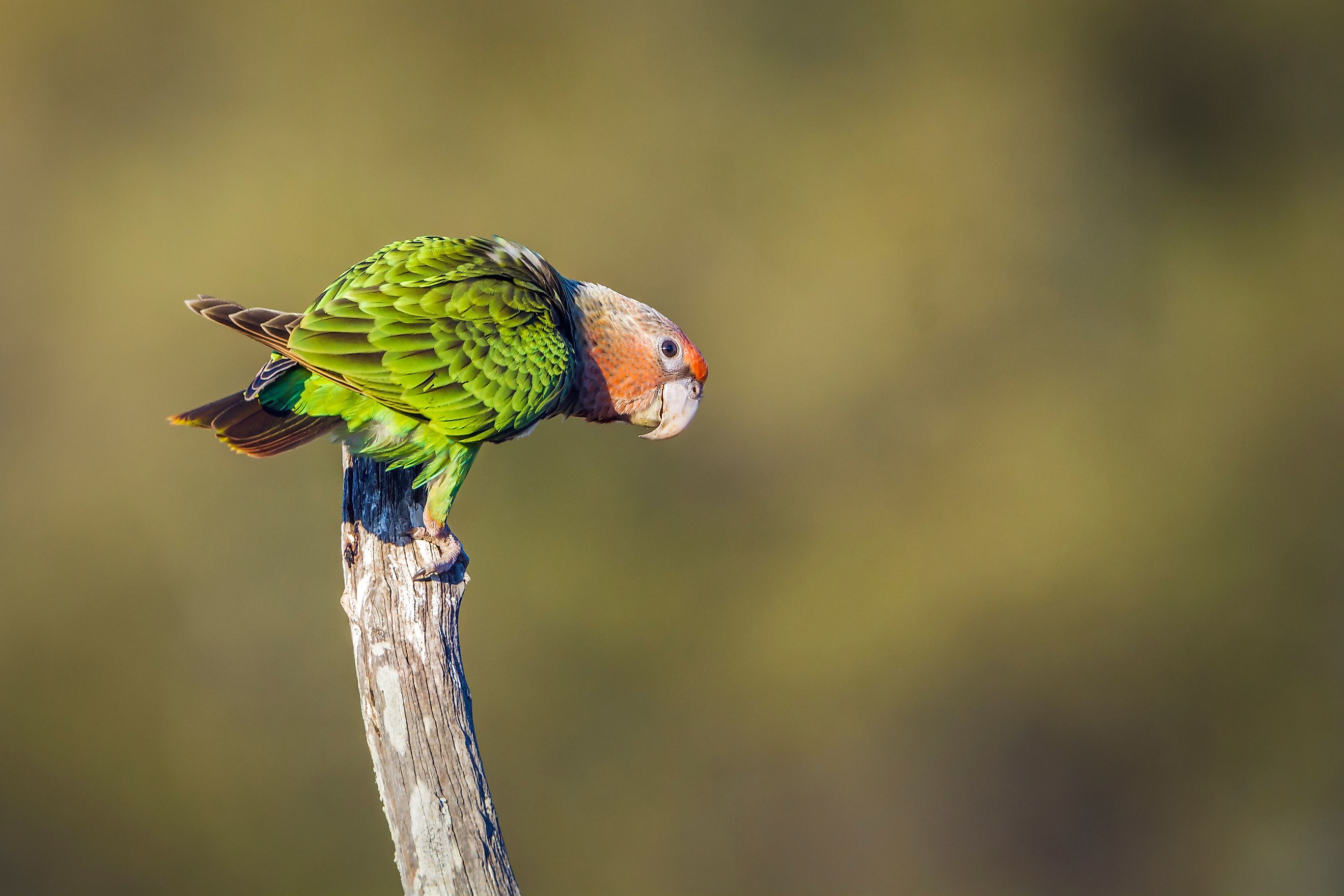
Cape Parrot

This endemic bird species lives in a handful of montane forests around South Africa. The Cape Parrot is recognizable by its short tail and emerald green body, and females can be identified by an orange patch on the forehead. The species has large beaks suited to cracking the nuts, seeds, and fruit kernels that make up most of its diet.
The Cape Parrot is currently classified as Vulnerable. Its habitat is already fragmented, which means the species may face increased risk if the remaining forest areas decline further.
Black Wildebeest

The Black Wildebeest resembles a mix of a horse, a bull, and a buffalo, and its size makes a strong impression. Large individuals measure up to seven feet long and about four feet tall, and they can reach running speeds of 50 miles per hour. They are both impressive and imposing. Black Wildebeest are one of two wildebeest species and inhabit the open plains of South Africa’s interior, where safari visitors often hope to see this notable native antelope of southern Africa.
Giant Girdled Lizard

The Giant Girdled Lizard has thick, scaled armor that gives it a distinctive appearance, and its size, usually no more than seven inches, contrasts with its rugged look. It resembles a bearded dragon with sharper features, which helps convey its general form. This South African reptile is found only in an inland area of the Highveld grassland biome and feeds mainly on insects.
The species is classified as Vulnerable by the IUCN. Habitat loss remains a primary concern, as development continues to reduce the native grasslands where these lizards live. The poaching of live specimens for the pet trade also contributes to population pressure.
Riverine Rabbit

The Riverine Rabbit has a distinctive appearance, with large ears, elongated bodies, and alert eyes that give it a slightly unusual look. It represents the only species in its genus. Its small population size adds to its vulnerability. It is thought that there are no more than 207 individuals alive today, all spread across the shrublands of the Karoo Desert.
Because the species is so rare and its remaining habitat is limited, the Riverine Rabbit is considered one of the most endangered mammal species in the world.
Bontebok

The Bontebok is a tall antelope with curved horns and a distinctive appearance. It is one of South Africa’s rarest ungulates. Bontebok are social grazing animals that may form single sex or mixed herds, and they travel within their territory seasonally to find food. They are also known for their ability to crawl under fences, which can complicate efforts to keep them out of certain areas.
There are two subspecies of Bontebok. This one, which shares the name of the full species, is the subspecies that is endemic to South Africa. The other subspecies, the Blesbok, is found in different parts of South Africa and in some neighboring countries.
Endemic Wildlife at a Glance
It is not often that a country can list as many endemic species as South Africa, and the range of wildlife found here reflects the variety of its landscapes. Even beyond the species most visitors know, the country supports many animals that occur nowhere else. These ten species represent only a small portion of that diversity. Anyone who looks more closely will find many additional examples of wildlife unique to South Africa.