An American Rebuilt Shakespeare’s Globe and He Died Before It Opened
Shakespeare's Globe in London is an accurate reconstruction of the open-air playhouse where England's greatest playwright staged many of his best-known works. On a recent visit to Bankside, I got to see this Thames-side cultural attraction from both sides of the curtain.
Starting off with a guided tour, I followed this up with a candlelight performance of The Tempest. Here's what I learned about how this remarkable building came to be and what to expect if you go.
Touring the Globe Theatre

As I discovered, a guided tour of Shakespeare's Globe is an ideal way to learn about this remarkable facility… as well as the great Bard himself. And combining it with a performance of a classic Shakespearean play is better still. Led by expert storytellers (my guide doubles as a professional actor), tours of the main Globe Theatre last around 50 minutes and cover both the history of the original 1599 playhouse and its modern-day namesake.
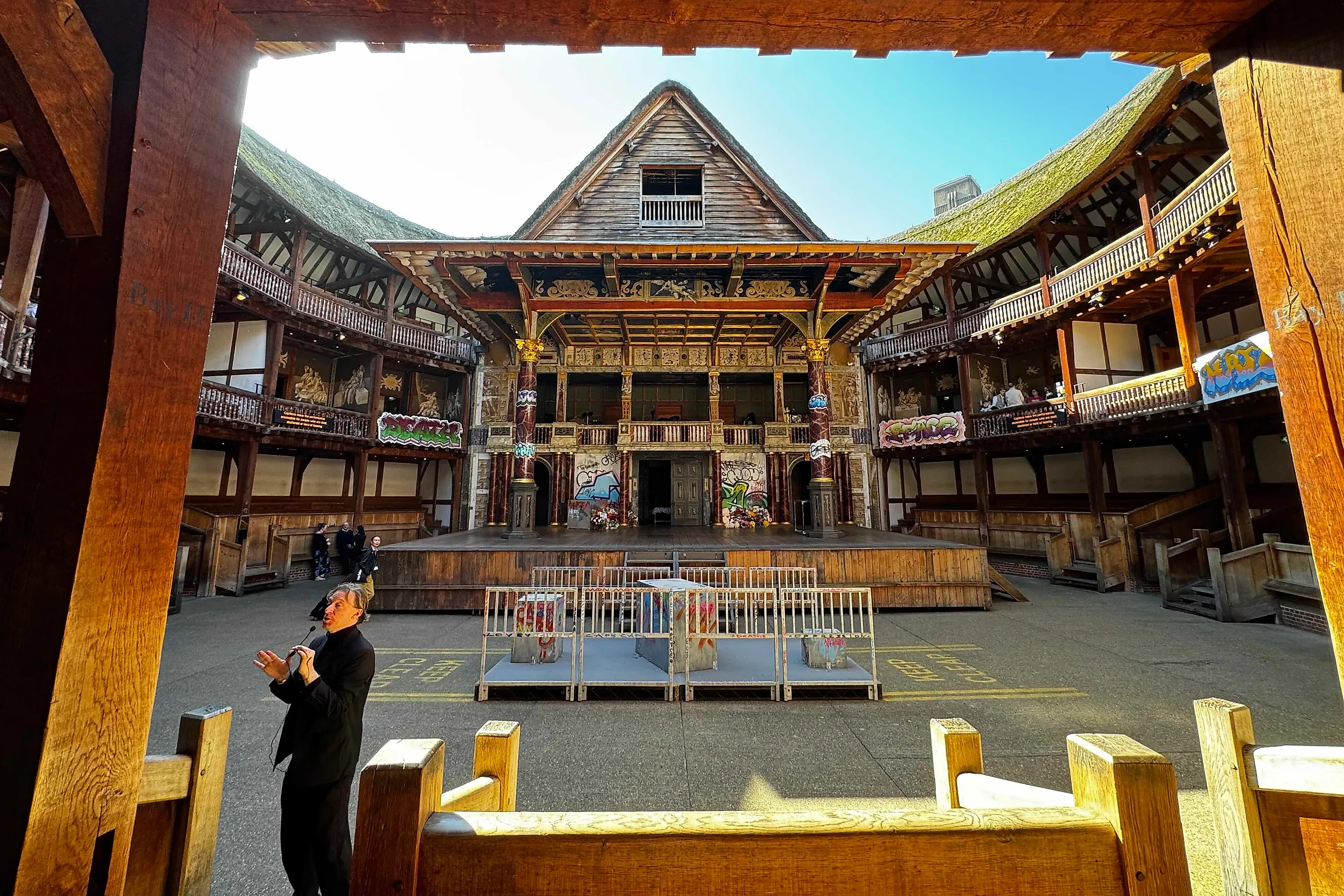
The first thing that struck me was its shape, something Shakespeare called a "wooden O." Like the original, this round, open-air auditorium features a stage that thrusts out into a central space that resembles a courtyard. There's no roof over that yard, so you'll need to dress for the weather (which in the UK means be prepared for anything) when you visit.

Three tiers of covered galleries fitted with simple wooden benches ring the stage and overlook the yard where, in Shakespeare's day, the "groundlings" stood. These were the spectators who paid a penny to watch while standing. Most importantly, from almost anywhere, you can see both the stage and the rest of the audience, which we were told was just as Shakespeare intended it.
You'll be given a headset at the beginning of the tour, which enables your guide to be heard over the noise of rehearsals and other tour groups. Although I didn't do it, some tours include live demonstrations of things like stage combat or period printing. Your tour ticket also covers an interesting walk-through exhibition about Shakespeare's London.
The Original Globe

Learning about the history of the first Globe was, for me, a highlight of the tour. The story, we were told, began with a property dispute. Shakespeare's company, the Lord Chamberlain's Men, had been performing at a playhouse on the other side of the Thames. But when the landlord refused to renew the lease, the company took matters into its own hands. Over a few days around Christmas 1598, they dismantled the building timber by timber, ferrying the whole lot across the river to Southwark.
There, on London's south bank, the reclaimed timbers were used to build the new Globe, which was completed in 1599. I was surprised to learn that Shakespeare wasn't just the resident playwright, but also a shareholder in the company, so he would have received a portion of its profits. And profit he did, with Julius Caesar, one of the first of his plays staged there, preceding money-makers like Hamlet, Othello, and King Lear.
However, disaster struck in June 1613, during a performance of Henry VIII when a stage cannon set fire to the building's thatched roof, burning everything to the ground. The rebuilt Globe, this time with a tiled roof, lasted until 1642, when the Puritan-led Parliament ordered all London entertainment to stop.
The building was pulled down two years later to make way for housing, and the site was eventually built over, its previous connection to Shakespeare all but forgotten. It remained lost until 1989, when part of the original foundation was rediscovered near Southwark Bridge, confirming where the playhouse had once stood. With directions from our tour guide, I made a point of visiting the site afterward as it's just a short stroll from today's Globe.
Building the New Globe

The driving force behind the modern Globe was American actor and director Sam Wanamaker, who visited Bankside in 1949 and was upset to find the original site marked only by a small plaque. He founded the Shakespeare Globe Trust in 1970 to build a faithful reconstruction. But it was to take Wanamaker another two decades to secure the land, win planning permission, and raise the money needed to build. Sadly, Wanamaker died in 1993 before the work was finished and never saw the completed project.
The Globe finally opened in 1997 with a production of Henry V, the same play used to open the original. Amazingly, it stands just 750 feet (230 m) from the site of the first Globe, separated only by a development of Georgian townhouses.

As you'll see when you tour the Globe for yourself, the reconstruction is as faithful to Elizabethan methods as modern rules allow. The frame is green English oak joined by wooden pegs, with no structural steel used anywhere. Its most distinctive feature, the thatched roof over the galleries, is the first permitted in the city since the Great Fire of London of 1666.
While safety rules mean the Globe can now only hold an audience of 1,570 (it held an estimated 3,000 in Shakespeare's day), the effect is considered an authentic replica of what things would have looked like in the 1600s.
A Candlelit Tempest

While the open-air Globe closes in winter, performances continue next door in the indoor Sam Wanamaker Playhouse. Modeled on the smaller roofed playhouses that existed around London in Shakespeare's time, it was here that I caught a candlelit performance of The Tempest. It's certainly intimate, holding just 340 people in a tight space with steep tiered seating looking down at the stage.
Though not a copy of any single building, it's reminiscent of the Blackfriars Playhouse, an indoor theater used by Shakespeare's company from 1609. Interestingly, Shakespeare wrote plays like The Tempest with this kind of candlelit space in mind, rather than the open-yard design of the Globe.
All of which made seeing a play like The Tempest in a small, intimate space even more interesting. The cast even made use of the candles, working them into the performance, and were already on stage, lighting them when we arrived at our seats.
And having toured the reconstructed Shakespearean playhouse next door, I was all ears when Prospero, the play's main protagonist, uttered his famous line about "the great globe itself," a direct reference to a structure that would have dominated the skyline here. He's right: it is indeed a great Globe.
Tips And Tactics
No visit to England is complete without learning at least a little about the Bard, and Shakespeare's Globe is an ideal place to do it. Here are a few details to help you make it happen:
- Shakespeare's Globe is located at 21 New Globe Walk, Bankside, London. It's on the south bank of the River Thames directly opposite St Paul's Cathedral.
- The nearest rail and Underground stations are London Bridge, Blackfriars, and Cannon Street, each around a 10-minute walk. From the north bank, the Millennium Bridge leads almost to the front door.
- Guided tours run throughout the year, though times vary depending on performances and rehearsals. Check the official website before you travel.
- Open-air performances in the Globe Theatre run from April to October, while indoor performances in the Sam Wanamaker Playhouse are year-round.
- The yard and galleries of the open-air theatre are exposed to the weather. Dress accordingly and rent a cushion or blanket if you are in for a long show.
- The on-site Swan Bar and Restaurant is a convenient spot for a meal before a performance.
- Tickets for tours of Shakespeare's Globe are a hot item in London, so book as far in advance as possible.