Exploring London's Thames-side Town Where Time Begins
Traveling by boat along the River Thames, I was excited to start exploring Greenwich. London's historic Thames-side town is an entirely unique part of the British capital. I'd just spent the morning exploring the Tower of London and found Greenwich only a short boat ride from the city's main attractions. Famous as the home of Greenwich Mean Time, it packs a lot of history into a small and very walkable area. Here's how I spent a full day plus a relaxed overnight stay exploring the place where time begins.
The Cutty Sark

You'll know you're getting close to Greenwich when you spy the three tall masts of the Cutty Sark in the distance. The world's last surviving 19th-century tea clipper, this elegant 212 feet (64.8 m) long vessel was launched in 1869 in Scotland and was considered the finest (and fastest) merchant ship of her time. And it still impresses.
Retired in permanent dry dock in Greenwich in 1954, the Cutty Sark is now a museum with exhibits about her nearly century-long career. Don't be perturbed by the glass dome that now surrounds the hull. This all-weather glass structure allows you to walk beneath the ship any time of year for an up-close look at her copper-clad hull.

While I wasn't adventurous enough to opt for the hour-long Cutty Sark Rig Climb experience, I did sample their afternoon tea. Enjoying a good "cuppa" next to this remarkable sailing vessel was a definite highlight of my Greenwich visit.
The Old Royal Naval College

Suitably refreshed, the Old Royal Naval College was just a short stroll away. Set directly on the Thames, this sprawling complex is steeped in history. Edward IV and later Henry VII had a palace here, one in which Henry VIII was later born, married two of his wives, and signed the death warrant of another. The buildings which replaced the old palace were built by Sir Christopher Wren (who had earlier designed St. Paul's Cathedral) between 1696 and 1712 as a hospital for injured and retired seamen.
The highlight of my visit was seeing the Painted Hall. One of the best examples of a Baroque interior in Britain, this extraordinary space took English artist Sir James Thornhill 19 years to paint and was finally completed in 1726. And it's simply breathtaking. Known as "Britain's Sistine Chapel," Thornhill's art covers some 40,000 square feet (3,720 sq m) of walls and ceilings with remarkably detailed scenes including kings, queens, and mythological characters. Self-guided tours are included with admission (guided tours are also available).

Afterward, I popped into the Chapel of St Peter and St Paul, notable for its altarpiece, The Preservation of St Paul after Shipwreck at Malta, painted in 1789. Its distinctive round pulpit, lectern, and font carved from timber salvaged from the old dockyard at nearby Deptford are also worth looking for.
And if, like me, you think the old college looks familiar, then you've more than likely seen it in a movie or TV show. Popular titles filmed here include Pirates of the Caribbean, Les Miserables, The Crown, Bridgerton... and some 200 others.
National Maritime Museum and Queen's House

Opened in 1937, the National Maritime Museum is the largest institution of its kind in the world. Its vast collection follows the history of the Royal Navy from Tudor and Stuart times right through to the Napoleonic Wars and up to today. The museum's collection of scale ship models is another of the world's largest. Several full-size vessels are housed in the galleries, from ornate royal barges to record-breaking speedboats.
Although perhaps a little somber, I did search out the jacket Lord Nelson was wearing when he died during the Battle of Trafalgar in 1805. The art collection is also impressive, featuring seascapes by Turner and portraits of naval figures by Reynolds and Gainsborough.

Speaking of art, I also recommend visiting Queen's House. Completed in 1635, check out the Tulip Staircase. Britain's first geometric, self-supporting spiral staircase, each of its wrought-iron treads is cantilevered from the wall and rests on the step below. It's a remarkable feat of engineering that still impresses.
Greenwich Park

Having explored Greenwich's naval history, it was time to make my way through Greenwich Park to get to the town's time-related exhibits. As eager as I was to get there, though, I didn't rush. Spread across 183 acres, this spectacular UNESCO World Heritage Site is the oldest of London's eight Royal Parks, with roots stretching back to Roman Britain.
Though steep in parts, the uphill climb is worth every step. Once at the top, the terrace beside the statue of General James Wolfe boasts one of the country's most incredible views. From here, you can see the skyscrapers in the City of London and Canary Wharf in one direction, and the tent-shaped O2 Arena in another. Queen's House is framed perfectly between them, with the Thames visible just behind. Pure magic.

You can also enjoy the views from several park benches set along usually quieter pathways leading off from the Pavilion Cafe. Built in 1906, take a close look at its roof, and you'll see a weathervane depicting Nelson peering through his telescope (and presumably enjoying the views, too). Although at the bottom of the hill near the main entrance, the White House Cafe and its surrounding gardens will have you feeling like you're in a small country village rather than in the UK's largest city.
You'll find the Ranger's House at the park's southern end near its fabled blossoms, where some 130 cherry trees add a dash of color each spring. This attractive red-brick Georgian villa holds the Wernher Collection of jewelry, along with many fine examples of medieval art and Old Master paintings.
The Royal Observatory and Flamsteed House

Opposite the Pavilion Cafe, you'll spot several attractive old buildings. It's here that I was headed in my quest to learn more about Greenwich's remarkable connection to time (and timekeeping) across the globe. My first stop was the Royal Observatory.
Established in 1675 to improve navigation at sea, it was originally housed in neighboring Flamsteed House, a purpose-built structure designed by Christopher Wren and named after John Flamsteed, the first Astronomer Royal. It now houses a fascinating collection of original telescopes and historic instruments developed to assist naval navigation over the centuries.

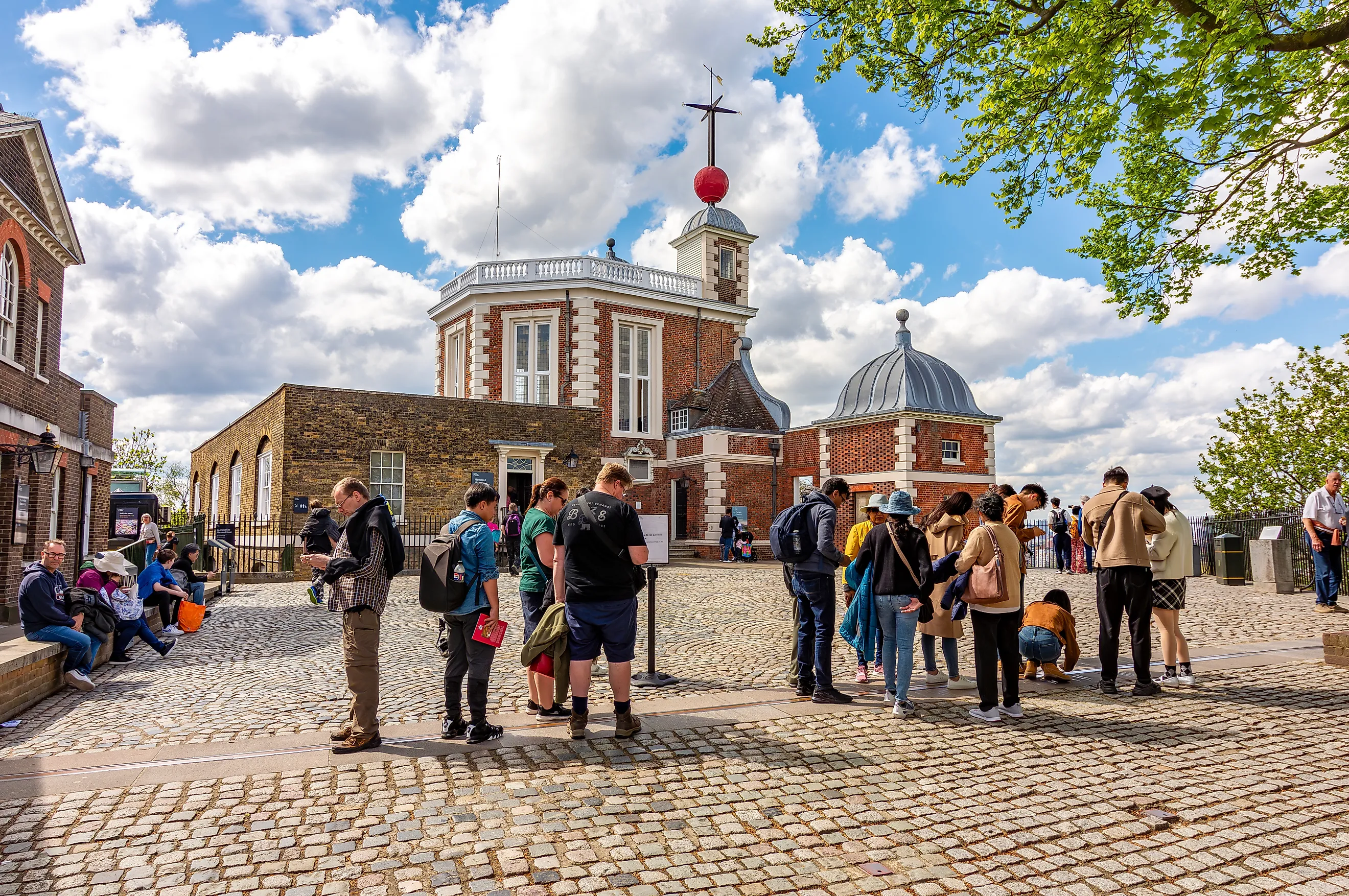
Perched atop the building is a red time ball that still drops at precisely 1 pm each day, a signal that enabled ships on the river below to set their chronometers. The prime (or "zero") meridian of longitude, the invisible line that divides the world into eastern and western hemispheres, passes directly through the Meridian Building and is marked by a steel strip set into the courtyard. Grabbing a selfie straddling the marker (and therefore both hemispheres) is a must.
Look out for the large dome caps the Equatorial Building, too. It houses the Great Equatorial Telescope of 1893, the UK's largest refracting telescope. And although it was closed for refurbishment when I visited, the Peter Harrison Planetarium will be an excuse for me to come back to Greenwich when it reopens in 2028.
Time for a Greenwich Getaway

To get the most out of your Greenwich visit, don't rush back to crowded Central London. Instead, end your day in this wonderful old port town with an overnight stay. I chose the 4-star Novotel London Greenwich for my base. Not only was it an easy walk to Greenwich Park and its attractions, but it also meant I could spend time seeing non-park sights like the Greenwich Market and St. Alfege Church.
For casual food, Heap's Sausages is an iconic eatery that serves up a wonderful sausage (of course!) and mash with onion gravy. The nearby Goddards is another joint serving up traditional hearty dishes like pies and mash, something it has been doing since 1890. Both are just around the corner from the entrance to Greenwich Park.
Planning Your Greenwich Visit
I was surprised to find out that Greenwich is one of London's easiest day trips. The Cutty Sark station is on the Docklands Light Railway from Bank or Tower Gateway, and Southeastern trains run from London Bridge to Greenwich Station in just 10 minutes.
The most scenic way to get there, though, is by river. I traveled along the River Thames with City Cruises, which runs frequent services from Central London piers to Greenwich Pier. The sightseeing commentary is a plus, so have your camera ready.
Those attractions in Greenwich that aren't free (several are) can be combined into a single discounted ticket through Royal Museums Greenwich. You can learn more about these and other options at the Discover Greenwich Visitor Centre, which also features exhibits about the area's 500-plus years of maritime heritage.
Allow a full day to see everything. Better still, an overnight stay means you can enjoy the town in quieter times without the crowds. Round it all off with a walk along the Thames at dusk, and you'll be glad you spent a day or two exploring the place where, quite literally, time begins.