The Route 66 Towns That Died When The Interstate Opened
Glenrio, on the Texas and New Mexico line, is a ghost town with a welcome center. The State of New Mexico opened it in 2008, and it has a movie theater, a pet walk and wifi, which is considerably more amenity than Glenrio offered when anybody lived there. That is roughly the shape of what the interstate did to Route 66: it emptied a string of towns over about twenty years, and then tourism came back looking for the emptiness. Here are the places that did not survive the bypass, the handful that clawed their way back, and the one man who bought an entire town for less than the price of a modest house.
The mechanism was always the same. A new four-lane opened a few miles away, the traffic left in a single season, and a town whose entire economy was people needing gas discovered that nobody needed gas there anymore.
Glenrio, Texas And New Mexico

Glenrio has the distinction of being abandoned in two states at once. It sits directly on the state line, which means it also straddled a time zone, and for a while the gas station on one side kept different hours from the cafe on the other. The name is a hybrid too: Scottish "glen" bolted onto Spanish "rio", describing a narrow river valley that is not especially visible from the road.
It was founded in 1903 as a railroad siding and did well enough that The Grapes of Wrath spent three weeks filming there in 1940, which is a grimly appropriate credit for a town that would later be emptied by economics. The depot closed in 1955 and Interstate 40 finished the job in the mid-1970s. By 1985 the population was two.
What remains is now the Glenrio Historic District, listed on the National Register in 2007, with the old roadbed and 17 abandoned buildings including a Texaco station and an Art Moderne diner. And, since 2008, the welcome center.
Amboy, California

Amboy exists because a railroad surveyor named Lewis Kingman needed to name a series of stations across the Mojave and decided to work through the alphabet. Amboy was the A. Bristol, Cadiz, Danby, Edson, Fenner and Goffs followed, which tells you exactly how much thought went into the founding of these places.
Route 66 arrived in California in 1926 and turned the alphabetical railroad stop into a genuine town. Roy Crowl opened a service station in 1938, added a motel and cafe, and by the peak Amboy had somewhere between 700 and 800 residents with roughly a tenth of them on Roy's payroll. The retro-futuristic sign went up in 1959 and is now one of the most photographed objects on the entire route. Harrison Ford is said to have flown into the local airstrip for lunch.
Interstate 40 opened in 1973 and moved the traffic ten miles north. The sign went dark in the 1980s and the population fell to four.
Somebody Bought The Whole Town

Amboy's second act is the best story on this list. In 2005, with the town scheduled for demolition, Albert Okura bought all of it for $425,000. Okura was not a preservation society or a heritage trust. He founded Juan Pollo, a chicken restaurant chain, and he purchased an American ghost town for roughly what a two-bedroom bungalow costs in the state it sits in.
He then set about slowly bringing it back. Roy's reopened as a gift shop, restoration work continues, and in 2019 the neon sign was relit for the first time in decades. Amboy is not exactly alive, but it is no longer being knocked down, and the difference between those two states was one man with a chicken fortune and a specific idea about what is worth keeping.
Cuervo, New Mexico
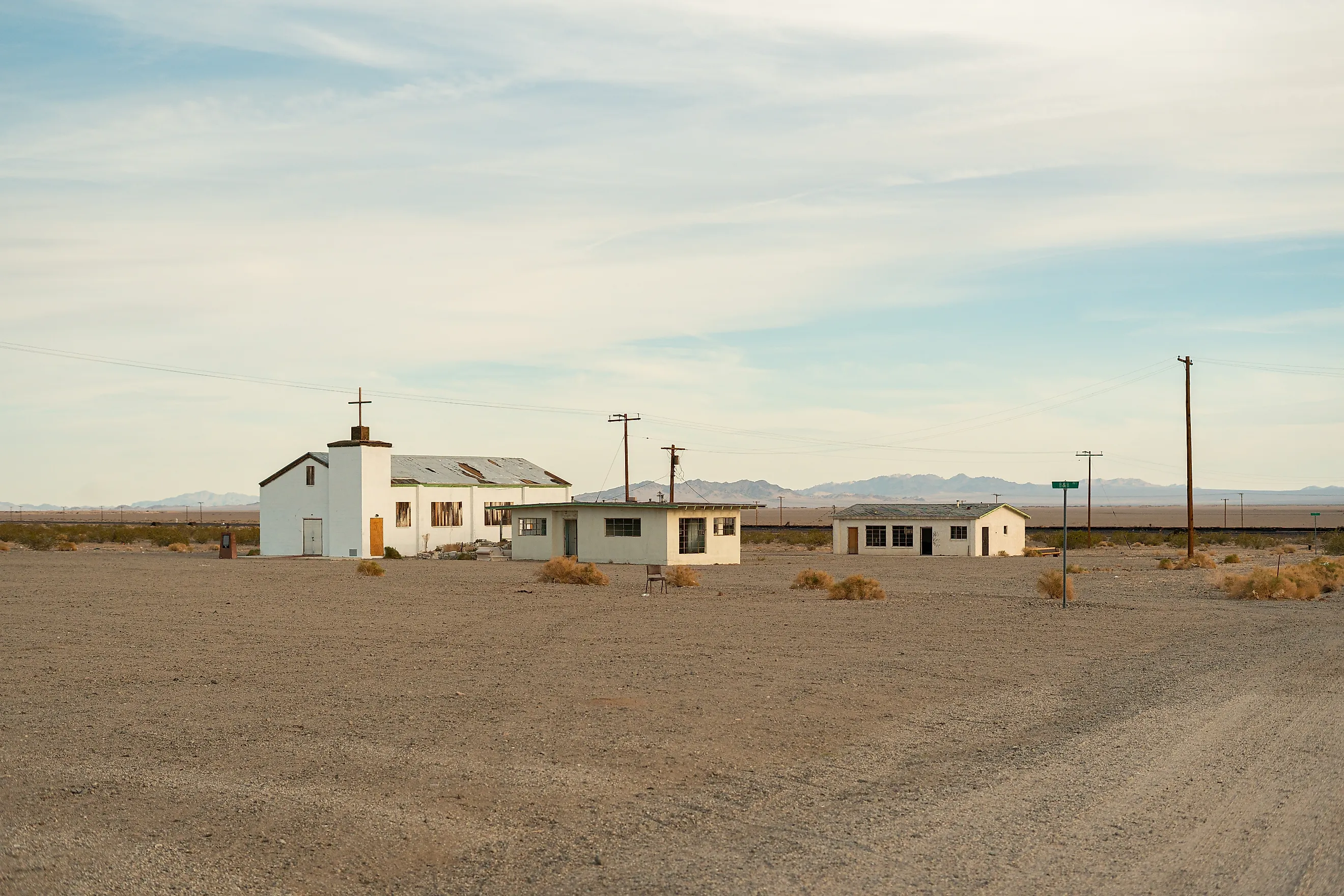
Most of these towns were bypassed. Cuervo was bisected. Interstate 40 was routed directly through it, splitting the town into two halves that now sit either side of four lanes of traffic doing 75 miles an hour, which is a considerably more brutal way to kill a place than simply ignoring it.
Cuervo started around the turn of the twentieth century as a railroad water stop, grew on cattle ranching and Route 66, and peaked at a few hundred residents in the 1940s. The church, the schoolhouse and a scatter of houses are still standing on both sides of the highway, close enough to see from the interstate and impossible to reach from it.
Texola, Oklahoma

Texola sits on the Oklahoma and Texas line, has a population in the single digits, and retains a nineteenth-century jail roughly the size of a garden shed. A sign on one of the abandoned buildings reads, more or less, that there is no other place like this place anywhere near this place, which is either profound or the result of somebody having a lot of time and one can of paint.
The town changed state affiliation several times in its early years because nobody could agree where the border actually was, which meant residents occasionally woke up in a different state without moving. Route 66 gave it a purpose for about fifty years, and the interstate took that purpose away in an afternoon.
The Mojave Alphabet Towns
Amboy was not alone. California's stretch of Route 66 supported around a dozen towns across roughly 100 miles of Mojave Desert, and Interstate 40 took nearly all of them at once in the early 1970s.
Bagdad is the extreme case. The town is so completely gone that when a film crew wanted to shoot Bagdad Cafe there in 1987, they had to use Newberry Springs instead, because the actual Bagdad no longer had anything to point a camera at. Siberia, Chambless and Essex are in similar condition. Ludlow hangs on with a gas station.
Seligman, Arizona Fought Back

Seligman, Arizona, got bypassed in 1978 and refused to accept it, largely because of a barber. Angel Delgadillo cut hair on the main street, watched the traffic vanish overnight, and organized his neighbors into a campaign to get the old road recognized and signposted as a historic route rather than left to rot.
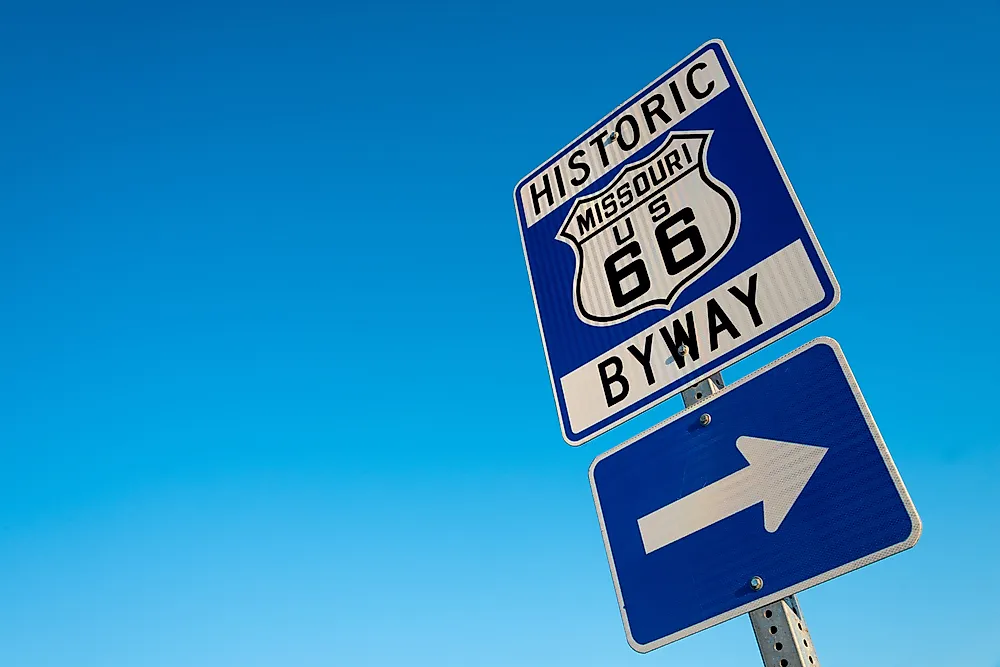
It worked. Arizona designated its stretch as Historic Route 66, other states followed, and the entire modern Route 66 tourism industry traces back to that effort. Seligman is now busy in a way it had not been since the seventies, full of visitors photographing a main street that survives because one man declined to let it die quietly.
Pixar's team drove the route while researching Cars, met Delgadillo, and built Radiator Springs out of Seligman and its neighbors. A town nearly erased by an interstate ended up as the setting of a film about a town nearly erased by an interstate.
Tucumcari Survived On Signage

Tucumcari, New Mexico, spent decades advertising itself to drivers hundreds of miles out with billboards promising "Tucumcari Tonite" and a specific room count, which climbed over the years and is usually remembered as 2,000 rooms. That was aggressive marketing for a town of a few thousand people.
The interstate hurt it badly but did not finish it, partly because Tucumcari is far enough from anywhere else that drivers still need to stop, and partly because the neon survived. The Blue Swallow Motel, opened in 1939, is still taking guests, and the surviving signs have become the attraction rather than the advertisement.
Why It Happened So Fast
The Interstate Highway Act passed in 1956 and the replacement of Route 66 took nearly thirty years, but no individual town experienced it as a slow process. For any given place, the bypass opened on a particular day and the traffic was gone by the end of the week.
The economics were unforgiving because these towns had no other function. A settlement whose businesses are a gas station, a motel, a diner and a curio stand exists purely to intercept people going somewhere else, and an interstate is specifically designed to stop travelers having to interact with anywhere along the way. Route 66 was finally decommissioned on June 27, 1985, at which point it promptly became far more famous than it had ever managed while it was an actual functioning highway.
What Is Left Out There

The towns that died are now, in a genuinely strange turn, the product. Nobody drives to Glenrio for the services. They drive there because there are 17 empty buildings and a road going nowhere, and that has turned out to be a more durable attraction than the gas station ever was.
The pattern across the whole route is consistent. Places that had something besides the highway generally survived. Places that were only the highway did not, unless somebody specific decided otherwise, whether that was a barber in Seligman or a chicken magnate in Amboy. Everywhere else, the interstate did exactly what it was built to do, and the towns found out on a Tuesday.