10 Washington Towns With Unforgettable Main Streets
Washington's most distinctive commercial blocks sit well away from the interstate, scattered along Puget Sound, across the Kittitas Valley, and out past the Columbia into wheat country. A few sit farther still, up in the Kettle River range near the Canadian border. Commercial Avenue in Anacortes carries more than one hundred sixty life-sized painted panels of real townspeople along its full length. Clark Avenue in Republic has a fossil dig at one end and a resident mule deer herd that has learned to use the crosswalks. Pennsylvania Avenue in Roslyn still has a saloon with a 23-foot spittoon trough with water flowing through it along the base of the bar.
Ellensburg

Pearl Street is a commercial core composed of a single vintage, rebuilt in a rush after a fire on July 4, 1889, that destroyed most of downtown Ellensburg. The work went quickly because the town believed it was about to become the state capital, a distinction it never got. Pearl Street Books occupies the 1888 Building, the only downtown structure to survive the fire. The Clymer Museum of Art fills the old Ramsay Hardware Building of 1901. It holds the work of John Ford Clymer, an Ellensburg native whose paintings appeared on Saturday Evening Post covers. The museum reopened in spring 2026 after a renovation that expanded its wall space, and the Ellensburg Rodeo Hall of Fame shares the building.
The Kittitas County Historical Museum is a block east on Third Avenue, in the 1889 Cadwell Building, another post-fire structure. Admission is free, and the collection includes antique automobiles, farm implements, an old switchboard, and a display on Ellensburg blue agate, a gemstone found only in this valley. Two more sights sit along the same walk. The Bull, a Richard Beyer sculpture, sits on a bench in Unity Park across from the Clymer. A block west on Main Street, the Palace Cafe has been serving since 1892.
Poulsbo

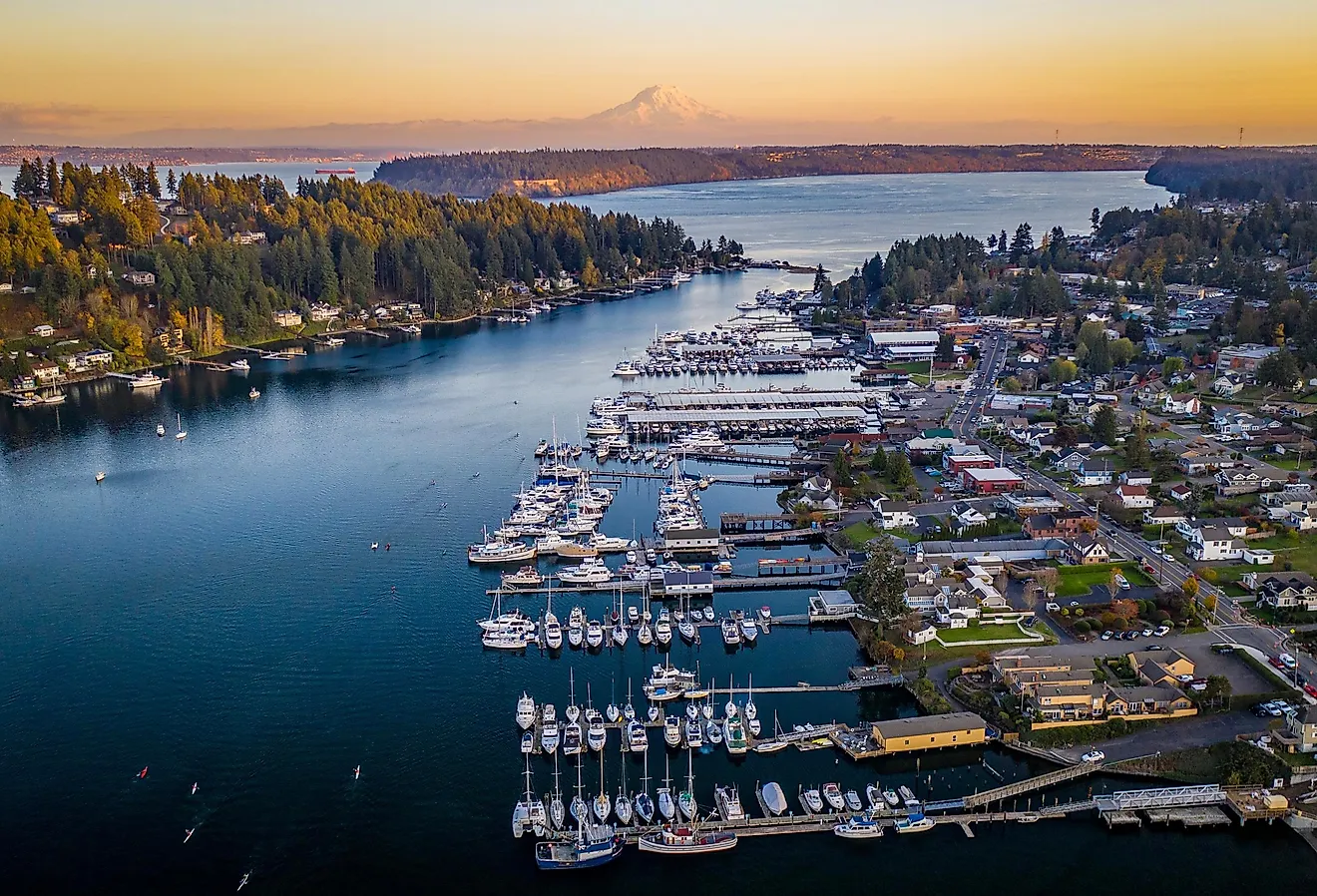
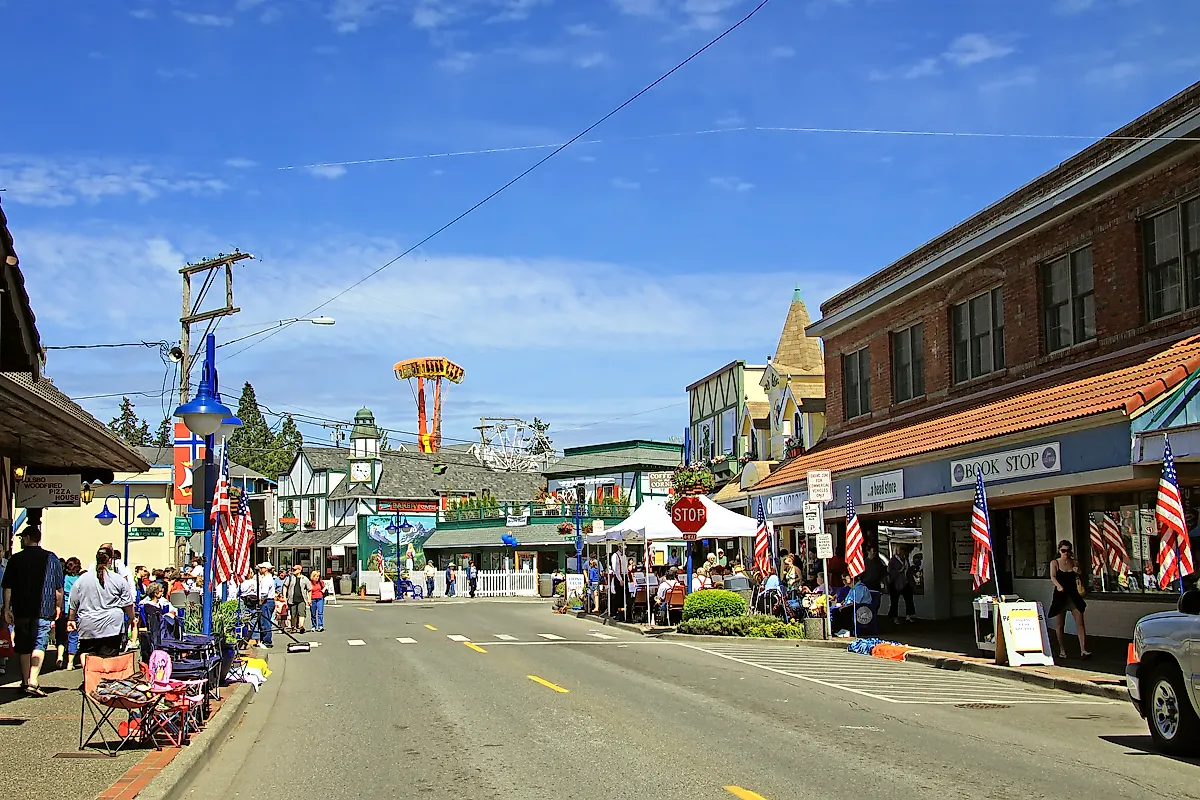
Poulsbo sits about forty-five minutes from Seattle, by ferry to Bainbridge Island and then north over Agate Pass. Front Street runs along Liberty Bay, and it looks the way it does because Norwegian fishermen settled here in the 1880s and thought the bay looked like home. Rosemaling covers the storefronts, Viking motifs, and Norwegian flags are everywhere, and the street grid ends at the water. Sluys Poulsbo Bakery on Front Street has been here since 1966, baking lefse, rye, and sourdough breads, hand-cut donuts, and Viking cups from scratch in small batches. It is also where Poulsbo Bread was invented in 1974, licensed to a national baker in the 1980s, and still hand-mixed here for local sale.
Down the block, the SEA Discovery Center is a public aquarium operated by Western Washington University, with a touch pool, interactive exhibits, and a gray whale skeleton. Admission is by donation. Hours have been limited to Friday and Saturday, so the schedule is worth checking in advance. The boardwalk runs directly behind Front Street, linking American Legion Park with Liberty Bay Waterfront Park. The Austin-Kvelstad Pavilion sits at the water's edge, with the Olympics across the bay and harbor seals in the marina. Sunset is the best hour for it. Liberty Bay is sheltered enough for beginners, and outfitters rent kayaks and paddleboards along the same stretch.
Dayton

Main Street runs through the middle of two historic districts, and the 90 buildings across them are on the National Register in a town of roughly 2,400. The Columbia County Courthouse sits at the center of the walk, Italianate and stuccoed brick, topped with a 22-foot lantern and a bellcast mansard roof with iron cresting. It is a working building and cases are still heard inside. Completed in 1887, two years before statehood, it is the oldest working courthouse in any of Washington's 39 counties.
One street over on Commercial Street, the Dayton Historic Depot was built in 1881 and is the oldest surviving passenger station in the state. Inside are early Northwest maps, telegraph equipment, and an original freight scale that still works. Admission costs a few dollars, children enter free, and hours shift between summer and winter. Back on Main, the restored Liberty Theatre shows films again. The Depot Society hands out self-guided walking tour maps, one for each district, and they explain what stands where rather than leaving visitors to guess.
Roslyn

Pennsylvania Avenue is brick and locally quarried sandstone along its full length, the result of an 1888 fire that took the commercial district of a town Northern Pacific had founded two years earlier. The last mine closed in 1963, and with the coal gone, nobody had a reason to rebuild, so the street stands as it went up. The Brick on Pennsylvania Avenue opened in 1889 and is generally credited as Washington's oldest continuously operating saloon. The back bar was shipped from England around Cape Horn, and a 23-foot spittoon trough with water flowing through it stretches the length of the bar and still works. There is a jail cell in the basement.
Directly across the street, the Roslyn Candy Company occupies the old bank building. Two blocks west, the Roslyn Cafe carries the camel mural on its side wall, and the Roslyn Museum, a few doors along Pennsylvania Avenue, holds mining photographs and memorabilia along with an exhibit on the town's 26 cemeteries. The Northwest Improvement Company Building, the 1889 company store, still stands with a bronze coal miner memorial out front. The old KBHR radio storefront is preserved in one of its corners.
Port Gamble

Port Gamble is not a main street so much as an entire nineteenth-century town, and all 120 acres of it are a National Historic Landmark. The architecture is New England transplanted, with maple and elm overhead and the Hood Canal below, and red plaques stand in front of most buildings explaining the family or business behind them. The village came through whole because one company owned it all. Andrew Pope and William Talbot built a sawmill on Gamble Bay in 1853 that operated until November 1995, the longest continuously operating mill in the country at the time, and the successor company held the townsite rather than selling it off.
The General Store, dating to 1916, sells everything and houses two museums under one roof. The Port Gamble Historic Museum is downstairs, and Of Sea and Shore, a shell collection, sits on the mezzanine. The Port Gamble Theater occupies a building that has hosted performances since 1906, and after dark, the town leans into its haunted reputation with guided ghost walks. A full lap of the village takes 25 minutes at a rush, but rushing is the wrong approach.
Coupeville

Front Street on Penn Cove is a line of nineteenth-century false-fronted commercial buildings, and it sits inside Ebey's Landing National Historical Reserve, the first reserve of its kind in the country. Bookstores, wine tasting rooms, and boutiques fill buildings that predate statehood. The Coupeville Wharf extends over the cove from the foot of Front Street, built in 1905 for grain storage and for Mosquito Fleet steamers that served Seattle, Bellingham, and Port Townsend into the 1930s. There are marine exhibits inside, coffee at the end, and kayak rentals for anyone wanting to see Penn Cove from the water. Orcas come through in spring.
The Island County Historical Museum is a block off Front Street, directly facing the wharf, with more than 20,000 artifacts covering the Ice Age forward, and admission is by donation. The 1855 Alexander Blockhouse, one of four surviving in the area, stands on the museum grounds. The self-guided walking tour guide is available at the museum or at the Chamber visitor center in the old fire hall next door. It maps 65 historic locations along Front and Coveland, and free parking sits a block away by the library.
Snohomish

First Street carries twenty-six blocks of redbrick and Western false-front, and what fills those storefronts is the draw. The city declared its downtown a historic district in 1973, got it on the state and national registers in 1974, and has been trading on it ever since. The nickname is Antique Capital of the Northwest, coined in 1982 by the man who opened Star Center Antique Mall. There are more than 175 antique dealers packed into less than a square mile, and the middle blocks of First are the densest stretch, walkable end to end from a single parking spot. Star Center, a block up on Second Street, alone represents more than 200 individual dealers across five floors.
The Oxford Saloon on First Street started as a grocery in 1890, is now a bar and restaurant, and has a haunting reputation that the staff will happily discuss. The Riverfront Trail runs directly below First Street along the Snohomish River, with four access points connecting up to the street. Interpretive signs cover the area's ecology, and a marker notes Pilchuck Julia, a Snohomish tribal leader in the 1920s. It ends at Cady Landing, and the beehive mural depicting valley crops is on the way back up.
Steilacoom

Lafayette Street is the spine of Steilacoom, lined with houses and storefronts dating back to the 1850s. Washington's first incorporated town was chartered here on April 22, 1854, ahead of both Seattle and Tacoma. It stopped growing once the railroad went to Tacoma in the 1870s, which is precisely why so much of it is still standing. Bair Drug and Hardware on Lafayette Street was built in 1895 by pharmacist W.L. Bair as a drugstore, hardware store, and post office. It now operates as a restaurant and is essentially a museum with a menu, holding original shelving, a 1908 soda fountain in working order, patent medicine tins, and early photographs on the walls. The building was donated to the historical association in 1973.
On Rainier Street, the Steilacoom Historical Museum covers the town's history, with the 1857 Nathaniel Orr home and orchard next door and Orr's reconstructed wagon shop just down the hill, holding his original tools. The town publishes a walking tour brochure worth downloading in advance. It covers the length of Lafayette Street and the homes built from the 1850s onward. Among them are the 1885 Rigney Home and the Gardner Home with its red-and-white barber pole. Frank H. Gardner, a Black barber and fruit grower, lived there for years.
Anacortes

Commercial Avenue is an outdoor gallery, and it was a deliberate act of economic rescue. In the 1980s, with the local economy struggling, a community group cast around for an idea. Local artist Bill Mitchell brought sketches to the second meeting, and by the third meeting, he was leading the project. Over the next 35 years, he produced more than 160 life-sized murals, painted on three-quarter-inch plywood and mounted on buildings along the full length of Commercial, between the south entrance of town and Guemes Channel. Each depicts a real Anacortes person or event taken from historical photographs: mayors, bartenders, boxers, fishermen, storekeepers. Mitchell died in 2019. A QR-code walking tour now accompanies them, and scanning the code beside a mural brings up the source photograph, the newspaper account, and, in some cases, audio of Mitchell discussing the piece.
There is a second mural worth finding indoors. The post office lobby on Commercial holds Kenneth Callahan's "Fishing," a New Deal commission from 1940 by one of the Northwest School painters. A few blocks east of Commercial, the Anacortes Museum occupies the 1910 Carnegie Library, one of more than 2,500 Carnegie libraries built worldwide. Admission is free, and the collection covers Samish Nation material assembled with Samish representatives, early logging and fishing displays, and the full mural project archive. The historic building stock on Commercial itself rewards a look upward, and the Wilson Hotel and the Fraternal Order of Eagles building are both on the National Register. Mural maps are available at the Visitor Center on Commercial.
Republic

Clark Avenue is as close as Washington comes to an Old West main street, balconied and false-fronted, with an old opera house now operating as a movie theater and bars that came through the 1938 fire that took part of the street. The town sits at 2,500 feet in the foothills of the Kettle Range, 120 miles from Spokane, founded on an 1896 gold strike on Granite Creek. The Kaufman Cabin, built in 1896, is the oldest standing structure in Ferry County. One local quirk is the resident mule deer herd that wanders Clark Avenue and has learned to use the crosswalks.
The Stonerose Interpretive Center occupies a 50-million-year-old Eocene lakebed, and the fossils are not behind glass. A site pass and a set of borrowed tools cover a two-tenths-of-a-mile walk to the Boot Hill dig, where visitors split shale themselves. Staff identify the finds, and each digger takes home up to three specimens per day. Admission to the center itself is free, and seasonal hours cover roughly late April through September. The site was discovered in 1977 by artist Wes Wehr and Kirk Johnson, then a Seattle high school student who went on to lead the Smithsonian's natural history museum. Stonerose specimens have appeared in National Geographic, and the site ranks among the world's significant Eocene localities.
What Makes A Washington Main Street Unforgettable
Washington's main streets earn their reputation at street level, along Puget Sound and out past the Cascades alike. Bair Drug in Steilacoom has a 1908 soda fountain in working order and serves lunch around the original shelving. Snohomish packs more than 175 antique dealers into less than a square mile of First Street, and the Coupeville Wharf reaches out over Penn Cove, where orcas come through in spring. What makes these ten Washington main streets unforgettable is not that the buildings survived, but that they are all still very much alive.