10 Prettiest Towns to Visit in Washington
Washington organizes its small towns along the state's two defining geographies: the water (Puget Sound, the San Juans, the Olympic Peninsula) and the mountains (the Cascades and the Methow Valley). Coupeville dates to 1853, making it the second-oldest town in the state. Friday Harbor reaches you only by ferry or floatplane. Leavenworth rebuilt itself as a Bavarian village in the 1960s and now draws more than two million visitors a year. And North Bend, an hour east of Seattle, is the diner in the opening of David Lynch's Twin Peaks. Below are ten towns worth the drive or the ferry.
Leavenworth

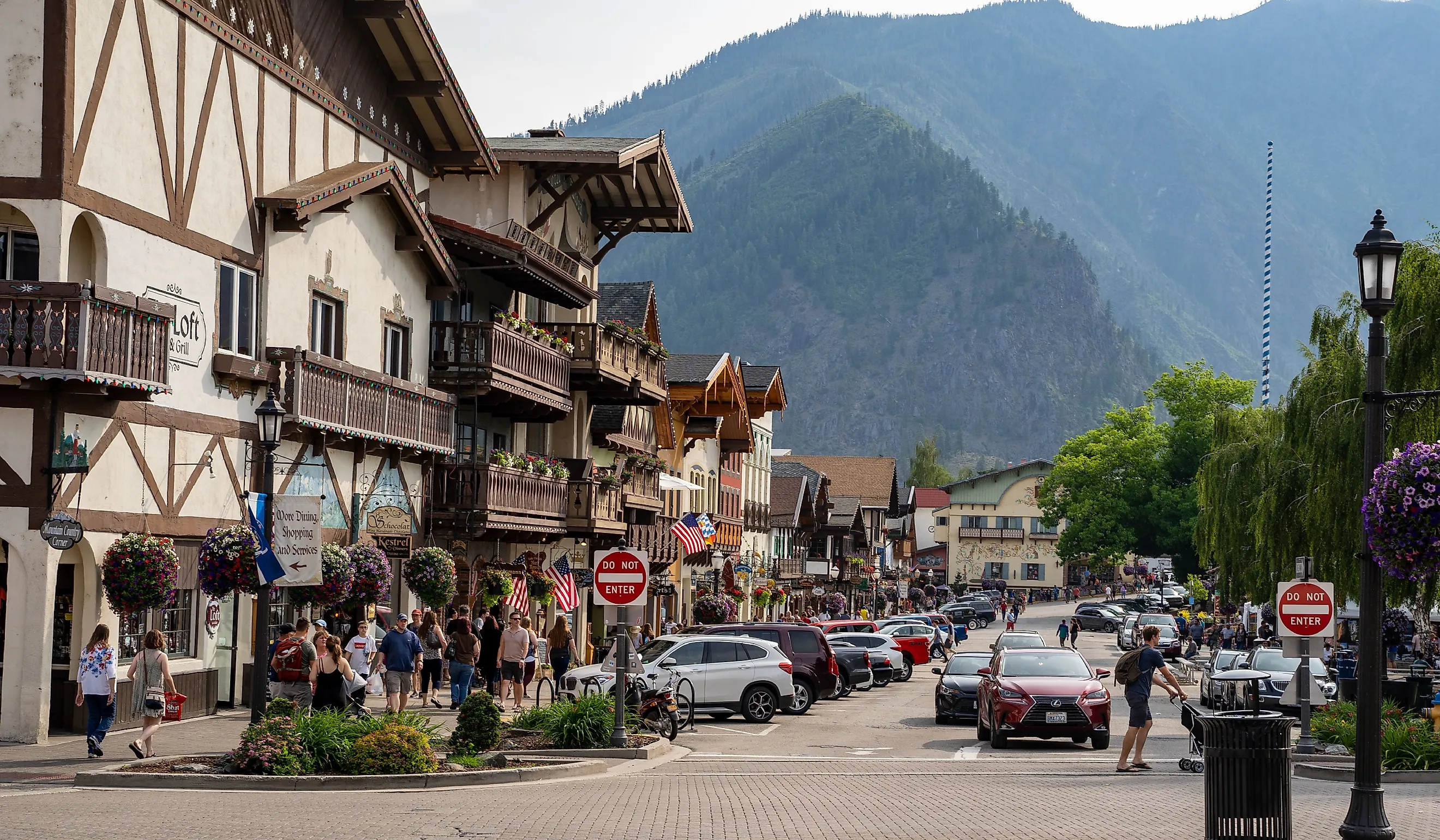
Visiting Leavenworth is the closest Washington gets to a Bavarian village. After the railroad was rerouted in the 1920s, the town leaned hard into the theme in the 1960s as a deliberate economic revival, and today every downtown building on Front Street wears painted timber, window boxes, and an Alpine roofline. The Leavenworth Nutcracker Museum, above Kris Kringl on Front Street, holds over 9,000 nutcrackers from 60 countries, some dating to the 1600s. The Christmas Lighting Festival in December and Oktoberfest in October are the two peak draws, but the surrounding Wenatchee River and Alpine Lakes Wilderness make the town a year-round base.
Outside the village theme, the Leavenworth Adventure Park runs a year-round Alpine Coaster at the mouth of Tumwater Canyon, and Waterfront Park along the Wenatchee River has walking trails and swimming access in summer. Lake Chelan, about 90 minutes north, and the Okanogan-Wenatchee National Forest round out the day-trip options.
Poulsbo

If Leavenworth is the German village of Washington, Poulsbo is Washington's "Little Norway." The town was founded in the 1880s by Norwegian immigrants drawn to the similarity between Liberty Bay and the fjords of their homeland, and the heritage still defines downtown. Sluys Poulsbo Bakery on Front Street has been baking cardamom bread, lefse, and julekake since 1966 and remains the town's single most visited institution. The Maritime Museum and the Poulsbo Heritage Museum both trace the town's Scandinavian and fishing history. Farther north, the Naval Undersea Museum covers the Cold War submarine program out of nearby Keyport.
On Liberty Bay itself, Poulsbo's Waterfront Park has a boardwalk, kayak launch, and marina with rentals for paddleboarding and boating. The town's annual Viking Fest in May is the largest Norwegian cultural celebration in the Pacific Northwest, drawing 30,000 people for parades, food, and Nordic music across three days.
Port Townsend

Northwest of Poulsbo, Port Townsend sits on the northeastern tip of the Olympic Peninsula. In the late 19th century the town expected to be the main terminus for the Northern Pacific Railroad, and built itself accordingly: massive Victorian mansions on the bluffs, three-story brick commercial blocks on Water Street, and a deep-water port. When the rail terminus went to Seattle instead, the building boom stopped almost overnight, and what was left is now one of the most intact Victorian downtowns on the West Coast.
Fort Worden Historical State Park, a former coastal artillery base on the north side of town, now anchors one of the Pacific Northwest's most active arts programs, including Centrum and the Port Townsend School of Woodworking. Olympic National Park, 50 miles west, covers rainforest, coastline, and alpine terrain, with Hurricane Ridge offering some of the most accessible high-country views in the park. The Jefferson Museum of Art & History downtown and the Rothschild House (open in summer) round out the cultural stops.
Winthrop

Winthrop sits in the Methow Valley on the eastern side of the North Cascades, and in the 1970s the town committed to a full Old West aesthetic, wooden boardwalks, false-front buildings, and swinging saloon doors, as a way to draw visitors along the newly opened North Cascades Highway. It still holds up. The town is the southern gateway to one of the largest cross-country skiing networks in North America, with more than 120 miles of groomed trails maintained by the Methow Trails association. The same trails convert to hiking, horseback riding, and mountain biking routes in warmer months.
The Methow River runs through town for trout fishing and Class II-III rafting, and North Cascades National Park and Ross Lake National Recreation Area both sit within an hour's drive. Winthrop also has the Sun Mountain Lodge on the ridgeline above town and Three Rivers Hospital in nearby Brewster, the closest full-service hospital in the valley.
La Conner

La Conner sits on the Swinomish Channel at the western edge of the Skagit Valley, with a downtown of 19th-century wood-frame buildings on First Street and a working channel-side waterfront. The town is best known nationally as the gateway to the Skagit Valley Tulip Festival, which runs through April and draws roughly a million visitors to the surrounding commercial tulip fields. Outside the festival, La Conner is much quieter.
Three museums anchor the cultural scene in a town of roughly 1,000 people: the Museum of Northwest Art, which collects the work of the Northwest Mystics (Morris Graves, Guy Anderson, and others who helped define postwar American art); the Pacific Northwest Quilt & Fiber Arts Museum in the 1891 Victorian Gaches Mansion; and the Skagit County Historical Museum on the hill above town. The Rainbow Bridge, an orange steel arch, connects La Conner to the Swinomish Indian Tribal Community on Fidalgo Island.
Sequim

Sequim sits in the Olympic Mountain rain shadow on the northeastern Olympic Peninsula, which produces a microclimate locally called the "Blue Hole." The town averages only about 16 inches of rain a year, a fraction of what falls on the western side of the peninsula, and the dry conditions made commercial lavender farming possible. Roughly two dozen farms now operate in the area, and the Sequim Lavender Festival in July is the largest in North America. The Dungeness Spit, five miles north of town, is the longest natural sand spit in the United States at 5.5 miles, and supports over 250 bird species at the National Wildlife Refuge at its base.
Downtown is compact, with independent shops (Cedarbrook Lavender, Pacific Mist Books, Northwest Native Expressions) along a few blocks of Washington Street. The Dockside Grill at the John Wayne Marina, named for John Wayne, who kept his yacht here in the 1970s, handles the waterfront dinner slot. Seattle is about two hours by road, and the Port Angeles ferry 15 minutes west connects to Victoria, British Columbia.
Gig Harbor

Gig Harbor sits on a small, protected bay on the west side of the Narrows, about 20 minutes from Tacoma across the Tacoma Narrows Bridge. The harbor's unusual geography, a nearly enclosed bay with a narrow mouth, made it one of the last working commercial fishing communities on Puget Sound, with a Croatian and Scandinavian fishing fleet still operating out of the town docks. On clear days the cone of Mount Rainier fills the horizon to the south.
The Harbor History Museum on Harborview Drive covers the town's maritime heritage with a full-size 65-foot fishing vessel, the Shenandoah, under restoration in the main hall. 7 Seas Brewing and Heritage Distilling both run tasting rooms downtown, and Tides Tavern on the marina has been open since 1973 and is the town's defining waterfront restaurant. The Cushman Trail, a 6.2-mile rail-trail, connects the harbor to the north end of Gig Harbor and handles most of the town's foot and bike traffic.
Friday Harbor

Friday Harbor is the only incorporated town in the San Juan Islands, reachable only by Washington State Ferries from Anacortes or by floatplane from Seattle. That limited access is part of its identity. The town of roughly 2,600 sits at the head of a deep natural harbor on San Juan Island, and the three resident pods of Southern Resident orcas that spend summers in the surrounding Haro Strait are part of its ecosystem, not a tourist add-on.
The Whale Museum on First Street, the first museum in the country dedicated to whales in the wild, opened in 1979 and is still the best starting point for understanding the orca population. Several outfitters run whale-watching tours from the main dock. The San Juan Islands Sculpture Park north of town has 150 rotating outdoor works across 20 acres. And San Juan Island National Historical Park, split between American Camp and English Camp, preserves the site of the 1859 Pig War, one of the oddest border disputes in US history.
Coupeville

Coupeville, founded in 1853 on the north shore of Whidbey Island, is the second-oldest town in Washington. Front Street runs along the south shore of Penn Cove with several blocks of 19th-century wood-frame buildings, including a number of sea captains' homes now on the National Register. The Island County Historical Museum at the foot of the wharf tells the story of the Lower Skagit (Coast Salish) villages that preceded European settlement and the town's years as a Puget Sound trading hub.
Penn Cove itself is one of the most productive mussel-farming waters on the West Coast, and Penn Cove Shellfish operates directly offshore. The mussels show up on menus across Washington but they are freshest at Front Street Grill and Toby's Tavern, right on the waterfront. Ebey's Landing National Historical Reserve, the country's first national historical reserve, preserves 17,000 acres of working farmland, coastal prairie, and bluff-top trail on the west side of town.
North Bend

North Bend sits at the foot of Mount Si, about 30 miles east of Seattle, and is best known outside the region as the filming location for David Lynch's Twin Peaks. Twede's Cafe on North Bend Way played the Double R Diner in the original 1990 series and the 2017 return, and still makes the "damn fine" cherry pie. Mount Si itself is one of the most-climbed peaks in Washington, a steep eight-mile round-trip hike with sweeping views east into the Cascades. Snoqualmie Falls, 270 feet tall, sits four miles west of town and draws roughly 1.5 million visitors a year.
The Snoqualmie Valley Trail, a 31-mile rail-trail between Duvall and Rattlesnake Lake, passes through North Bend and handles most of the town's bike traffic. The North Bend Historical Society Museum, in a 1922 clapboard building, covers the town's logging and railroad roots.
A State Divided by Water and Mountains
What makes these ten towns worth the trip is how different they are from each other, even inside the same state. Leavenworth and Poulsbo committed to specific cultural identities and have held them for 60 years. Port Townsend and Coupeville have kept their 19th-century downtowns almost entirely intact. Winthrop made a bet on Old West theming and turned the Methow Valley into a ski-trail network the size of some national forests. And the San Juans, at the end of a ferry ride, still set their own pace. Washington's cities keep growing; the towns on this list keep doing what they do.