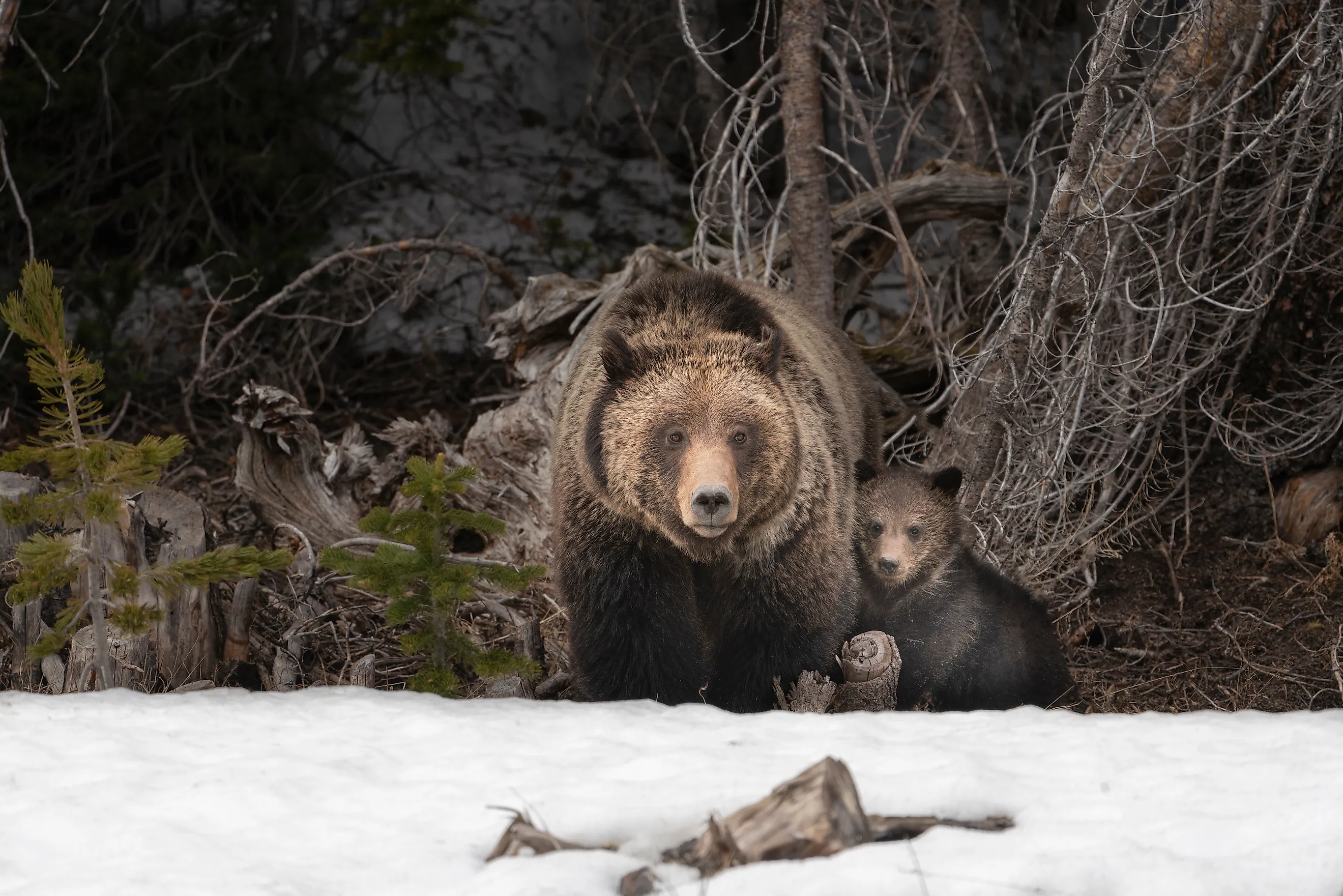
Grizzlies Are Being Brought Back To The North Cascades
The North Cascades National Park plans to restore the grizzly bear population within its borders. In 2024, they announced the restoration plan was created due to the grizzly bear's historic presence and their importance to the ecosystem, both through hunting down prey and spreading seeds across the land. Although grizzly bears have called these mountains home, human hunting eliminated the population entirely.
A history laid bare: how the North Cascades lost its grizzlies

Grizzly bears' historical range is much larger than their current distribution today. They used to be found from Alaska through the entirety of the Western U.S., including the Great Plains and the North Cascades Mountains.
Native Americans were familiar with grizzly bears and were often associated in legends with wise teachers, leaders, and healers. Some even believed grizzly bears could heal their own wounds. Healers in Native American cultures were often heavily associated with bears.
One of the first documented European encounters with grizzly bears was by Lewis and Clark, who noted that these bears were far larger than black bears and more difficult to kill. Muzzle-loading guns were often ineffective at killing them, unless shot in the head or heart.
In 1815, George Ord classified the bear as a Grizzly Bear due to its "grizzled character." Furthermore, he gave it the Latin name Ursus horribilis, which translated to terrifying bear.
As settlers moved west, they would kill grizzly bears when encountering them or deliberately hunting them. They were killed out of fear and for their furs. Over a period of 70 years, grizzly bears were killed off from 95% of their original range in the U.S. Without any regulations, legal killings of grizzly bears continued until the 1970s. This included more isolated mountain regions such as the North Cascades.
In 1967, Rocky Wilson shot a grizzly bear at Fisher Creek, which is now part of the North Cascades National Park. It was the last documented legal killing of a grizzly bear.
This was just part of a longer trend of grizzly bear hunting in the region. Between 1827 and 1859 alone, The Hudson's Bay Company trading posts shipped approximately 3,788 grizzly bear hides.
In 1975, with fewer than 1,000 grizzly bears left in the lower 48 states, they were listed under the Endangered Species act.
Bringing grizzly back

The North Cascades National Park was established in 1968 by President Lyndon B. Johnson, a year following the last legal killing of a grizzly bear. Hunting for bears here was illegal, even before the passage of the Endangered Species Act.
Unfortunately, the damage was already done, and grizzly bear populations were very low, with estimates from 1991 of only 10 to 20 bears. The last confirmed sighting of a grizzly bear in the North Cascades was in 1996.
In 2022, the National Park Service and the U.S. Fish & Wildlife Service began to evaluate options for restoring grizzly bear populations in the park, with the wider goal of eventually removing bears from the Endangered Species Act list. By raising their population, park authorities, ranchers, and landowners would have more options for managing bears to reduce or avoid conflicts while focusing on recovery, which is highlighted by a news release by a North Cascades National Park.
After two years of commentary and revisions, the National Park Service and the U.S. Fish & Wildlife Service announced the plan to restore the population. The plan noted it would bring in three to seven grizzly bears annually until it reached 25 bears, with a longer-term goal to grow 200 bears by the end of the century. These bears could spread out over about 9,800 square miles of the North Cascades Ecosystem, and these bears would be classified as a nonessential experimental population as covered by section 10(j) of the Endangered Species Act. This provision allows wildlife authorities to reintroduce populations to areas that are no longer part of that species' range. It also gives them the authority to help protect private property and landowners.
The plan in hibernation

As of October 2026, no new grizzly bears have been introduced to the park. Despite being announced in 2024, there was no set timeline for reintroducing the grizzly bears and there has been a federal stall under the Trump Administration. In a 2026 appropriations bill, Republican Congressman Dan Newhouse introduced a measure to block any spending on reintroduction. While on the Canadian side of the North Cascades, B.C. First Nations have been hoping to begin reintroducing grizzlies.
The plan has had large-scale support among voters in the state of Washington in the past, with 91% of Democrats and 85% of Republicans noting they supported restoring the population of grizzly bears, based on a poll from 2023.
Part of the reason for this is that this program requires funding and advanced planning, both of which take political capital. Mitch Friedman, executive director of Conservation Northwest, claims that there is no one with the willpower to "stick their necks out for bears" at this time.
Grizzly encounters

The North Cascades National Park is one of the least visited national parks in the U.S., only seeing 47,000 visitors in 2025. Even with so few visitors, grizzly bear encounters could occur under the proposed plan by the NPS.
Grizzly bear attacks do occur in national parks, including a hiker who was injured by a bear in Yellowstone National Park in September 2025 and another in May 4, 2026, where two hikers were attacked by a mother grizzly bear with cubs.
The NPS recommends several safety precautions to help avoid incidents. For one, if attacked, the NPS recommends playing dead with hands clasped behind your neck and legs spread apart. One of the best ways to handle grizzly bears is to carry an EPA-approved bear pepper spray, which can be used defensively against an aggressive grizzly bear.
The bear facts: How grizzlies help the ecosystem
In short, grizzly bears would immensely benefit the environment. They are omnivores, so they eat a wide range of plants and animals, while also dispersing seeds and berries that they eat and then defecate on the ground.
Also, they dig into the soil with their claws, which creates seed beds. In these beds, wildflowers and grasses alike can grow more easily. However, in order to bring this restoration plan to fruition, the NPS will need funding and a timeline for when this reintroduction of grizzly bears will take place in the North Cascades National Park.