11 Top Places To Visit In Wisconsin In The Fall
Wisconsin's fall color does not arrive all at once. It rolls north to south over about three weeks, from the Lake Superior shore in the last days of September to the Milwaukee suburbs around October 20. That staggered timing is the secret: if you chase it, you can catch peak color somewhere in the state for most of a month. Here are eleven of the best places to be when the maples, aspens, and oaks turn, and the week in 2026 to aim for at each one. Time it right and you will not just see the season, you will land in the thick of it.
Chequamegon-Nicolet National Forest

Start up north, where the color starts. This 1.5-million-acre forest across northern Wisconsin is usually the first part of the state to turn, with leaves beginning to change in the last week of September and peaking in the first week of October. Peak week in 2026 lands around the end of September into early October, earlier than almost anywhere else in the state.
With more than 800 miles of trails, you have room to roam: hike a stretch of the Ice Age Trail, chase the cascade at Morgan Falls, or paddle a quiet lake at the Anvil Lake or Black Lake recreation areas. Rent a cabin on Lost Lake near Eagle River to wake up inside the color, and keep an eye out for white-tailed deer, foxes, and beavers along the way.
Apostle Islands National Lakeshore

Out on Lake Superior, the Apostle Islands span 21 islands and a 12-mile strip of mainland, roughly 41,000 acres of maritime hardwood forest that lights up over the big lake. Color here peaks in early-to-mid October, and the move is to catch it before the autumn gales pick up: book a morning boat tour or a kayak trip out to the sea caves while the water is calm.
Base yourself in Bayfield, the gateway town, and hike Big Bay State Park on Madeline Island or the mainland Lakeshore Trail. Time your trip for the first weekend of October and you also hit the Bayfield Apple Festival, a harvest celebration with orchards, wineries, and local restaurants in full swing.
Rib Mountain State Park

One of the oldest geological formations on Earth at over a billion years old, Rib Mountain rises above Wausau in the north-central part of the state, which puts its peak color in early October. The payoff for the climb is a 60-foot observation tower with a sweeping view over the Wausau area and the Wisconsin River valley, an ocean of color from above.
Beyond the overlook, the park packs in miles of trails, a former quarry, an amphitheater, and Granite Peak Ski Area on the north face. The park also runs seasonal naturalist programs, from "why do leaves change color" talks to guided ecology and raptor hikes that make the timing make sense.
Devil's Lake State Park

Wisconsin's most popular state park wraps a 360-acre lake in 500-foot quartzite bluffs, and from the top the fall view is hard to beat. Sitting in Sauk County near Baraboo, Devil's Lake peaks in early-to-mid October, roughly the Oct 4-12 window in 2026. Go on a weekday if you can, because its three-million-plus annual visitors pack the trails on peak October weekends.
The park's 29 miles of trails range from the lakeshore-level Tumbled Rocks Trail to the steep bluff climbs that earn the best overlooks. Between the hiking, the kayaking, and the sandy beaches, it is an easy full day, and it pairs naturally with a drive through the surrounding Baraboo Hills.
Wisconsin Dells

Best known for its waterparks, Wisconsin Dells has a quieter fall identity worth the trip: the sandstone gorges along the Wisconsin River that gave the town its name. Central Wisconsin color peaks in early-to-mid October, and the best way to see it is from the water, on an Upper Dells boat tour that threads between fern-draped rock walls and golden canopy.
Off the river, nearby Mirror Lake and Rocky Arbor State Parks trade the crowds for quiet trails through turning hardwoods. Come midweek in mid-October and you get the gorges, the color, and the river tours without the summer throngs.
University of Wisconsin-Madison Arboretum

In the south, color comes later, which makes the UW-Madison Arboretum a mid-to-late October stop. A world leader in ecological restoration, its 1,200 acres stitch together wetlands, restored prairie, oak savanna, and woodland, so the fall palette shifts from scarlet maples to the russet and gold of tallgrass and oak.
Wander the walking trails with a trail map and you can identify hundreds of plant species, or focus on the two showpiece collections: the Longenecker Horticultural Gardens and the Wisconsin Native Plant Garden. Admission is free, and the late-season timing means you can still catch color here after the north has gone bare.
Holy Hill, National Shrine of Mary

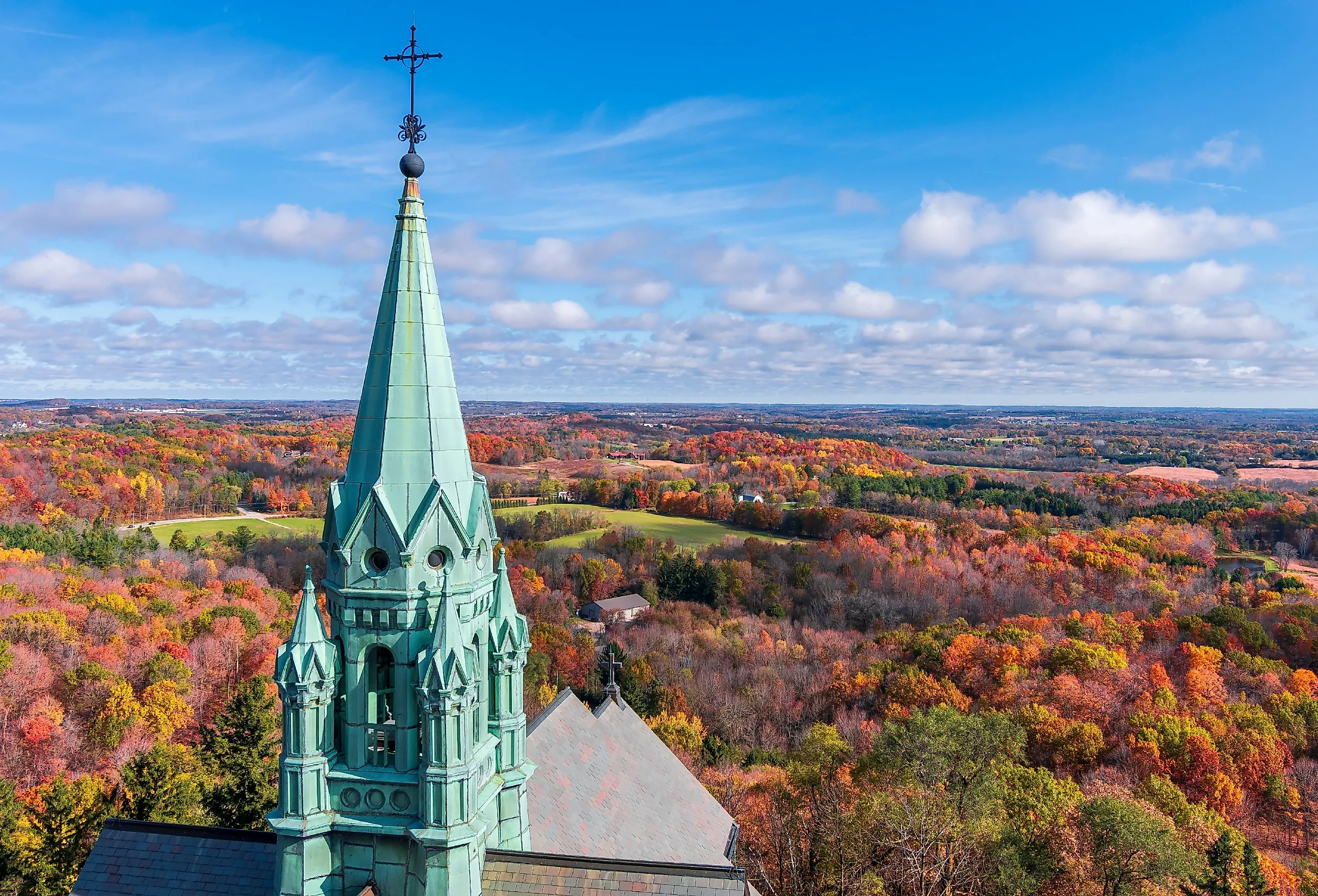
For the single most photographed fall view in southern Wisconsin, climb the scenic-overlook tower at Holy Hill. The twin-spired Basilica of the National Shrine of Mary, Help of Christians, sits atop a 1,345-foot drumlin in Washington County, surrounded by 435 acres of hardwoods that peak in mid-October (the county runs roughly Oct 4-12 in 2026). From the tower, the forest rolls out below the Gothic Revival church in every shade of red and gold.
The shrine dates to the late 19th century, and its current basilica was dedicated in 2006. It remains an active Roman Catholic pilgrimage site, so visit respectfully, then pair the trip with apple picking at the on-site orchard, which is in full swing at peak-color time.
Lapham Peak Unit, Kettle Moraine State Forest

At the highest point in Waukesha County, the Lapham Peak unit of the Kettle Moraine State Forest is a mid-to-late October favorite for a reason: a 45-foot wooden observation tower that puts you right at canopy level as the glacial hills turn. On a clear day, the view stretches for miles across the kettles and moraines left by the last ice age.
Miles of loop trails, including a stretch of the Ice Age Trail and the Prairie Path, make it an easy place to spend an afternoon hiking or, later in the season, cross-country skiing. Stop by the Hausmann Nature Center to learn how the glaciers shaped the terrain you are walking through.
Havenwoods State Forest

Wisconsin's only urban state forest sits on the north side of Milwaukee, which means it peaks last of all, in the third week of October or even later. Its 237 acres of wetland, grassland, ponds, and woods make a quick, car-free fall escape for anyone in the city, and the late timing is a feature: when the rest of the state has gone brown, Havenwoods is often still turning.
The land has had many past lives, as an army base and a county house of corrections, before becoming an environmental education center, and the nature center lays out that history in old photos. Walk or bike the Trek Through Time Trail, watch for migrating birds, and take in the color without leaving the county.
Door County

No Wisconsin fall list is complete without Door County, the peninsula between Green Bay and Lake Michigan that turns its 66-mile shoreline into a blaze of red and gold. The lake microclimate runs it about a week behind the rest of the state, so peak lands in mid-to-late October, with the third week of October the sweet spot in a typical year.
The single best vantage is Eagle Tower in Peninsula State Park, a 60-foot tower on Eagle Bluff with the canopy, Eagle Harbor, and the Green Bay shoreline laid out below (a ramped walkway makes the top accessible to all). Drive Highway 42 up the peninsula and loop back on the quieter Highway 57, stopping at harbor towns like Fish Creek and Ephraim, the orchard and cider stands, and Cana Island Lighthouse along the way. Parking lots at the marquee overlooks fill by mid-morning on peak weekends, so start early.
Geneva Lake Shore Path

End in the far south, where the season wraps up in mid-to-late October. The 21-mile Geneva Lake Shore Path traces the entire lakeshore past Gilded Age estates like Stone Manor and Villa Hortensia, their landscaped grounds framed by turning trees and the blue water dotted with sailboats. You can walk as much or as little of it as you like, since public access runs the whole way around.
The town of Lake Geneva rounds out the trip with wineries, breweries, and orchards across Fontana, Williams Bay, and downtown. As one of the last places in the state to peak, it is the natural final stop on a color-chasing tour that started up on Lake Superior weeks earlier.
Chasing The Color, North To South
The beauty of a Wisconsin fall is that it hands you weeks, not a single weekend. Start in the Chequamegon-Nicolet woods and the Apostle Islands in late September, work through Devil's Lake, the Dells, and Door County in the first half of October, and finish in Madison, Holy Hill, and Geneva Lake as the month winds down. Check the Travel Wisconsin fall color report before you go, pick the region at peak, and let the season roll south with you.