The State Parks Where You Can Dig For Gems
There is nothing more fun than hounding for shiny rocks! It's one of the favorite pastimes in human history and blends the ancient quest for hidden wealth with the sheer joy of finding a natural gemstone on a hike. It's all about the thrill of discovery, and every once in a while you might actually hit the jackpot! The frontier is gone and the gold rushes have passed, yet untouched ground in our state parks still yields treasures you are free to take home. Just beware "salted gem mining," the tourist-trap buckets of imported dirt full of rocks that were never native to the park you are visiting. These 6 state parks steer you clear of the pretenders and toward legitimate ground where you can still dig for real gems today.
Crater of Diamonds State Park

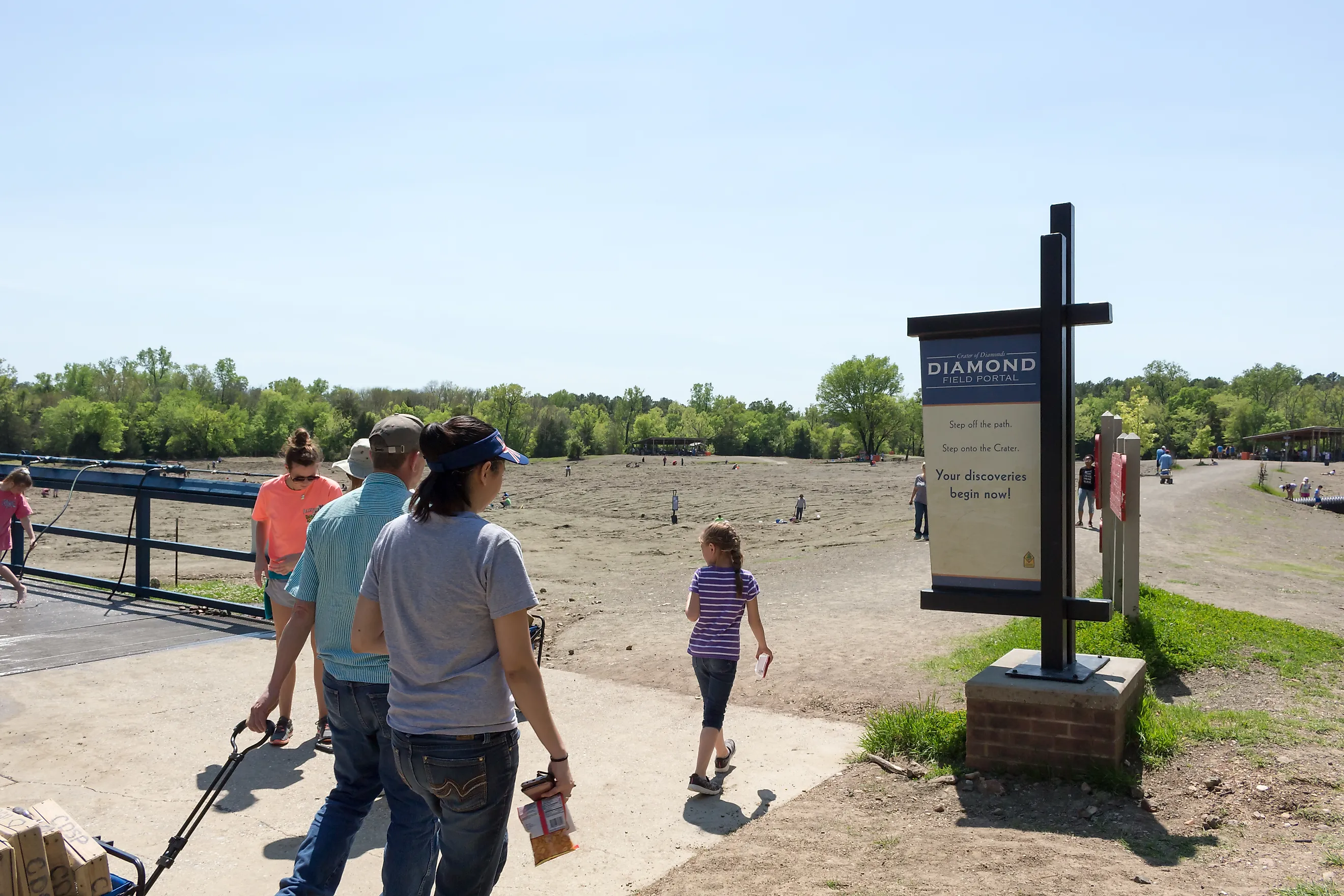
The ultimate mecca for public access gem hunting in the United States is in Murfreesboro, Arkansas at the Crater of Diamonds State Park. Reasons for this are both historical and geographical. This is important to grasp because the impact of legend on gem hunting is a major factor that creates more incentive. Knowing that a piece of ground has a certain type of sediment friendly to this or that type of precious gem is secondary to knowing that someone actually found a massive piece of this type of stone "once upon a time..." So there is a certain allure to the specific 37.5 acre diamond volcanic crater field in Murfreesboro, because this is the site where the Uncle Sam Diamond, originally 40.23 carats and the largest diamond ever found in the US, was discovered in 1924 by Wesley Oley Basham. Boom! The raw diamond would eventually be refined into a magnificent 12.4 carat multi-faceted gemstone, currently housed in the Smithsonian Institution.

Diamonds had been found on the site since 1906, when the area was first dubbed "Crater of Diamonds." More than 75,000 diamonds have been discovered across the 911 acre park in the years since. This is the only place in the world, apart from potential excavations on private property, where you can hunt, find, and keep raw diamonds from an original volcanic crater source. Diamond color varies from white to brown to yellow. It is also possible to find amethyst, jasper, garnet, agate, and quartz.
Sue-Meg State Park

Among seashells on the seashore, explorers can find colorful gems, adding another layer of potential excitement at Agate Beach, within the Sue-Meg State Park in Trinidad, California. Here the ocean tide serves as a gigantic tumbler for an array of multi-colored agates, translucent semi-precious gems that were originally formed as volcanic crystals cooled millions of years ago.

This 2 mile long stretch within the larger 640 acre park is located among the Redwood forest filled cliffside coasts of northern California, 30 miles north of Eureka, in a hidden curve of beachfront that can be reached through park hiking trails connecting to the Agate Beach Campground. Generally, the state parks system in California prevents mineral takeaway by the public in most of its other parks as official advice. But here the tradition is more open and visitors are encouraged to take away what they can find without being too greedy or bringing in some heavy equipment to drill or disrupt the terrain beyond casual gathering, digging, and sifting. Since the mid-1800s, the area was generally known as Patrick's Point, named after Irish homesteader Patrick Beegan, who reportedly was responsible for the deaths of several Native Americans of the Yurok tribe, who originally called the area "Sue-meg." In 2021, an initiative passed, at the instigation of surviving members of the Yurok Tribe, altering the name from Patrick's Point State Park, the name given in 1930, to Sue-Meg State Park, to honor the original inhabitants.
Rockhound State Park

Rockhound State Park in Deming, New Mexico stands out as the first state park in the United States to allow visitors to actively dig for gems and keep them, a tradition that the state of New Mexico has honored for 60 years since the park's founding in 1966. Situated on 1,100 acres in the Little Florida Mountains, 2 hours south of the Route 66 Corridor, this apparently barren desert terrain contains highly prized geodes and thundereggs that continue to surface through natural erosion, rainfall, and some digging around by determined collectors. Geodes are hollow or air-pocketed spheres in shape with crystalline centers, whereas thundereggs are more solidly spherical or oval crystal conglomerates, anywhere from a 1/4 inch to a foot wide. Each person can take away up to 15 lbs. of rock findings per day, although dealers are prohibited from directly selling any gems obtained from the park.

Other semi-precious gemstones found in this volcanic terrain include gray perlite, jasper, onyx, quartz, rhyolite, and obsidian, also called "Apache Tears." From 1880 to 1956, miners extracted copper, lead, and silver in considerable quantities. Today recreational use dominates and the campground of 29 sites is usually full every single night through the busy season of the cooler months of October through April. If you can wait till the poppies bloom, that's the sign when the snowbirds return home, ensuring a less crowded park before the Summer heat comes on. Thunder Egg Trail is the most popular hike to look for the gems.
Great Salt Plains State Park

Great Salt Plains State Park in Jet, Oklahoma is the only area in the entire world where the rare gem, Hourglass Selenite, a form of Gypsum, can be collected by crystal enthusiasts between April and October 15th each year. Though the park is just over 800 acres, the Great Salt Plains encompasses a larger region of 11,000 acres and is thus called because of an ancient inland salt sea, most of which has dried up, except for the Salt Fork River, a tributary of the Arkansas River. The Salt Plains Lake, a dammed up portion of the Salt Fork River, still offers recreational opportunities where there is swimming, fishing and boating, along with hunting for the coveted hourglass crystals. Though the selenite abounds in its raw form throughout the park, the hourglass crystal digging area is to the southwest of the lake and is open daily from sunrise to sunset. Digging techniques are simple and only require lightly pressing and shoveling with a small spade in order to reveal the distinctive gems sought. The park also contains 300 species of protected birds and borders the much larger adjacent Great Salt Plains National Wildlife Refuge. Hourglass Selenite is formed from the combination of gypsum with saline water. The reddish color present in many of the crystals is derived from iron also present in the soil. There is no fee to pay to gather crystals, but there is a limit of 10 lbs per day.
Fairy Stone State Park

A Fairy Stone is a type of Staurolite crystal that forms the shape of various styles of crosses with different degrees of intersection such as 90 degrees or more commonly, 60 degrees with 6 sides. "Stauros" is the word for "cross" in Greek. It is a porphyroblast, a type of crystal that forms within another rock. They are formed from ancient geothermal, tectonic processes originally 7 miles below the surface, at the base of the Blue Ridge Mountains in this part of Stuart, Virginia. Fairy Stones are not translucent like many semi-precious gems but are rare finds and are sought after by crystal enthusiasts looking for a fun objective during a day quest. Fairy Stone State Park in Stuart, Virginia is one of few known locations in the world, next to Georgia, New Mexico, Switzerland, Madagascar and Brazil, where such anomalies can be found. There is no fee for gathering the stones but you can only use your hands to clear the dirt. Shoveling is discouraged. Other key features of the park include the 168 acre Fairy Stone Lake, cabins for rental, and 15 miles of hiking trails. The Blue Ridge Parkway lies 60 miles to the West.
Petoskey State Park

The prized Petoskey Stone can be found along the shores of the Little Traverse Bay portion of Lake Michigan in Petoskey State Park. This gem anomaly is a honeycombed patterned, fossilized form of coral from 350 million years ago, that proliferates in this park beach area just 3 miles northeast of Petoskey, Michigan but also in other parts of Northern Michigan, too, especially around the lake.

The Petoskey Stone has been the state rock of Michigan since 1965. Takeaway limits at the state park are currently at 25 lbs per year per person. Rockhounds can also discover Charlevoix Stones here, another type of fossilized coral with different patterning. Though you might be lucky enough to discover these coveted rocks naturally tumbled by Lake Michigan, try hand sanding them to bring out a beautiful polish for an exquisite paperweight to show off. And even if you don't find the more rare pink ones, you can still add some brown or gray ones to your collection, which are easier to find. Visitors to the park wander along the mile long beach shore, simply turning over rocks or wading into the water and picking up what they can find with their bare hands, any time between 8 am and 10 pm daily.
A Pocketful of Gems
That wraps up our dive into state parks where you can dig for gemstones in the United States. Spots covered represent a fair cross section of the best known specifically curated rockhound haunts at the state sponsored level. The United States has a vast area of natural geological treasures, especially in the form of quartz crystals, which turn up across much of the country. For example, Arkansas, in addition to diamonds, produces more quartz crystals than anywhere else on Earth. Many other parks that do not contain digging areas or regulated formats for retrieving gems may still be viable locations for light rockhounding. Check with park rangers for area specific rules about taking rocks home and talk to the locals for tips on where the big crystals still hide in the North American landscape waiting to be found.