The State Park With The Tallest Sand Dunes
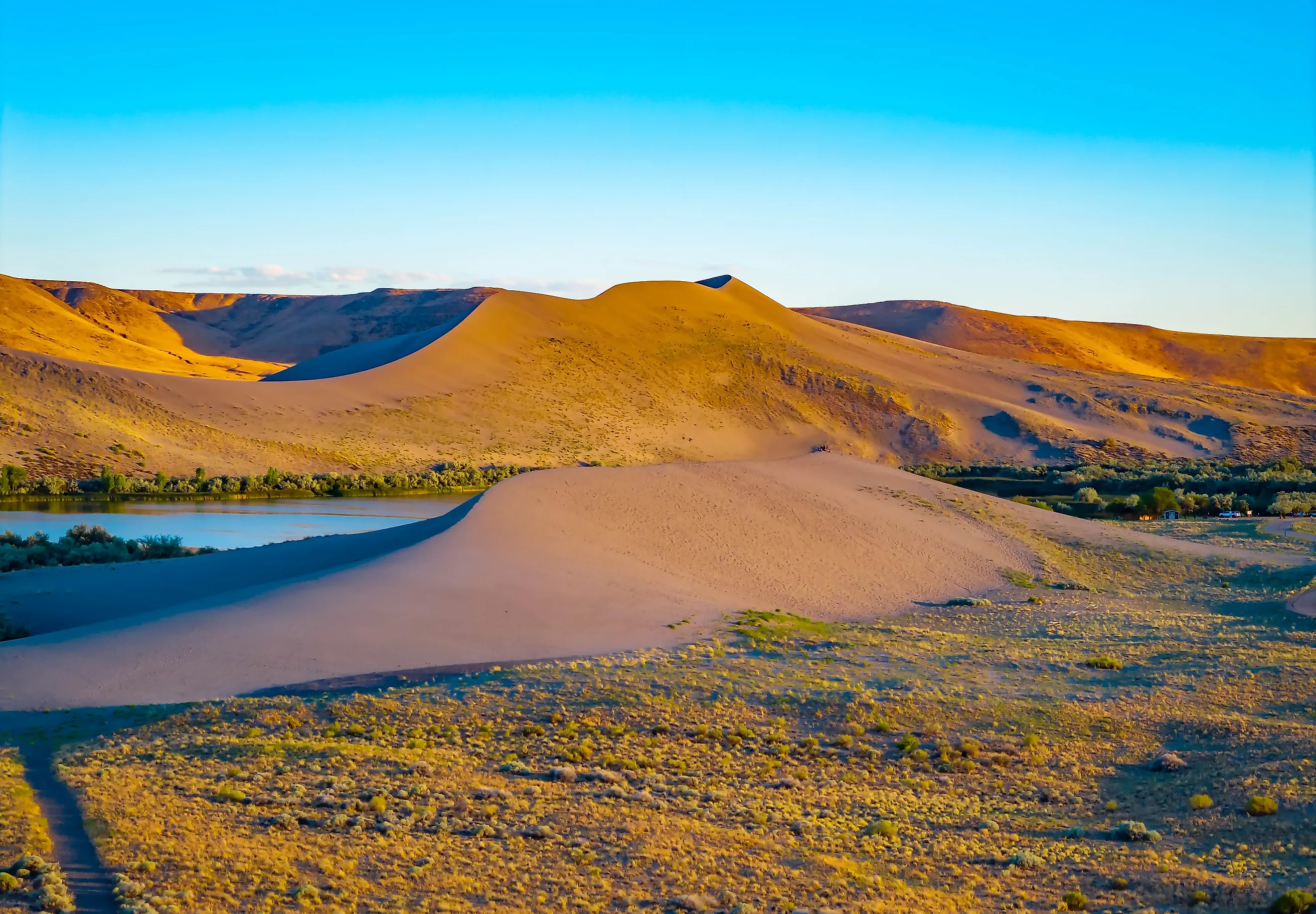
Bruneau Dunes State Park in southwest Idaho has the tallest sand dunes of any state park in America. Its largest dune rises 470 feet from base to crest. Taller dunes do exist, such as the 741-foot pair in Colorado's Great Sand Dunes National Park and Preserve, but they're all on federal land, not in a state park.
Idaho's Bruneau Dunes aren't just cool to look at. Visitors will also find sandboard rentals, two fishing lakes, and even a public observatory, all just 18 miles south of the town of Mountain Home. Here's what you need to know about the tallest sand dune in a state park.
How To Measure A Sand Dune

The measurement used here is vertical height from the base of a dune to its crest, as published by the agency that manages the land. The Idaho Department of Parks and Recreation describes the main dune at Bruneau Dunes State Park as the tallest single-structured sand dune in North America, with a peak that's 470 feet above the surrounding desert floor.
The dunes owe their position to Eagle Cove, a horseshoe-shaped basin 3.5 miles across that was cut by an old meander of the Snake River. During the Bonneville Flood, when Ice Age Lake Bonneville in Utah spilled north into the Snake River drainage, slow backwaters pooled in the cove and left layered beds of clay, silt, and sand. Sources disagree on the date this happened, with various estimates placing the flood at either 14,500 or 18,000 years ago.
Prevailing winds took care of the rest. Here, winds blow equally strongly from the southeast and northwest. With the winds pushing from opposite directions, the sand piles up instead of spreading across the desert the way most dunes do. The dunes are unique in the Western Hemisphere because they formed near the center of a natural basin, not along its edge, with a central bowl-like crater in the dune complex.
The two largest dunes cover 600 of the park's 4,800 acres and remain stable due to the lake at their base, the vegetation on and near the sand, and silt in the lower slopes that retains moisture.
Climbing And Sandboarding The Big Dune
Since it opened to visitors in 1970, the park has become a major state attraction. Sure, reaching the top of the main dune takes legwork, with the park's self-guided loop starting at the Visitor Center requiring a six-mile hike that crosses the crest of the westernmost dune at 470 feet. Set aside three to six hours for the full circuit. Motorized vehicles aren't allowed on the sand, and off-road vehicles are restricted to the main park road, so the only way up is on foot.
Getting down, though, is a whole other ballgame, and a lot more fun. Sandboarding is the quickest way down, and the Visitor Center provides daily sandboard rentals in stand-up and sled-style configurations for visitors to glide down the sand dunes.
How many times you can make the journey up and down depends not just on your physical fitness, but on temperatures, too. Summer heat is intense, and the park recommends hiking in the morning or evening while carrying one to two quarts of water or more but watch out for rattlesnakes, as they're known to inhabit the park.
Park Life

Getting into Bruneau Dunes State Park is the easy part of the puzzle. As of 2026, the park charges a $7 Motor Vehicle Entrance Fee, payable by cash or check if the entrance kiosk and Visitor Center aren't staffed. Day-use areas, including the dunes, are open from 7 a.m. to 10 p.m. with pets only allowed on a 6-foot leash, and drones may fly but only in the designated area.
The two lakes at the foot of the dunes are a big reason people come. Officially listed as Dunes Lake (99.3 acres) and Bruneau Dunes Pond North (35.3 acres), both lakes permit fishing for bluegill and largemouth bass. Boats are limited to electric motors, and the bass limit is two fish, none under 20 inches. The park also loans fishing rods.
The lakes are relatively new and appeared on their own after C.J. Strike Dam, a hydroelectric dam on the Snake River downstream of the park, filled in 1952 and the local water table rose. Together with the surrounding marsh, they give the park five habitats in one basin: desert, dune, prairie, lake, and marsh.
Riding And Camping
Horse riders can enjoy the park, too. Two horse trails are available, one at seven miles and the other at nine miles. The park's Equestrian Campground has corrals, water spigots, a picnic shelter, and 19 first-come, first-served campsites.
Everyone else can head to the Broken Wheel and Eagle Cove campgrounds. Between them, they offer many serviced sites with hookups, standard sites, and two camper cabins that sleep five on a bunk bed and futon. The cabins also feature air conditioning, heat, and a porch swing facing the dunes (guests bring their own bedding). Reservations are required in season.
Dark Skies
Bruneau Dunes is also well known for its night skies. The first observatory opened in 1998 with a 25-inch reflecting telescope. A second observatory was built in 2023 with a dome that doubles as a planetarium.
Designated Idaho's third International Dark Sky Park in 2024, Bruneau Dunes offers a variety of public night sky programs on Friday and Saturday nights from March through October. Admission covers the planetarium, tours of both observatories, a 25-minute astronomy presentation, and telescope viewing. Park staff also lead guided night walks to find scorpions, which glow under a black light.
Other State Parks With Dunes
The gap between Bruneau and the runner-up is a wide one. Warren Dunes State Park on the shore of Lake Michigan has a dune formation rising 260 feet above the lake. Across the Michigan state line in Indiana, the dunes at Indiana Dunes State Park tower nearly 200 feet above Lake Michigan.
Over on the Atlantic side of the country, North Carolina's Jockey's Ridge State Park is home to the tallest living sand dune system on the East Coast at 80 to 100 feet high, depending on weather conditions. In West Texas, some dunes at Monahans Sandhills State Park rise 70 feet.
Idaho's Tallest Dunes
At 470 feet, Bruneau Dunes State Park's main dune is 271 feet shorter than the tallest in Colorado's Great Sand Dunes National Park and Preserve. But that doesn't detract in the slightest from its importance or its beauty. It's the tallest of any state park in the country by a margin of 210 feet and is one of Idaho's leading natural wonders. Whether you go for the hiking, the sandboarding, the fishing, the camping, or to observe the night sky, it's a trip worth making.