8 Snake Infested State Parks In The Southern United States
State Parks across the Southern United States protect some of the habitats where snakes are most likely to thrive, from swamps and marshes to dense forests and lake edges. In places like Chicot State Park, those conditions also support the fish, amphibians, and small mammals that make these landscapes especially active for both venomous and nonvenomous species. This list highlights eight Southern state parks where snake activity is a visible part of the habitat.
Gulf State Park, Alabama

Gulf State Park spreads 6,150 acres across the shoreline of the Gulf of Mexico in Alabama. With 2.5 miles of white sand beaches, 29 miles of multi-use trails, a lodge, and 496 modern campsites, the park offers a wide range of outdoor activities. The park also has a large diversity of reptiles, including nonvenomous and venomous snakes.

Venomous snakes include the Cottonmouth (Agkistrodon piscivorus) and the Pygmy Rattlesnake (Sistrurus miliarius). Pygmy Rattlesnakes are shy creatures who usually remain still and hidden in dense thickets and shrubbery to avoid detection. Cottonmouths, on the other hand, have been observed crossing roads and sitting coiled in the middle of trails, including in campground areas.
Nonvenomous species in the park include: Banded Water Snake (Nerodia fasciata), Black Racer Snake (Coluber constrictor priapus), Mud Snake (Farancia abacura), Southeastern Crowned Snake (Tantilla coronata), and Ribbonsnake (Thamnophis sauritus).
Hillsborough River State Park, Florida

Hillsborough River State Park is one of Florida's earliest state parks, opening in 1938. The fast-flowing Hillsborough River runs through the park, supporting activities like canoeing, kayaking, and fishing.

The most commonly encountered snakes in the park are the Southern Black Racer (Coluber constrictor) and the Yellow Rat Snake (Pantherophis alleghaniensis). Both of these snakes are nonvenomous and harmless to humans. If approached, both of these snakes will likely flee. Southern Black Racers will especially rely on their speed and agility. Both of these snakes, however, may bite if captured or attacked.
Other snakes, less commonly seen but still observed in the park, are the Southern Ringneck Snake (Diadophis punctatus), Peninsula Ribbonsnake (Thamnophis saurita sackenii), and the Eastern Garter Snake (Thamnophis sirtalis).
Brazos Bend State Park, Texas

Covering roughly 5,000 acres, Brazos Bend State Park offers abundant opportunities for outdoor recreation and wildlife observation. Its rich ecosystems support all kinds of wildlife, from more than 300 species of birds to the American Alligator (Alligator mississippiensis).
The park is also notable for its snake diversity, home to numerous nonvenomous species as well as all four groups of venomous snakes found in Texas: Copperheads, Cottonmouths, Rattlesnakes, and Coral Snakes.

Among its inhabitants are the Timber Rattlesnake (Crotalus horridus), the third-largest venomous snake in the United States, and second-largest in Texas; the Common Kingsnake (Lampropeltis getula), a nonvenomous species known for its resistance to rattlesnake venom and its tendency to prey on them; and the Texas Coral Snake (Micrurus tener), the most venomous snake in North America.
Chicot State Park, Louisiana

Chicot State Park covers 6,400 acres in south central Louisiana, which includes 2,000 acres of Lake Chicot. Lake Chicot is encircled by an extensive hiking trail, which is dotted with primitive campsites. The park leads hikers through bottomland hardwood forest and provides access to the lake itself. This environment is favored by Timber Rattlesnakes, who have a preference for bottomland hardwood forests, swamp edges, and riparian areas.

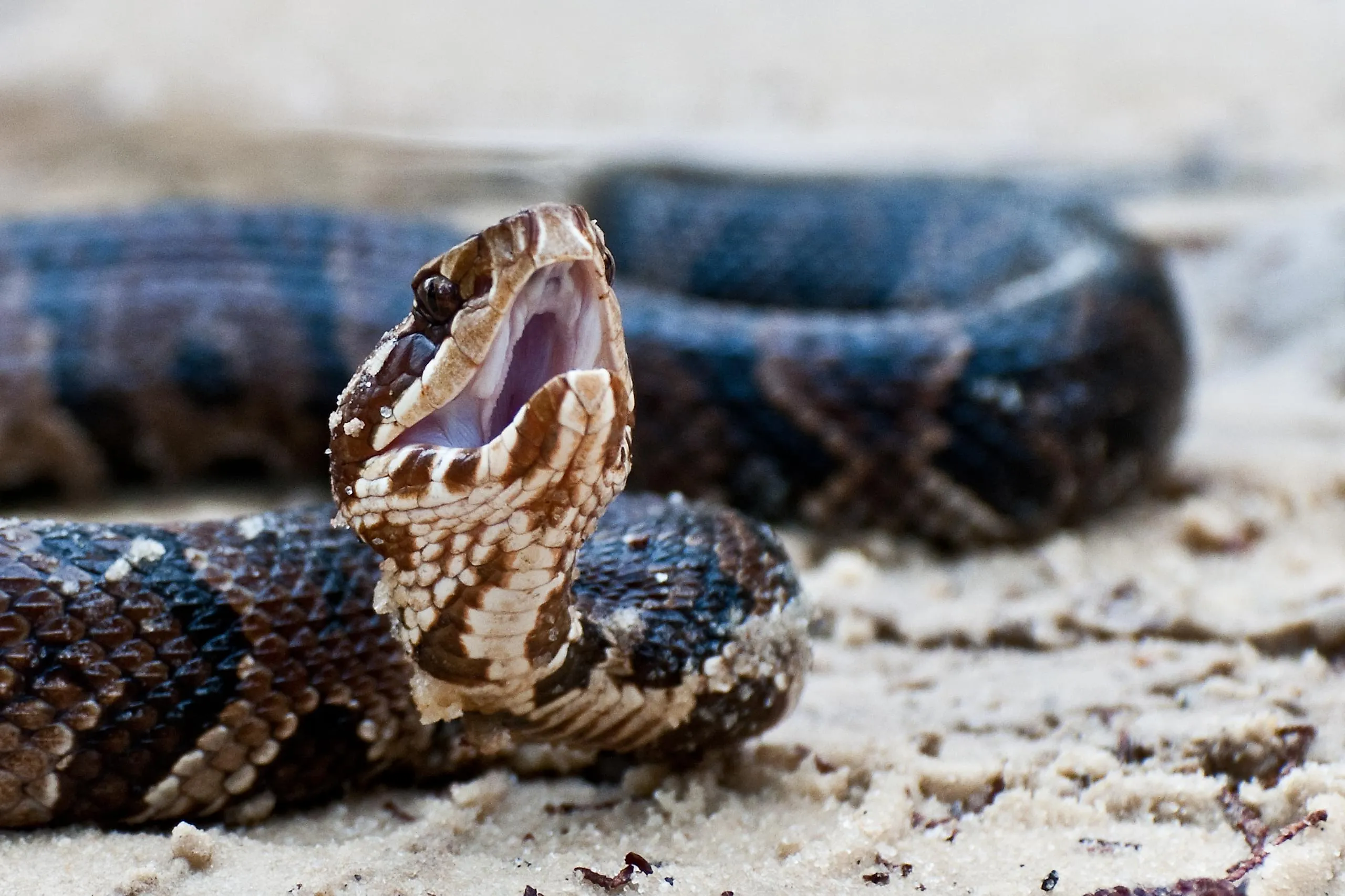
Aquatic snakes have also found a home within Chicot State Park. The nonvenomous Broad-banded Watersnake (Nerodia fasciata confluens) and the venomous Cottonmouth live in all types of aquatic habitats, feeding on aquatic prey like fish and amphibians. Both of these snakes are often confused for one another, resulting in Water Snakes being killed by humans. They do, however, have differences. Water Snakes usually reside on the edges of bodies of water, which they will flee into if startled or threatened. They also lack heat-sensing pits on their faces, which are present in Cottonmouths. Additionally, when Cottonmouths are approached, they may stand their ground with their mouths gaped open, exposing the white lining inside, which is how they got their name.
First Landing State Park, Virginia

First Landing State Park is Virginia’s most visited State Park due to its historical significance. The park marks the site where English colonists first landed in 1607. Since then, the park’s waterways have been navigated by Native American canoes, Colonial settlers, 20th-century schooners, and modern cargo ships. The park has 20 miles of trails and 1.5 miles of sandy beach on the Chesapeake Bay.

Snakes are some of the park’s permanent inhabitants, with the Red Bellied Water Snake (Nerodia erythrogaster erythrogaster) as the most prevalent. Red Bellied Water Snakes are frequent in almost all aquatic habitats such as swamps, ditches, freshwater marshes, and streams. They are commonly seen resting on logs and vegetation, often entering the water if disturbed. Other common species of snakes seen along trails are Rat Snakes, Black Racers, King Snakes, and Milk Snakes. While significantly less common, Copperheads and Cottonmouths are still seen on occasion.
Reelfoot Lake State Park, Tennessee

Reelfoot Lake State Park is tucked into the northwest corner of Tennessee. Reelfoot Lake is the jewel of the park, taking up 15,000 acres. It was created by a series of earthquakes between 1811 and 1812, which caused the Mississippi River to flow backwards. Not only did this form the lake, but it also created a flooded forest ecosystem that does not exist anywhere else in Tennessee, an environment that supports a wide range of snakes.

The Cottonmouth is one of the most common snakes in the park, most abundant around Reelfoot Lake itself. Whereas the Northern Water Snake (Nerodia sipedon) is found throughout the park. The Northern Water Snake is the most common Water Snake in Tennessee and is found statewide. Other species of Water Snake found in the park are the Diamond-Backed Water Snake (Nerodia rhombifer) and the plain-bellied water Snake (Nerodia erythrogaster).
Goose Creek State Park, North Carolina

Goose Creek State Park provides visitors with a wide range of coastal experiences in North Carolina. The park features a long boardwalk, allowing visitors to view wetlands along the Pamlico River and cypress swamps. Remnants of the lumber industry remain in the park, such as boat piers, trackless railroad bed, and burnt remains of tar kilns.

Despite the water's slight salinity, aquatic snakes still inhabit the park, including the Banded Water Snake, Red Bellied Water Snake, and the Cottonmouth. These snakes sometimes inhabit brackish waters, although their preference is for freshwater habitats. Muskrats also enjoy the brackish marshes of the park. Cottonmouths will utilize Muskrat burrows to hibernate over winter.
Paynes Prairie Preserve State Park, Florida

Paynes Prairie Preserve State Park is one of the few places in Florida where wild-roaming bison and horses can still be seen. Spanning nearly 23,000 acres, the park has eight trails totaling more than 30 miles and over 20 biological communities. That mix of habitats supports a wide range of wildlife, including several snake species.

Some standout species are the Eastern Diamondback Rattlesnake (Crotalus adamanteus), which is the largest venomous snake in North America, the Dusky Pygmy Rattlesnake (Sistrurus miliarius barbouri), which is the smallest venomous snake in Florida, and the largest native snake in the United States, the Eastern Indigo Snake (Drymarchon couperi). The park is also home to many other common snakes, like multiple species of Water Snakes, King Snakes, and Garter Snakes.
What These Parks Reveal About Southern Wildlife
Snakes are everywhere in the Southern United States, and if you want to enjoy the beach and trails at Gulf State Park, then you may need to accept that there could be a coiled up Cottonmouth on the trail with you. Although snakes may spark fear in some people, their presence signifies a healthy, well-balanced ecosystem. The best way to avoid conflict with snakes is to give them ample space to move on when you encounter them, and avoid sticking your hands and feet into places you can’t see. After all, these State Parks are the snake’s home.