11 Storybook Towns In South Dakota
South Dakota is home to dreamy towns that seem to step right out of a storybook. Some, like Deadwood, sit within pine-lined Black Hills gulches where 19th-century saloons still define the skyline. Others, like Mitchell, rise unexpectedly from flat prairie with Moorish Revival domes decorated entirely in corn. A few, like Pierre, sit quietly on the banks of the Missouri River, their surrounding bluffs lending a timeless stillness. Together, their intact historic character and striking natural settings create a quality that is difficult to find elsewhere in the region.
Mitchell

Mitchell is a captivating prairie town where an unlikely architectural marvel rises from the flat grasslands, giving it a character unlike any other town on the Northern Plains. That marvel is the World's Only Corn Palace, a whimsical building of domes and minarets. Its entire exterior is redecorated every year with murals made from 12 natural colors of corn, grasses, and grain.
The town's quieter magic lives along the shores of Lake Mitchell where the calm water gives Mitchell a serene, timeless quality. The shoreline is home to the Mitchell Indigenous Archaeological Site, which preserves a Native American village over 1,000 years old. Inside the Archaeodome, people can watch year-round excavations from viewing decks above.
Mitchell's storybook character extends into its downtown streets. The Dakota Discovery Museum brings the story of the Great Plains to life through Native American artifacts and exhibits, while the Carnegie Resource Center occupies a beautifully preserved historic building, the former Carnegie Library.
Vermillion

Vermillion is a beautiful academic town on a bluff above the Missouri River valley, its historic buildings and tree-lined streets giving it an almost old-world grace. The University of South Dakota has shaped its character since 1862, and its influence is felt across every corner of town. The National Music Museum on the USD campus is one of the great surprises of the Northern Plains, holding over 15,000 musical instruments from across the globe and throughout history.
Vermillion's downtown adds its own quiet enchantment to the town's appeal. Historic Main Street is lined with well-kept 19th and 20th-century storefronts beneath mature trees, evoking a slower pace of life.
Spirit Mound State Historic Prairie, a few miles north of town, is a Lewis and Clark site in South Dakota. It is one of the rare spots where one can stand and know Lewis and Clark stood in the exact same location. The Lakota and other Indigenous peoples had long considered it sacred, and a trail winds to the summit today, where views across the Missouri River valley stretch far in almost every direction.
Pierre

One of the most quietly magical state capitals in the US, Pierre lies on the eastern bank of the Missouri River, where sweeping bluffs and open sky give it a vast, mythical quality. The town holds a rich share of South Dakota's history, with the state archives and many historic institutions within its borders.
The South Dakota Cultural Heritage Center is built into a hillside in a design that echoes the shape of a Native American earthen lodge. Its collections span prehistoric times through the pioneer era.
The South Dakota State Capitol is a spellbinding landmark. Its prominent copper dome rises above the prairie like something from a fairy tale, and the ornate interior has hand-laid mosaic floors and painted ceilings. The Flaming Fountain Veterans Memorial on the Capitol grounds adds a final touch of wonder, its waters shimmering softly in the evening light.
Brookings

A stunning prairie town in eastern South Dakota, Brookings is shaped by the graceful presence of South Dakota State University and its rich academic and artistic traditions. The campus sets a stately tone, with red-brick buildings, wide lawns, and the tall Coughlin-Alumni Campanile tower rising against the open sky.
The town is rich in art and culture, with a remarkable collection of museums and galleries rooted in Great Plains heritage. The South Dakota Art Museum on the SDSU campus holds Harvey Dunn's vivid prairie paintings alongside a celebrated collection of Oscar Howe's Native American art. Nearby, the South Dakota Agricultural Heritage Museum preserves the story of prairie farming through original 19th-century farm buildings relocated to the campus grounds.
The town's natural and architectural beauty rounds out its enchanting appeal. McCrory Gardens, the public botanic gardens in the upper Midwest, spreads across 70 acres on the edge of campus. The Brookings Commercial Historic District features the 1894 Masonic Temple, built in Romanesque style from red cherry brick.
Deadwood

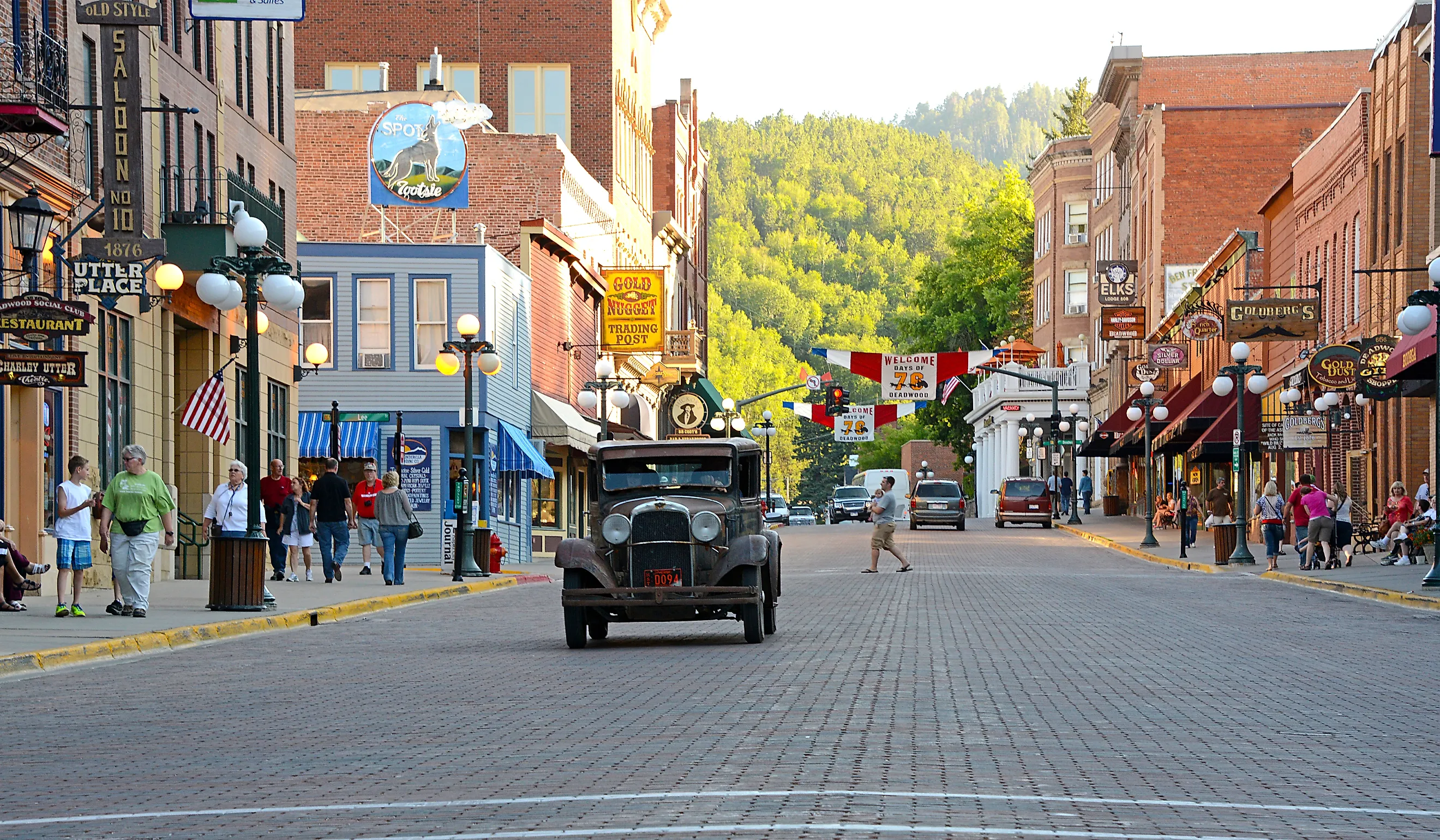
Deadwood is a National Historic Landmark town with the soul of a gold rush frontier settlement in a picturesque natural setting. Its steep pine-lined gulch and well-preserved downtown make it among the best atmospheric towns in the Black Hills. Dense ponderosa pine presses against the town's edge, and in winter, snow settles over the land giving the whole scene a hushed, enchanting quality.
Downtown is a living record of the 1876 gold rush, where 19th-century saloons and frontier relics line streets that feel frozen in time. The Adams Museum, founded in 1930, holds gold rush artifacts that paint a rich picture of the town's wild origins. The Historic Adams House, a meticulously preserved Victorian mansion, adds a touch of elegance to an area already full of character.
Deadwood's past comes to life further through an impressive collection of historic vehicles and frontier craftsmanship. The Days of '76 Museum houses over 50 historic animal-powered vehicles alongside a significant firearms collection.
Spearfish

Spearfish is a mountain town where dramatic natural beauty meets small-town charm. Its position at the northern edge of the Black Hills gives it a striking entrance. Spearfish Creek flows through the heart of town, and the surrounding landscape shifts from open prairie to forested canyon within just a few miles.
That canyon is the town's alluring natural feature. The limestone cliffs of Spearfish Canyon tower above the canyon floor in shades of grey and gold, turning amber and crimson every autumn. The 19-mile Spearfish Canyon Scenic Byway winds through this landscape, passing Bridal Veil Falls, a 60-foot waterfall that spills down the cliff face with quiet, elemental grace.
The town itself has a rich cultural and historical depth that goes well beyond its natural surroundings. The D.C. Booth Historic National Fish Hatchery has operated since 1896, sitting on 10 beautifully kept acres along Spearfish Creek. The High Plains Western Heritage Center tells the story of Old West pioneers and Native Americans of the Northern Plains. Just outside town, the Termesphere Gallery houses dozens of intricately painted spheres rotating slowly inside geodesic domes, creating a mesmerizing optical illusion.
Custer

Custer is one of the oldest towns in the Black Hills, where gold rush history and pristine wilderness meet at every turn. Thick forests of ponderosa pine and pale pink granite outcroppings press in from every direction. Its modest streets are lined with historic buildings that speak quietly to the town's frontier past.
The wilderness surrounding Custer is alive with wildlife waiting just beyond the town's edge. Custer State Park lies close to downtown, and its 18-mile Wildlife Loop Road is a magical drive. Bison herds, elk, antelope, and wild burros roam freely along the route, creating encounters that feel worlds away from ordinary life.
Custer's historic downtown has held onto its 19th-century character with remarkable grace. Original storefronts and buildings reflect the town's gold rush origins. The George Mickelson Trail passes directly through town, giving hikers and cyclists access to a 109-mile corridor through the Black Hills.
Hill City

Hill City is a preserved mountain village at the heart of the Black Hills, where a thriving arts scene and deep frontier heritage give its compact Main Street a fairy-tale character all its own. Working art galleries and studios line the street, each one a quiet window into the creative spirit that define the area.
The town's railroad past remains very much intact. The 1880 Train departs from the historic Hill City Depot on scenic rides through the Black Hills, pulled by a restored steam engine that has carried passengers since the town's earliest days. The George Mickelson Trail runs directly through town, connecting Hill City to 109 miles of converted rail trail through pine forest and granite country.
The town sits at the center of significant fossil and conservation sites. The Museum at Black Hills Institute holds an important fossil collection, including the remains of locally unearthed dinosaurs and the famous Tyrannosaurus rex known as STAN. The CCC Museum of South Dakota tells the story of the Civilian Conservation Corps and their work shaping the Black Hills landscape during the 1930s.
Lead

On the steep slopes of the northern Black Hills, Lead is a historic mining town where gold rush roots and modern science meet against a dramatic mountain backdrop. Its streets and buildings stack up the hillside in a way that feels almost theatrical, as if the town itself was carved from the mountain.
Lead owes its existence and its enduring character to over a century of gold mining that shaped every corner of town. Founded in 1876, it grew rapidly around the Homestake Mine, once among the largest and deepest gold mines in North America. Gold Run Park offers a walking trail through old mine infrastructure and atmospheric concrete ruins, with elevated views that feel frozen in another age.
That same underground legacy has given Lead a remarkable second life as a center of cutting-edge scientific research. The Sanford Lab Homestake Visitor Center serves as the public gateway to this fascinating story. Its 8,000-square-foot exhibit hall covers the mine's rich past and the pioneering physics research now taking place deep underground at the Sanford Underground Research Facility.
Hot Springs

Hot Springs is an architecturally harmonious town in South Dakota, where warm-pink Romanesque Revival buildings line the Fall River in a scene that feels lifted from another century. Its intact 19th-century streetscape has earned it a place on the National Register of Historic Places.
The town sits above a prehistoric world of remarkable paleontological richness, where ancient giants slumber beneath the surface. The Mammoth Site is the world's largest mammoth research facility, an active dig with over 60 Columbian and woolly mammoths. The Fall River Pioneer Museum, housed in the town's original 1893 sandstone schoolhouse, adds a quiet, timeworn charm with exhibits on the town's early settler past.
Hot Springs is home to natural mineral springs with a long history, giving the town a mythical, restorative quality. Evans Plunge Mineral Springs has been in operation since 1890, its pool fed by springs at a constant 87 degrees Fahrenheit.
Keystone

Keystone is a former gold and mica mining town sitting in a mountain valley, with a fabled frontier past and an abundance of natural wonders that make it a captivating small town. Its Historic Boardwalk and Main Street preserve the spirit of the old frontier, with shops, restaurants, and Western-themed galleries lining a classic mountain-town strip.
Keystone sits within reach of awe-inspiring landmarks in the American West. Mount Rushmore National Memorial rises just 3 miles from downtown, its presidential faces carved into the granite mountain with breathtaking precision. The Presidential Trail viewing loop departs from the memorial itself, offering an up-close encounter that never loses its sense of wonder.
The hills and forests surrounding Keystone hold a wealth of underground and outdoor adventures. Rushmore Cave is a living limestone cavern on the hillside above town, open for guided tours that reveal a glittering subterranean world. The Big Thunder Gold Mine, an 1880s-era mine, opens its historic tunnels to the public and offers gold panning on site.
Where Town Meets Magic!
South Dakota's storybook towns bring together frontier history, striking architecture, and landscapes that feel unreal. From Deadwood’s preserved gold rush streets to Mitchell's one-of-a-kind Corn Palace and the quiet beauty of towns along the Missouri River, each place has its own distinct charm. Together, they reveal a side of the state that feels both deeply rooted and wonderfully memorable.