8 Fairy-Tale Small Towns In Alabama
A fairy-tale town is not one with a castle. It is one where the everyday rules seem to bend a little, where a place has kept doing something the rest of the world stopped doing long ago. Alabama has a surprising number of towns like that, and none of them trade on make-believe. Their spell comes from the real and the specific: mail still delivered by boat along a river, a downtown built around a waterfall, a village so little changed it feels paused a century back. The eight towns here each hold on to one of those genuine oddities, and that is what earns them the fairy-tale name.
Mentone

DeSoto Falls drops more than 100 feet through the woods just outside Mentone, and a short walk from the parking area brings you to two overlooks above the plunge. The town itself sits atop Lookout Mountain, where the elevation keeps summers cooler than the valley below and cabins line the winding roads under the pines. Mentone Market stocks local goods and souvenirs on the main strip, an easy stop before or after the falls. For breakfast, The Hatter Café serves Wonderland-themed plates and runs a country inn out of the same building, so you can eat and stay in one place.
Mooresville

The Alabama Territorial Legislature incorporated Mooresville on November 16, 1818, a full year before Alabama became a state, which makes it the oldest incorporated town in Alabama. Guided walking tours trace the tree-lined streets and the early-1800s buildings that still stand along them. Most of the town's gardens sit on private property, but 1818 Farms opens to the public, where you can walk the flower fields, cut your own bouquet, visit the farm animals, and shop for homemade goods.
The Stagecoach Inn and Tavern, built around 1820, is one of the oldest frame buildings in the state; restored in the 1990s, it now serves as a museum and town hall. Across the street, Lyla's Little House sells candies and Southern baked goods, including pralines and divinity. The scale of the place is part of the appeal: the entire town is listed on the National Register of Historic Places, and its year-round population runs to only a few dozen residents.
Monroeville

Harper Lee grew up in Monroeville, and the town has built its identity around that fact as the self-styled Literary Capital of Alabama. Each spring, a stage production of To Kill a Mockingbird runs in and around the historic Old Courthouse, the building that inspired the courtroom in the novel. Inside, the Old Courthouse Museum keeps the courtroom on view along with exhibits on Harper Lee and Monroe County history, and you can tour all of it in an afternoon.
Downtown fills the blocks around the courthouse square with boutiques, restaurants, and public art. The Literary Capital Sculpture Trail runs through the same district, with 14 bronze sculptures honoring the ten writers who gave Monroeville and Monroe County the literary title, Truman Capote and Hank Williams among them. A walking tour links the courthouse, the shops, and the sculptures in one loop.
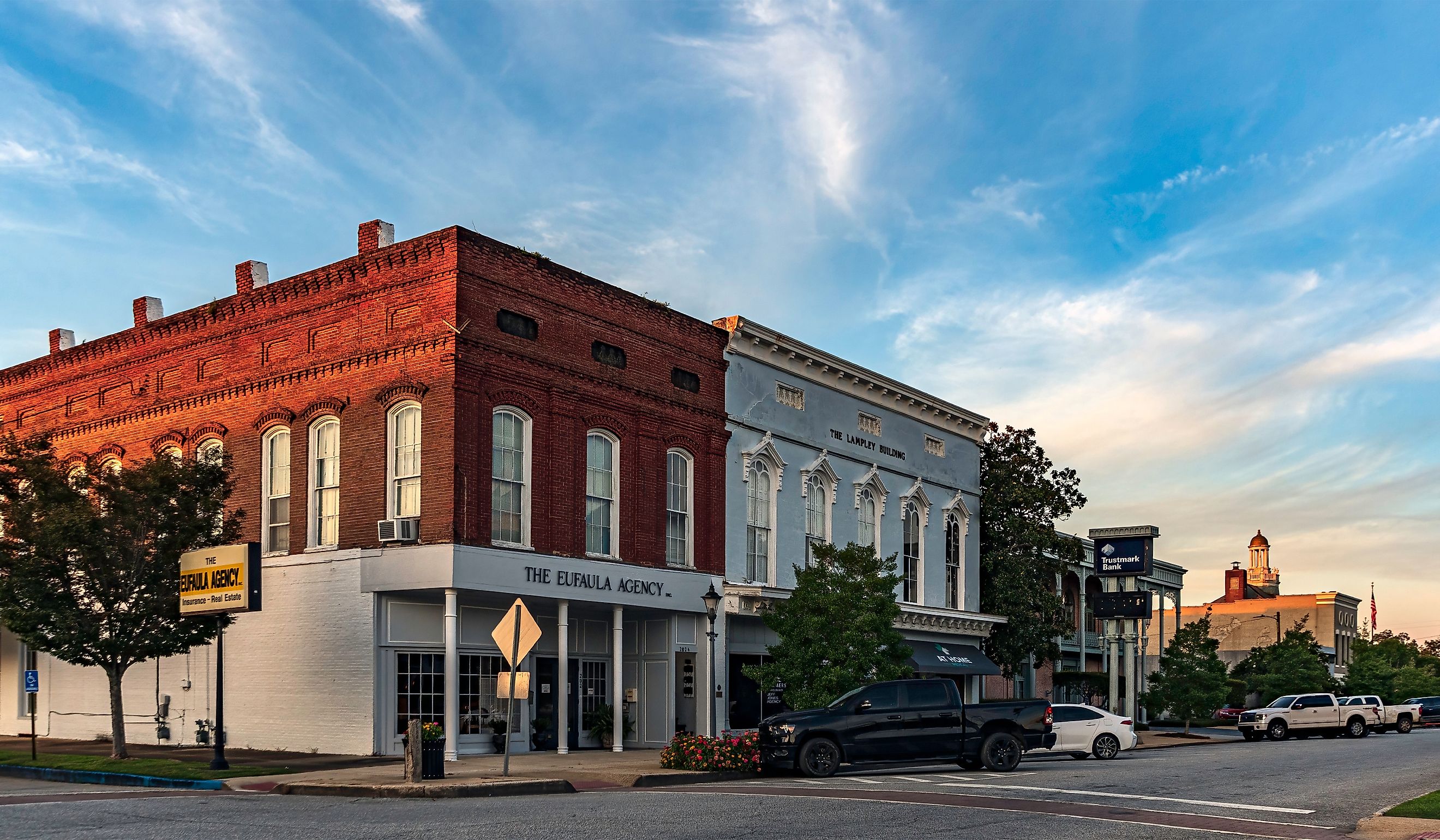
Eufaula

The Shorter Mansion anchors Eufaula's historic district, a Neoclassical house open for tours and rented out for weddings and events. It stands inside the Seth Lore and Irwinton Historic District, one of the largest concentrations of 19th-century architecture in the state, where you can walk past preserved homes and older cemeteries such as Shorter and Fairview. The district rewards an unhurried walk more than a quick drive-through.
Lake Eufaula spreads over 45,181 acres along the Chattahoochee River at the edge of town. Eufaula promotes itself as the "Big Bass Capital of the World," and the reservoir backs the claim with fishing tournaments, boat rentals, and open water for a day out. Between the district and the lake, the town splits neatly into an afternoon of history and an afternoon on the water.
Magnolia Springs

Magnolia Springs holds the only year-round mail route in the continental United States delivered entirely by boat. The carrier runs the Magnolia River dock to dock, and residents keep their mailboxes out on their piers. Live oaks draped in Spanish moss arch over the streets of this Gulf Coast town, and the pace slows to match.
The Magnolia Springs Bed & Breakfast puts you on a front porch under those trees, close enough to watch the mail boat pass in the morning. A short walk away, Jessie's Restaurant serves upscale Southern plates in a casual setting, a fixture in a town this size. There is not a long list of things to do here, and that is the point.
Tuscumbia

Spring Park sends more than four million gallons a day over Cold Water Falls, promoted as the world's largest man-made natural stone waterfall, right in the center of Tuscumbia. The park packs a lot around it: a splash pad, a train, a children's roller coaster, a fountain honoring Im-Mi-Ah-Key, the wife of Chickasaw Chief Tuscumbia, and a lighted water show set to music. The Tennessee River runs nearby for fishing and a quieter stretch of shoreline.
Tuscumbia carries as much history as spectacle. Ivy Green, the 1820 home where Helen Keller was born, is open for tours of the house and grounds, with gardens worth a walk on their own. Belle Mont Mansion, a Palladian-style house on the edge of town, opens for tours and hosts events through the year.
Wetumpka

The name Wetumpka comes from a Creek word for tumbling or rumbling water, a nod to the Coosa River that runs through the middle of town. The Bibb Graves Bridge crosses the river at the heart of downtown and frames the view from either bank. Kayaking, canoeing, paddleboarding, and fishing all draw people to the Coosa and to nearby Lake Jordan.
About 85 million years ago, near the end of the age of the dinosaurs, an asteroid struck a shallow sea here and left the Wetumpka Impact Crater, one of the best-preserved marine impact sites anywhere. The Wetumpka Impact Crater Exhibit lays out the science, and a self-guided driving tour takes you along the crater's outer rim and up toward its uplifted center, with overlooks of the Coosa and the town on the way.
Greenville

Greenville goes by the Camellia City, and it earned the name: growers here were central to getting the camellia named Alabama's official state flower in 1959. Beeland Park Camellia Gardens covers eight acres and holds dozens of camellia varieties that bloom through the cooler months, roughly November into March. Victorian-era homes line the older streets, many of them fronted by the same flower.
Cambrian Ridge is one of Greenville's public golf courses, a well-regarded layout on the Robert Trent Jones Golf Trail. For a different afternoon, the Ritz Theatre, a restored historic venue downtown, stages performances and community arts programming. The Butler County Courthouse, built in 1903, still anchors the square.
Planning The Route
These eight towns split roughly along the map. Mentone, Mooresville, and Tuscumbia sit in the northern half of the state, close enough to pair on a single trip through the Tennessee Valley and Lookout Mountain. Wetumpka and Greenville fall in the central corridor near Montgomery, while Monroeville, Eufaula, and Magnolia Springs anchor the south, the last of them within reach of the Gulf. A visitor deciding among them can weigh what each does best: Monroeville for the literary history, Eufaula for the lake and the architecture, Magnolia Springs for the slow river days, and Mentone or Tuscumbia for the waterfalls.