The Oldest Working Drawbridge In America
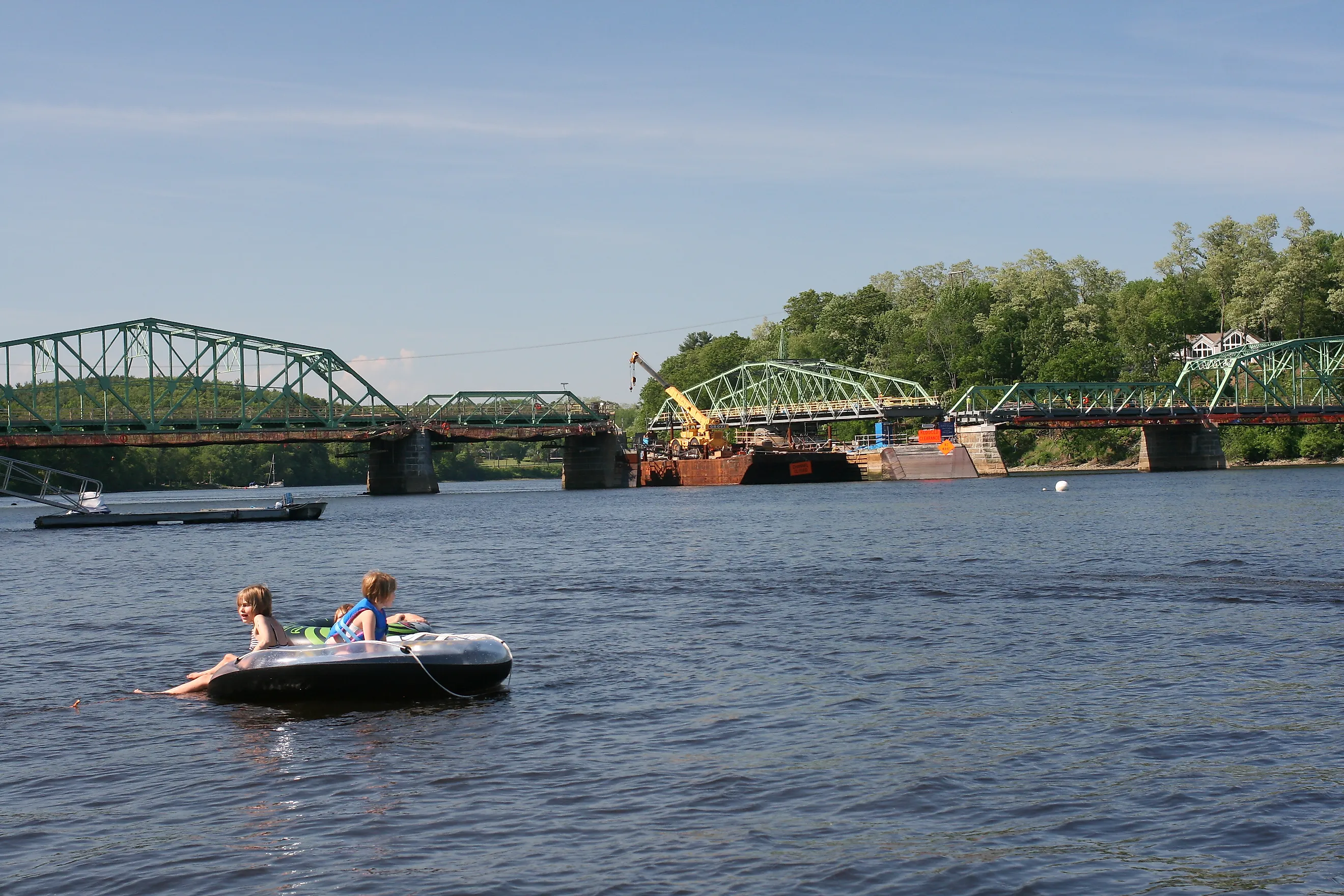
The Rocks Village Bridge has been swinging open the same way since 1883, when one person with a hand crank could turn its center span clear across the Merrimack River in a few minutes and let boats slip through. More than 140 years later, that same iron span still turns. Cars cross it between Haverhill and West Newbury, Massachusetts, and boats can still make it move. That mix of everyday road traffic and a draw that still opens is what makes Rocks Village the oldest working drawbridge in America.
A Crossing At Rocks Village Since 1795

People were crossing the Merrimack here long before the current ironwork appeared. Ferry service operated at Rocks Village by the early 1700s, when the crossing was known as Swett's Ferry. In 1794, the Massachusetts General Court authorized construction of a bridge between Haverhill and Newbury and required a passage wide enough for vessels.
The first Merrimac Bridge opened on November 26, 1795. Bells rang, cannon fired, flags went up, and a procession crossed the new bridge during the opening celebration. It lasted a little more than two decades. A severe flood in the winter of 1818 destroyed much of the structure after rain and melting snow sent ice and debris down the river.
A replacement opened in 1828 with wooden Town lattice spans and a movable section for boats. Essex County bought the crossing for $4,000 in 1868 and removed the toll. By the 1870s, the wooden draw had deteriorated badly enough to need replacement.
The 1883 Swing Span

Essex County received permission to reconstruct and relocate the draw in 1882. Boston Bridge Works supplied two new iron spans the following year. One was a 71-foot Pratt pony truss. The other was a 158-foot rim-bearing swing span designed under engineer David H. Andrews.
The movable section turns horizontally instead of rising into the air. When closed, the span rests across the river like an ordinary truss bridge. To clear the channel, it rotates around machinery at its center pier, opening passages on either side.
The mechanism was built to work without a large power system. Historic American Engineering Record documentation found that one person could turn the span by hand in only a few minutes. That hand-operated machinery remained part of the bridge through later repairs and rehabilitation projects.
Not Every Part Of The Bridge Dates To 1883

The present Rocks Village Bridge contains six spans built during three separate construction periods. The 158-foot swing span and the 71-foot pony truss next to it date to 1883. A 175-foot Pennsylvania through truss was added on the Haverhill side in 1895.
The last wooden portions remained until 1914. McClintic-Marshall & Company then supplied three new steel spans for the West Newbury side: two Pratt pony trusses and another Pennsylvania through truss. By that point, the crossing had reached roughly the arrangement seen today.
Decks, floor systems, machinery, and individual structural components have been repaired or replaced over the decades. The 1883 claim does not depend on treating the full 812-foot bridge as original. The surviving drawspan is the part being dated.
Boston Bridge Works Built The Draw

David H. Andrews founded Boston Bridge Works in 1876 after working in the iron-bridge business elsewhere in New England. The company became a significant regional fabricator and built highway, railroad, and movable bridges across the Northeast.
The Rocks Village spans are among its early surviving work. The company name still appears on a builder's plate at the western end of the bridge, while plates from McClintic-Marshall mark some of the later 1914 construction.
Those different names match the bridge's uneven appearance. The crossing is not six copies of the same truss. Shorter pony trusses sit beside larger Pennsylvania trusses, with the rotating 1883 section near the middle. The sequence records more than 30 years of bridge construction in one place.
The Draw Still Opens For Boats

The Merrimack carries far less commercial river traffic past Rocks Village than it did in the 19th century, but the draw has never been reduced to a decorative relic. Federal drawbridge regulations still cover the crossing at river mile 12.6. The span must open on signal when at least two hours' notice is provided.
The roadway remains active as well. Vehicles cross between Haverhill and West Newbury over the same narrow trusses, subject to a maximum posted clearance of 12 feet 6 inches.
An overheight truck showed how vulnerable that arrangement can be on March 17, 2022. The truck struck the bridge and caused enough structural damage to close the crossing. MassDOT completed emergency repairs and restored both vehicular and marine operation on October 11 of that year.
Major Repairs Have Kept It In Service
Rocks Village has needed substantial work to remain usable. A major rehabilitation project launched in the 2010s addressed structural steel, the bridge deck, piers, and parts of the swing mechanism. Crews replaced worn material while retaining the historic truss configuration and movable span.
Maintenance on a swing bridge is different from work on a fixed crossing. The center bearing, drive system, trusses, deck, and supporting piers all have to function together. Repairs that change the weight of the span can also affect how easily the draw turns.
At Rocks Village, those mechanical concerns come on top of the ordinary problems facing an iron bridge exposed to traffic, weather, road salt, and river moisture. The 2022 collision added another major repair job to a maintenance history already stretching back more than a century.
An Older Swing Bridge Survives In Michigan

Michigan has a surviving swing bridge that predates Rocks Village. The New Richmond Swing Bridge over the Kalamazoo River was built in 1879 by the Milwaukee Bridge & Iron Company. Its original structure included Warren pony trusses and a movable center section.
The bridge stopped carrying motor vehicles in 1997. It was later restored as part of New Richmond Bridge Park, where pedestrians can cross the river and see the historic ironwork. The preserved swing mechanism makes it an older surviving movable bridge, but it no longer operates as an active highway drawbridge serving both cars and navigation.
That difference keeps the 1879 structure outside the criteria used here while making it an important contender whenever the question is simply the oldest surviving movable bridge.
The 1884 Cribari Memorial Bridge

Connecticut's William F. Cribari Memorial Bridge comes much closer. Built in 1884, it carries Route 136 across the Saugatuck River in Westport and still includes an operational swing span.
The movable section can rotate roughly 90 degrees around its pivot to clear the channel. CTDOT continues to maintain operating rules for vessels, while cars, cyclists, and pedestrians use the roadway above. The bridge has undergone repairs and alterations over its long life, including changes to its deck and machinery.
Only one year separates its original construction from the Rocks Village swing span. Under the same road-traffic and marine-opening criteria, Cribari remains one of the strongest surviving rivals but dates to 1884 rather than 1883.
Hawthorne Holds The Vertical-Lift Record

Portland's Hawthorne Bridge belongs in the discussion for a different reason. Opened in 1910, it is the oldest operating vertical-lift bridge in the United States. Instead of rotating sideways, its central roadway rises between two 165-foot towers.
Large counterweights balance the movable span while motors raise it for vessels on the Willamette River. The bridge remains heavily used by cars, buses, bicycles, and pedestrians, and its draw can open many times in a busy month.
Its record is specific to vertical-lift bridges. Swing bridges such as Rocks Village use a much older movable-bridge design, which pushes the broader working-drawbridge date back into the 19th century.
Still Turning After More Than 140 Years

The Rocks Village drawspan has outlasted wooden predecessors, later truss additions, changing river traffic, major rehabilitation work, and a serious truck collision. Its operating system comes from a period when a bridge tender could clear the Merrimack with hand power alone.
Today, drivers still cross the 1883 span, and boats can still require it to move. That surviving combination of road use and an operational draw is what places Rocks Village ahead of the younger working contenders while excluding older movable bridges that have retired from highway service.