How Long It Takes A Giant Sequoia To Grow
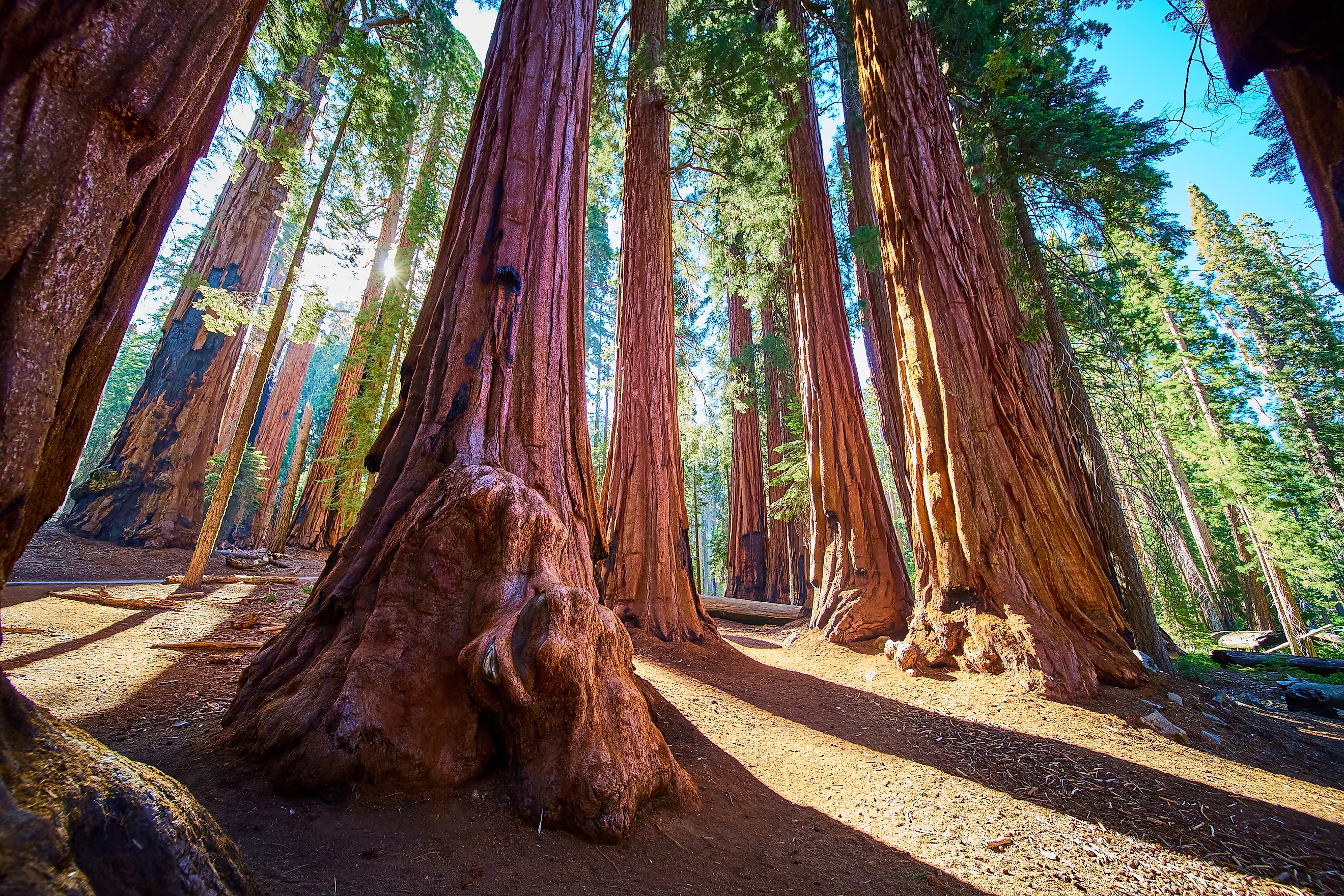
Giant sequoias never fully stop growing. They can continue to grow for hundreds of years, with some of the oldest being more than 3,000 years old, although most generally reach their maximum height after around 200 years. Giant sequoias are unlike other flora for many reasons. First is their size as the largest tree on Earth. Second is the fact that they rely not just on water and sunlight but also on fire to reproduce. As they grow, their thick bark protects them from periodic wildfires.
Where are giant sequoias found?

Giant sequoias have a very small range. They only grow on the western slopes of the Sierra Nevada Mountains in Central California. According to the University of California's Agriculture and Natural Resources, giant sequoias are located in 75 groves over a 260-mile-long stretch of land, which is less than 14 miles wide.
Giant sequoias were once far more widespread than they are today, spreading across the states of Nevada, Idaho, Wyoming, and Colorado. They flourished in the wetter, colder temperatures at the time, but as the climate warmed at the end of the last Ice Age, their range was restricted significantly.
What makes them different from coastal redwoods?

Giant sequoias are often confused with coastal redwoods, but the two are different. For one, coastal redwoods are only found on the coast of California and southern Oregon. In addition, coastal redwoods are the tallest trees on Earth, while giant sequoias are the largest by volume. Coastal redwoods have small rounded cones that are less than an inch long, whereas giant sequoias produce massive cones that are the size of a chicken egg. Their leaves are also different, as coastal redwoods have flat leaves, whereas giant sequoias have scale-like leaves (often called needles) meant to retain water.
They also thrive in different environments. Coastal redwoods rely on cool air from the Pacific and alluvial soils, whereas giant sequoias are found at higher elevations at anywhere from 4,000 to 8,000 feet, and receive moisture from melting snow each spring. Lastly, coastal redwoods are known to resprout when cut down or devastated by fires, whereas giant sequoias do not.
Sequoia's life cycle

Sequoia seedlings grow a surprisingly small root system for their overall structure. The largest roots are no more than two to three feet in diameter, with tiny feeders that branch off for it. Their entire root system tends to only take up 3 to 12 feet of soil surface. At the same time, these roots can spread out quite extensively, from 100 to 200 feet.
In order to grow, it needs more moisture than any other mixed conifer tree, with a soil moisture of at least 15 to 20%. For its first 10 years of life, it is considered a seedling and can grow at a rate of about 1 to 2 feet annually. This assumes that the soil has enough nutrients and is well-drained, whereas denser soil will slow down their growth rate.
Once they reach the juvenile stage, they can grow up to 4 feet a year for 10 to 50 years. This growth continues throughout their mature growth stage, reaching heights of anywhere from 150 to 250 feet.
Their most impressive feature is their trunk diameter, which can grow up to 2 inches per year, typically can reach diameters of 20 feet or more. This is what makes them the largest trees on Earth. Coastal redwoods, by comparison, do not grow nearly as large, with the largest having diameters of more than 20 feet.
In order to regenerate, the trees need help from one of several sources. First, wood-boring beetles release larvae into the cones, which allows the seeds to be released. Secondly, a Douglas squirrel may eat the green scales of cones, which allows the seed to come out.
The final element is fire, which is one of the most effective ways for giant sequoias to grow. Forest fires dry up the cones, opening up large quantities at once so seeds can release onto the earth. The fire on the surface also burns off any litter such as leaves or branches over the soil, allowing seeds to enter the nutrient-rich soil and grow.
The giant sequoias themselves are usually not harmed by the fires, as their bark is up to two feet thick. They also typically prune their lower-hanging branches as they grow, so wildfires do not have as much of an opportunity to ascend up the top by feeding off lower-hanging branches.
The largest sequoias

The largest tree in the world by volume is a giant sequoia known as the General Sherman Tree, at 52,500 cubic feet. A tree's trunk volume is calculated using its overall height and diameter at breast height of a human. Experts measure the tree at this height to avoid the much larger section at the base of the tree. They use a specialized tape measure with a small hook at the end to attach to the bark.
If the General Sherman Tree were to be cut up, it would make up 630,000 board feet of lumber, which could build 120 homes.
The General Sherman Tree has a diameter of 36.5 feet at its base and a height from its base of 274.9 feet. It is located in Sequoia National Park, which is jointly managed with Kings Canyon National Park.
The tree is believed to be around 2,200 years old. One little-known fact is that before Sequoia National Park was founded, a utopian group called the Kaweah Colony called the tree the Karl Marx Tree after the political philosopher and founder of Communism. Today, the tree is named after the Union General William Tecumseh Sherman, whose campaigns in the later years of the American Civil War proved crucial to defeating the Confederacy.
The General Grant Tree is the second largest of the giant sequoias, found in Kings Canyon National Park. It has a trunk volume of 46,608 cubic feet and has an overall height of 268.1 feet.
It only gained this honor in 2003, due to a lightning strike and massive fire that severely damaged the Washington Tree in Sequoia National Park, which first collapsed its upper section. Following a heavy snow load in January 2005, its height was further reduced. It originally stood at 254 feet tall, but now is only about 115 feet, and is hollow on the inside.
Are giant sequoias under threat?
Unfortunately, giant sequoias are under threat. Droughts pose a major threat to their trees, as they need significant moisture to grow. In addition, these droughts can produce devastating wildfires that not even giant sequoias can withstand. In fact, wildfires in 2020 to 2021 are estimated to have killed 13 to 19% of all large giant sequoias. During the 2021 KNP Complex Fire, firefighters placed protective foil around the General Sherman Tree's lower sections to try to prevent the tree from burning down, especially if fire reached its older scars caused by past fires.
Although these trees do grow to immense heights and widths, they are not invulnerable to devastating weather events. As a result, national park authorities and others have to work together on programs that reduce fuel for these wildfires and, in turn, reduce their intensity.