The Largest Indoor Arenas In The United States
While we all have ideas about what exactly constitutes an arena (big or small), there are a few ground rules we need to clarify before everyone pipes up with their favorites. An arena, for the purposes of this list, is a single enclosed building with a fixed roof and one continuous bowl of seats wrapped around a floor. And yes, the floor has to convert for basketball, hockey, concerts, and pretty much anything else that can be staged indoors.
To level the playing field, we've ranked the largest arenas in the United States by the seating capacity each owner, operator, or home team publishes for basketball, the one configuration every building on this list uses. Where an operator rounds its number, we have used it as published. So, if you're a college hoops fan, rejoice: the results put college basketball at the top.
1. KFC Yum! Center, Louisville, Kentucky

Basketball seating stands at 22,090.
KFC Yum! Center opened in October 2010 on the Ohio River waterfront in downtown Louisville. Built at a cost of $238 million, it's the home of the University of Louisville Cardinals men's and women's basketball teams. The building covers 721,762 square feet over seven levels and includes 71 luxury suites, 62 premium boxes, and more than 2,000 sidecourt club seats. Its basketball seating capacity is 22,090, the largest published figure of any arena in the country, and the venue lists a maximum of 23,000 for concerts.
This Louisville arena has hosted NCAA men's tournament regionals in 2016, 2019, and 2023, and has been selected for first- and second-round games in 2027. The arena bowl floor covers 28,000 square feet, and the building's Pepsi Plaza entrance adds room for another 1,500 people at events.
2. First Horizon Coliseum, Greensboro, North Carolina

Basketball seating stands at 22,000.
Greensboro Coliseum opened in October 1959 with several performances of Holiday on Ice. The city-owned operator lists it at 22,000 seats, although UNC Greensboro, whose Spartans play here, says more than 23,000 for basketball, and the operator's own history records 23,500 after a 1993 renovation.
The name change to First Horizon Coliseum came in October 2024, and the arena has rung up a string of ACC men's and women's basketball tournaments. All told, it has hosted them a combined 53 times, more than any other venue. It also staged the 1974 NCAA Men's Final Four. The biggest recorded crowd, 23,642, came to see Phish in March 2003. It's the centerpiece of an eight-venue campus in Greensboro that also includes the Greensboro Aquatic Center.
3. Dean E. Smith Center, Chapel Hill, North Carolina

Basketball seating stands at 21,750.
The Dean E. Smith Center takes its name from the coach who led North Carolina for 36 seasons between 1961 and 1997, and who won national championships in 1982 and 1993. It's for this reason that Tar Heel fans call it the "Dean Dome." It opened in January 1986, when top-ranked North Carolina beat third-ranked Duke 95-92 in the first game played there.
The building covers 300,000 square feet on 7.5 acres in Chapel Hill, measures 340 feet wide, 380 feet long, and 140 feet high, and required the excavation of more than 20,000 cubic yards of rock. The playing floor inside was renamed Roy Williams Court in 2018, for the coach who took over in 2003 and won three more titles in 2005, 2009, and 2017. Unlike the pro buildings on this list, it was built for basketball alone and hasn't published hockey or concert configurations.
4. Food City Center, Knoxville, Tennessee

Basketball seating stands at 21,678.
Thompson-Boling Arena at Food City Center opened in December 1987, when Tennessee beat Marquette 82-56 in front of a crowd of 25,272 sports fans. The Knoxville arena originally seated more than 25,000. Named for B. Ray Thompson Sr., a university benefactor, and Edward J. Boling, a former university president, it stands on the bank of the Tennessee River on the Knoxville campus. A $35 million renovation completed in 2008 added 32 luxury suites and 166 loge seats, and capacity has stood at 21,678 since.
Food City, the supermarket chain based in Abingdon, Virginia, took naming rights in August 2023, and 2025 saw the addition of a new center-hung video board and a 360-degree LED ribbon. The 2025 work also added the Riverside Club, serving 1,500 lower-level seats, without changing the count. Sellout games against Louisville in December 2025 and LSU in February 2026 were each recorded at 21,678.
5. Xfinity Mobile Arena, Philadelphia, Pennsylvania (Tie)

Basketball seating stands at 21,000.
Originally named the CoreStates Center when it opened in August 1996 in the South Philadelphia sports complex, Xfinity Mobile Arena is the shared home of the NBA's 76ers and the NHL's Flyers. Seating numbers are 21,000 for basketball and 19,600 for hockey. Crews can convert the ice floor to hardwood in just two hours and ten minutes.
A $300 million transformation, completed in 2022, rebuilt the club level. Despite the renos, however, the building's days are pretty much numbered after a recent announcement about a joint replacement arena on the same complex. It's scheduled to open in the early 2030s.
5. Little Caesars Arena, Detroit, Michigan (Tie)

Basketball seating stands at 21,000.
Little Caesars Arena opened in September 2017 in the District Detroit development, bringing the Red Wings and Pistons under one roof. Its operator, 313 Presents, publishes rounded figures of 21,000 for basketball and 20,000 for hockey. The 885,000-square-foot building opened with ten consecutive sold-out concerts, starting with Kid Rock on September 12, 2017, and including Ed Sheeran and Paul McCartney.
Its signature feature is its video. There are more than 13,500 square feet of LED display, made up of 16.5 million individual LEDs, including a 6,020-square-foot center-hung board. Outside the bowl, the Via, a glass-roofed concourse lined with restaurants, wraps around the arena and connects it to the rest of the district.
7. United Center, Chicago, Illinois

Basketball seating stands at 20,917.
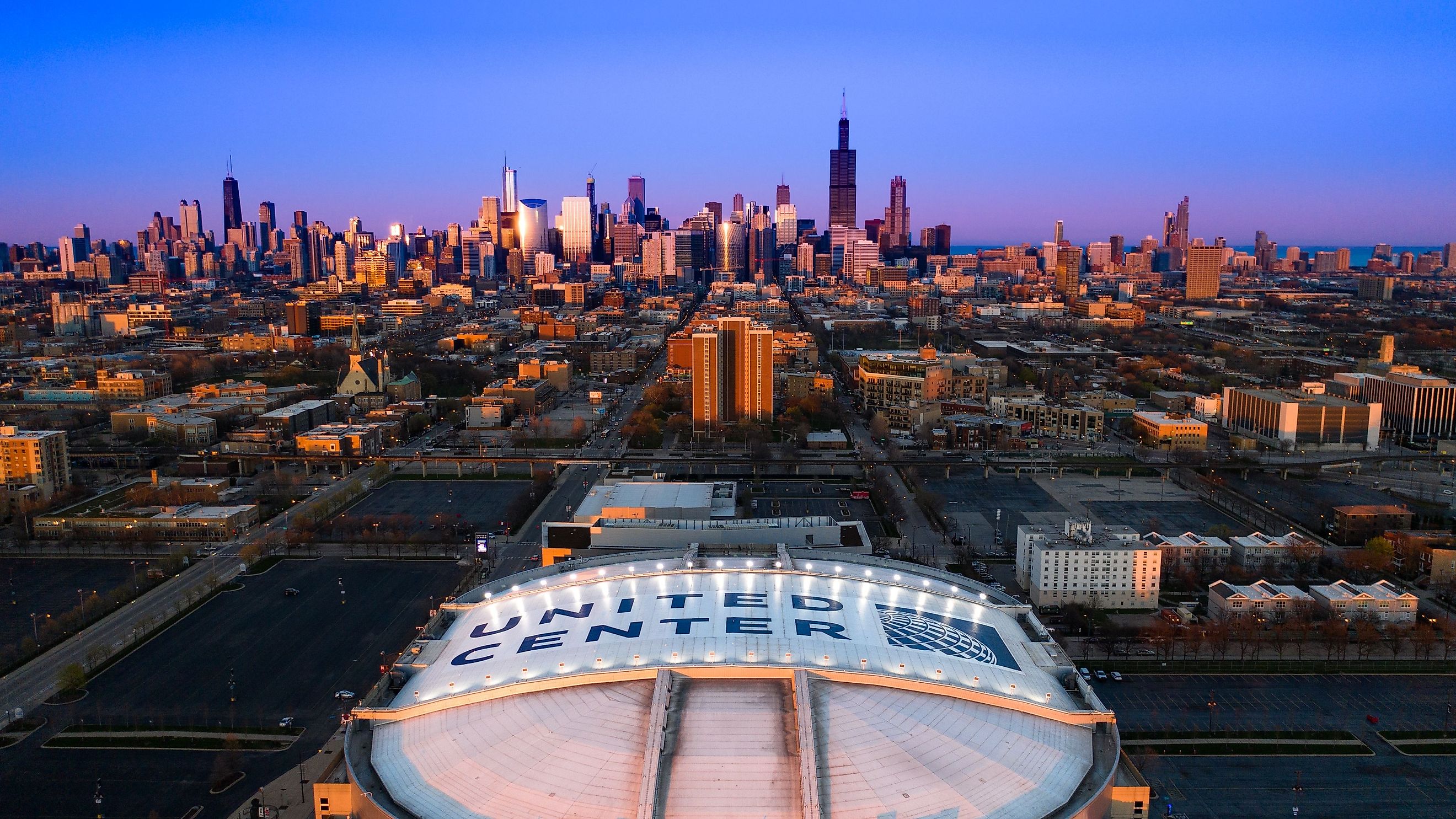
Opened in August 1994 in Chicago's Near West Side, the United Center replaced the old Chicago Stadium across the road as the home of the Bulls and Blackhawks. The arena calls itself the largest in the United States, a claim based on its 960,000 square feet of floor space rather than seats. It publishes no seating capacity, so the 20,917 basketball figure used here is the one widely reported in the sports press.
The arena has 167 executive suites on three levels and has welcomed more than 40 million guests since opening. It has also hosted the Democratic National Convention in 1996 and 2024 and the 2017 NCAA Frozen Four. For the 2025-26 season, its former penthouse suites were rebuilt as the Banner Level. The Michael Jordan statue, unveiled in 1994, stands in the east atrium.
8. Rupp Arena, Lexington, Kentucky

Basketball seating stands at 20,500.
Rupp Arena opened in the fall of 1976 as the home of the Kentucky Wildcats, and is named for Adolph Rupp, the coach who won four national championships in Lexington between 1930 and 1972. Seating was pegged at 23,500 in the 2010s when much of its upper deck was still bleacher seating. A conversion of some sections to chair-backs for the 2019-20 season brought the count down to 20,500.
A $16 million upgrade completed in 2016 added a Daktronics center-hung video board and a new sound system. It now forms part of the Central Bank Center convention complex in downtown Lexington.
Contenders
Three arenas share the next rung with operator-published figures of 20,000 for basketball. Amerant Bank Arena in Sunrise, Florida, is home of the Florida Panthers. American Airlines Center in Dallas opened in 2001. Capital One Arena in Washington, D.C., is midway through an $800 million renovation due for completion ahead of the 2027-28 season. Below them come Lenovo Center in Raleigh at 19,700, Kaseya Center in Miami at 19,600, and Ball Arena in Denver at 19,520.
Madison Square Garden in New York, opened in 1968, publishes no basketball figure of its own. The widely reported capacity is 19,812. Two domed stadiums would beat everything above if they qualified. The JMA Wireless Dome at Syracuse University seats 30,286 for basketball following the switch to chair-back seating in 2024, and the Alamodome in San Antonio lists 31,853 in its arena-basketball layout, as covered in our look at the biggest indoor arenas in the world.
Why College Towns Win
The four largest arenas in the country belong to universities or the cities that host them, not to NBA or NHL teams. College arenas were built for one sport with long rows of upper-deck seats, while the pro buildings that followed traded seats for suites, clubs, and loge boxes. For the buildings where the pros play, see our rankings of the largest NHL arenas in North America and the largest concert venues in the United States.