The Largest Stadiums In North America
- The largest stadium in North America is Michigan Stadium, home to the Michigan Wolverines, part of American College Football.
- Kyle Field was the place where the football game with the highest attendance in the history of Texas happened, with 110,633 people present at the game.
- Neyland Stadium is named after Robert Neyland, the head coach at the University of Tennessee from 1926 to 1952.
The five largest stadiums in North America are all on US college campuses, and the top eight all belong to football programs that fill them to or beyond capacity for major home games each fall. Michigan Stadium in Ann Arbor leads the list at 107,601, and the next seven venues all top 100,000 seats. The United States has more 100,000-capacity stadiums than any other country in the world. The list below reflects current capacities for the 2025-2026 seasons; several of the SEC and Big Ten programs are still in the middle of multi-year renovation projects that have shifted the rankings in recent years and will continue to shift them.
1. Michigan Stadium: 107,601 Capacity

Michigan Stadium in Ann Arbor, Michigan, known as "The Big House," has held an official capacity of 107,601 since 2015 and is the largest stadium in North America. It opened on October 1, 1927 with an original capacity of 72,000 and was designed by architect Bernard L. Green, modeled on the Yale Bowl, at the direction of legendary athletic director Fielding Yost. The stadium has been the home of the University of Michigan Wolverines football team for every home game since opening. Attendance has exceeded 100,000 for nearly every home game since 1975, and the record attendance is 115,109, set against Notre Dame on September 7, 2013.
Recent renovations have focused on premium-seating retrofits, accessibility, and amenity upgrades rather than total seat count. The stadium also hosts the annual Michigan-Ohio State rivalry game in years when the game is played in Ann Arbor, one of the most-attended regular-season college football games each year.
2. Beaver Stadium: 106,304 Capacity

Beaver Stadium at Penn State University in University Park, Pennsylvania, currently lists 106,304 seats, slightly below the longstanding 106,572 figure, owing to a $700 million Phase II revitalization that is reconfiguring the press-box side of the stadium through 2027. It has been the home of the Penn State Nittany Lions football team since 1960, when the original Beaver Field was disassembled and moved across campus and rebuilt in modular fashion. Subsequent expansions over six decades have brought it to its current second-largest position in North America.
Beaver Stadium's "White Out" night games, where the entire crowd wears white, are widely cited as among the most intimidating environments in college football. Recent attendance has regularly approached or exceeded the official capacity, including 111,030 against Ohio State in November 2024 and 111,015 against Oregon in November 2025.
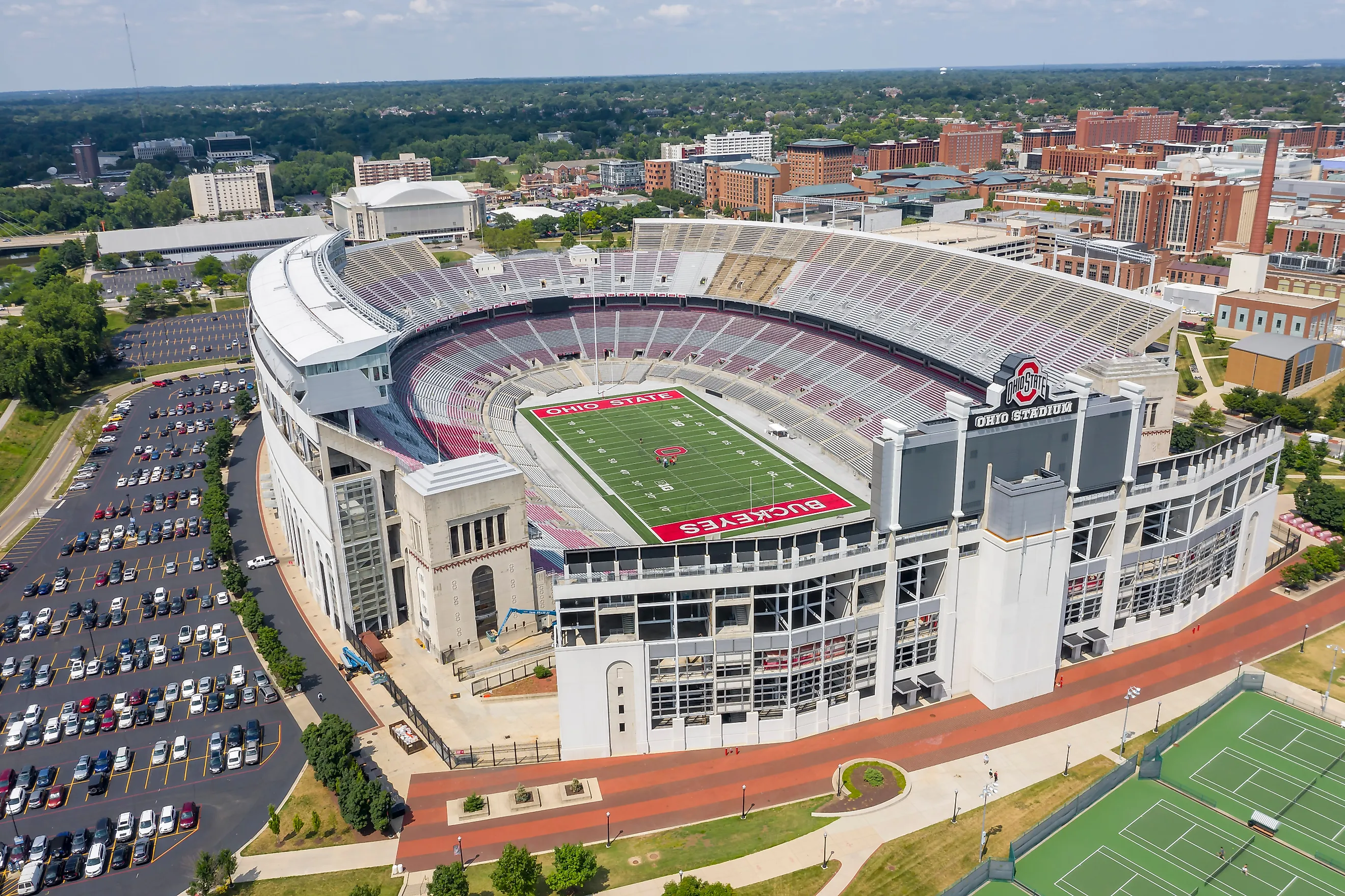
3. Ohio Stadium: 102,780 Capacity

Ohio Stadium on the campus of Ohio State University in Columbus, known as "the Horseshoe" or "the Shoe," has held a capacity of 102,780 since 2019, when a four-year renovation reduced the stadium's 104,944 capacity in order to add luxury suites and premium seating. The stadium opened in October 1922 with an original capacity of 66,210 and is the home of the Ohio State Buckeyes football team. The C-shaped horseshoe design, by Ohio State alumnus and architect Howard Dwight Smith, was novel for its era and remains one of the most distinctive in college football. The stadium was added to the National Register of Historic Places in 1974.
Ohio Stadium also served as the home venue for Major League Soccer's Columbus Crew from 1996 to 1998 before the team moved to its dedicated facility in 1999. The record attendance of 110,045 was set against Michigan on November 26, 2016. The stadium is regularly used as a concert venue, with U2 and The Rolling Stones among the acts that have performed there.
4. Kyle Field: 102,733 Capacity

Kyle Field at Texas A&M University in College Station has held a capacity of 102,733 since the 2014-2015 redevelopment, a $484 million project that nearly doubled the stadium's previous size of 82,589. It has been home to the Texas A&M Aggies football team since the original wooden grandstand opened in 1904, and was rebuilt as a permanent concrete structure in 1927. Kyle Field is the largest stadium in the Southeastern Conference.
The highest football attendance in Texas history was recorded at Kyle Field on October 11, 2014, when 110,633 fans came to watch Texas A&M lose to Ole Miss. The all-time stadium attendance record is now held by a George Strait concert on June 15, 2024, which drew 110,905 spectators. The 2014-2015 redevelopment was designed by Populous and is among the largest single college-stadium expansion projects in US history.
5. Tiger Stadium: 102,321 Capacity

Tiger Stadium at Louisiana State University in Baton Rouge, known as "Death Valley," has held an official capacity of 102,321 since the 2014 south end-zone expansion. It opened in 1924 with a capacity of 12,000 and has expanded repeatedly over the past century to become one of the largest stadiums in the SEC. A notable 1936 expansion enclosed the north end zone, increasing capacity to 46,000; that addition was famously constructed as a dormitory complex housing 1,500 students at the direction of Governor Huey P. Long, who circumvented the state legislature's refusal to fund a pure stadium expansion by combining it with student housing.
Tiger Stadium is the home of the LSU Tigers football team and is widely cited as one of the most difficult venues for visiting teams in college football, particularly for night games. The famous quote attributed to legendary Alabama coach Bear Bryant after a loss in Baton Rouge calls it "the worst place in the world for a visiting team. It's like being inside a drum."
6. Neyland Stadium: 101,915 Capacity

Neyland Stadium at the University of Tennessee in Knoxville has held an official capacity of 101,915 since 2022, reduced from the previous 102,455 by a renovation that added lower-west club seating and an upper-north social deck. It opened in 1921 as Shields-Watkins Field with a capacity of 3,200 and has undergone sixteen separate expansion projects in the century since; the playing surface is still officially called Shields-Watkins Field within Neyland Stadium. The stadium was renamed for Robert Neyland, who served three stints as head football coach at the University of Tennessee between 1926 and 1952, with two interruptions for military service.
Tennessee's renovation program continues through 2026 with a total budget of $337 million, focused on widened concourses, expanded gates and entryways, and additional restrooms and concessions on the south side. The all-time attendance record is 109,061, set against Florida on September 18, 2004.
7. Darrell K Royal-Texas Memorial Stadium: 100,119 Capacity

Darrell K Royal-Texas Memorial Stadium on the University of Texas campus in Austin has held a capacity of 100,119 since the 2009 expansion that added the upper deck. It is the home of the Texas Longhorns football team, which joined the SEC in 2024 from the Big 12 along with Oklahoma. The stadium opened in 1924 as Memorial Stadium, dedicated to Texans killed in World War I; the Royal name was added in 1996 to honor head football coach Darrell K Royal, who led the Longhorns to three national championships in the 1960s and early 1970s.
The stadium's program attendance record of 105,213 was set in 2022 against Alabama, when standing-room tickets were sold for the rivalry game. Texas plays its annual Red River Rivalry game against Oklahoma at the Cotton Bowl in Dallas rather than on either school's campus.
8. Bryant-Denny Stadium: 100,077 Capacity

Bryant-Denny Stadium at the University of Alabama in Tuscaloosa has held a capacity of 100,077 since a 2020 renovation reduced the stadium's previous 101,821 capacity in order to add premium-seating areas. It opened in 1929 as Denny Stadium, named for university president George H. Denny, who served from 1912 to 1932. The Bryant name was added by an act of the Alabama state legislature in 1975 to honor Paul "Bear" Bryant, the head football coach who continued to coach the Crimson Tide for seven more seasons after the renaming until his retirement in 1982.
Alabama has played its home games at Bryant-Denny since the stadium opened, and the venue consistently ranks among the most-filled stadiums in college football. A $92.5 million upgrade as part of a broader $600 million athletic-facilities plan added new social areas, premium seating, and improvements to player and recruiting facilities.
9. Estadio Azteca: 87,000 Capacity (capped during renovation)

Estadio Azteca in Mexico City has had its capacity temporarily capped at 87,000 since 2024 during a major renovation for the 2026 FIFA World Cup, when it will host the opening match on June 11, 2026 between Mexico and South Africa. With that match, Azteca will become the first stadium in soccer history to host games at three FIFA World Cups (1970, 1986, and 2026). The stadium is the home of the Mexico men's national soccer team and Liga MX clubs Club América and Cruz Azul, and is the only stadium on this list whose primary tenant is a professional soccer team rather than a US college football program.
Azteca opened in 1966 and is best known as the venue where Brazil's Pelé won the 1970 World Cup final and Argentina's Diego Maradona won the 1986 World Cup final, including the famous "Hand of God" and "Goal of the Century" matches against England. The stadium originally seated over 110,000 in its peak 1960s configuration, but the figure has been progressively reduced through safety, accessibility, and premium-seating renovations over the decades. At 7,200 feet above sea level, Azteca's elevation has long been considered a significant advantage for Mexican home teams against opponents from lower altitudes.
10. Sanford Stadium: 92,746 Capacity

Sanford Stadium at the University of Georgia in Athens has held a capacity of 92,746 since a 2018 renovation. It opened in 1929 as one of the founding stadiums of the Southeastern Conference and has been the home of the Georgia Bulldogs football team for nearly a century. The stadium is named for Steadman V. Sanford, the long-serving Georgia president who pushed for the construction. The famous privet hedges along the field, planted in 1929 for the stadium's opening, are the source of Georgia's "Between the Hedges" nickname for home games.
The annual Georgia-Florida rivalry game is traditionally played at EverBank Stadium in Jacksonville rather than on either school's campus, but Sanford hosts the rest of Georgia's home schedule. The Bulldogs have won three national championships since 1980, most recently in the 2021 and 2022 seasons.
Notable Stadiums Just Outside the Top 10
Several stadiums fall just outside the top 10 by capacity but warrant mention. Ben Hill Griffin Stadium at the University of Florida (known as "The Swamp") holds 88,548; Jordan-Hare Stadium at Auburn holds 88,043; Memorial Stadium at the University of Nebraska in Lincoln holds 85,458 after recent renovations. The Cotton Bowl in Dallas (92,100) hosts the annual Texas-Oklahoma Red River Rivalry, and the Rose Bowl in Pasadena (89,702) is the home of the UCLA Bruins and the historic site of the 1994 FIFA World Cup Final, the 1984 Olympic soccer gold medal match, and 1999 FIFA Women's World Cup Final. Among NFL venues, MetLife Stadium in East Rutherford, New Jersey (82,500) will host the 2026 FIFA World Cup Final; AT&T Stadium in Arlington, Texas (80,000, expandable to over 100,000) will host nine 2026 World Cup matches, the most of any tournament venue; and Lambeau Field in Green Bay (81,441) remains widely cited as the most distinctive atmosphere in the NFL.
The 50 Largest Stadiums In North America
| Rank | Stadium | Capacity | City | Country | Primary Tenant |
|---|---|---|---|---|---|
| 1 | Michigan Stadium | 107,601 | Ann Arbor | USA | Michigan Wolverines football |
| 2 | Beaver Stadium | 106,304 | University Park | USA | Penn State Nittany Lions football |
| 3 | Ohio Stadium | 102,780 | Columbus | USA | Ohio State Buckeyes football |
| 4 | Kyle Field | 102,733 | College Station | USA | Texas A&M Aggies football |
| 5 | Tiger Stadium | 102,321 | Baton Rouge | USA | LSU Tigers football |
| 6 | Neyland Stadium | 101,915 | Knoxville | USA | Tennessee Volunteers football |
| 7 | Darrell K Royal-Texas Memorial Stadium | 100,119 | Austin | USA | Texas Longhorns football |
| 8 | Bryant-Denny Stadium | 100,077 | Tuscaloosa | USA | Alabama Crimson Tide football |
| 9 | Sanford Stadium | 92,746 | Athens | USA | Georgia Bulldogs football |
| 10 | Cotton Bowl | 92,100 | Dallas | USA | Red River Rivalry, State Fair Classic |
| 11 | Rose Bowl | 89,702 | Pasadena | USA | UCLA Bruins football, Rose Bowl Game |
| 12 | Ben Hill Griffin Stadium | 88,548 | Gainesville | USA | Florida Gators football |
| 13 | Jordan-Hare Stadium | 88,043 | Auburn | USA | Auburn Tigers football |
| 14 | Estadio Azteca | 87,000 | Mexico City | Mexico | Mexico national team, Club América, Cruz Azul |
| 15 | Memorial Stadium (Nebraska) | 85,458 | Lincoln | USA | Nebraska Cornhuskers football |
| 16 | MetLife Stadium | 82,500 | East Rutherford | USA | New York Giants, New York Jets |
| 17 | Memorial Stadium (Clemson) | 81,500 | Clemson | USA | Clemson Tigers football |
| 18 | Lambeau Field | 81,441 | Green Bay | USA | Green Bay Packers |
| 19 | Gaylord Family Oklahoma Memorial Stadium | 80,126 | Norman | USA | Oklahoma Sooners football |
| 20 | AT&T Stadium | 80,000 | Arlington | USA | Dallas Cowboys, Cotton Bowl Classic |
| 21 | Doak Campbell Stadium | 79,560 | Tallahassee | USA | Florida State Seminoles football |
| 22 | Notre Dame Stadium | 77,662 | Notre Dame | USA | Notre Dame Fighting Irish football |
| 23 | Williams-Brice Stadium | 77,559 | Columbia | USA | South Carolina Gamecocks football |
| 24 | Los Angeles Memorial Coliseum | 77,500 | Los Angeles | USA | USC Trojans football |
| 25 | Arrowhead Stadium | 76,416 | Kansas City | USA | Kansas City Chiefs |
| 26 | Donald W. Reynolds Razorback Stadium | 76,212 | Fayetteville | USA | Arkansas Razorbacks football |
| 27 | Empower Field at Mile High | 76,125 | Denver | USA | Denver Broncos |
| 28 | Camp Randall Stadium | 75,822 | Madison | USA | Wisconsin Badgers football |
| 29 | Spartan Stadium | 75,005 | East Lansing | USA | Michigan State Spartans football |
| 30 | Bank of America Stadium | 74,867 | Charlotte | USA | Carolina Panthers, Charlotte FC |
| 31 | Caesars Superdome | 73,208 | New Orleans | USA | New Orleans Saints, Bayou Classic |
| 32 | NRG Stadium | 72,220 | Houston | USA | Houston Texans |
| 33 | Highmark Stadium | 71,608 | Orchard Park | USA | Buffalo Bills |
| 34 | Legion Field | 71,594 | Birmingham | USA | Magic City Classic |
| 35 | M&T Bank Stadium | 71,008 | Baltimore | USA | Baltimore Ravens |
| 36 | Mercedes-Benz Stadium | 71,000 | Atlanta | USA | Atlanta Falcons, Atlanta United FC |
| 37 | SoFi Stadium | 70,240 | Inglewood | USA | Los Angeles Rams, Los Angeles Chargers |
| 38 | Husky Stadium | 70,083 | Seattle | USA | Washington Huskies football |
| 39 | Kinnick Stadium | 69,250 | Iowa City | USA | Iowa Hawkeyes football |
| 40 | Raymond James Stadium | 69,218 | Tampa | USA | Tampa Bay Buccaneers, South Florida Bulls football |
| 41 | Nissan Stadium | 69,143 | Nashville | USA | Tennessee Titans, Music City Bowl |
| 42 | Lumen Field | 68,740 | Seattle | USA | Seattle Seahawks, Seattle Sounders FC |
| 43 | Levi's Stadium | 68,500 | Santa Clara | USA | San Francisco 49ers |
| 44 | Acrisure Stadium | 68,400 | Pittsburgh | USA | Pittsburgh Steelers, Pittsburgh Panthers football |
| 45 | EverBank Stadium | 67,814 | Jacksonville | USA | Jacksonville Jaguars, Gator Bowl, Georgia-Florida game |
| 46 | Lincoln Financial Field | 67,594 | Philadelphia | USA | Philadelphia Eagles, Temple Owls football |
| 47 | Cleveland Browns Stadium | 67,431 | Cleveland | USA | Cleveland Browns |
| 48 | The Dome at America's Center | 67,277 | St. Louis | USA | St. Louis BattleHawks (UFL) |
| 49 | US Bank Stadium | 66,655 | Minneapolis | USA | Minnesota Vikings |
| 50 | Gillette Stadium | 65,878 | Foxborough | USA | New England Patriots, New England Revolution |
How North America's Largest Stadiums Compare
The list is overwhelmingly dominated by US college football venues, with eight of the top ten 100,000-plus stadiums in North America belonging to universities rather than professional sports franchises. This concentration reflects the unique scale of US college football. Most of these stadiums were originally built between 1921 and 1929 and have been expanded several times over the past century to keep up with rising fan demand at the country's largest football programs. The remaining venues at the top of the list reflect different sports and markets: Estadio Azteca anchors Mexican club soccer and the Mexican national team, the largest NFL stadiums top out in the low-to-mid 80,000 range by listed capacity, and Major League Baseball stadiums are typically built for capacities under 50,000 due to the much larger number of home games each season. The 2026 FIFA World Cup, jointly hosted by the United States, Mexico, and Canada, will be the first major test of many of these venues for global audiences.