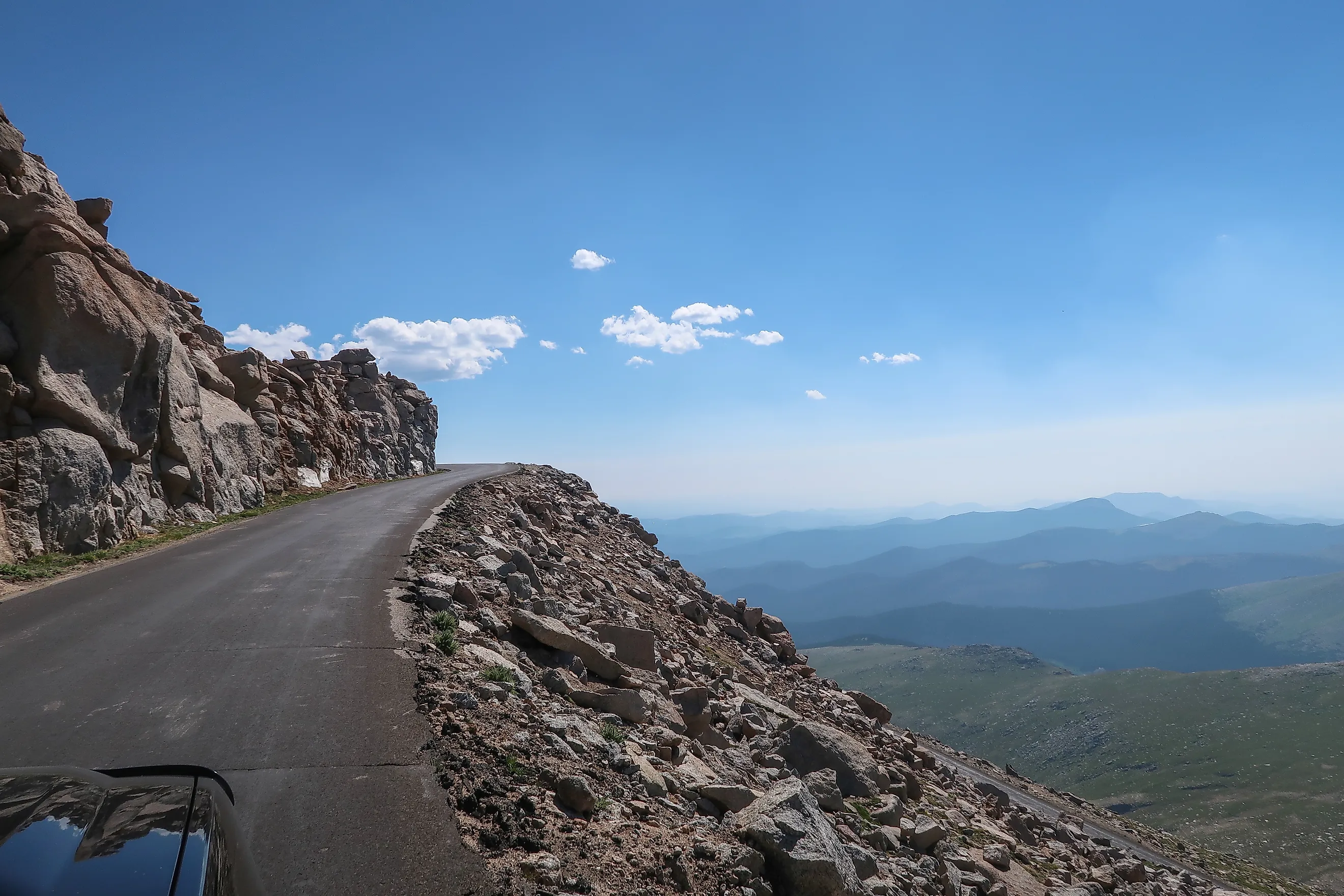
The Highest Mountain Pass Road In America
More than 2.6 miles above sea level, Mount Blue Sky Scenic Byway in Colorado is the highest mountain pass road in America. At 14,130 feet, it's high enough that some travelers might require supplemental oxygen to comfortably traverse it. The fully paved road climbs more than 7,000 feet through the Front Range of the Rocky Mountains and ends near the summit of Mount Blue Sky, one of Colorado's famous fourteeners. In this case, mountain roads must be fully paved to their highest public driving point and open to ordinary passenger vehicles. By that measure, Mount Blue Sky Scenic Byway reaches the highest elevation, edging out nearby Pikes Peak Highway by just 15 feet.
History

Mount Blue Sky, formerly known as Mount Evans, rises to 14,264 feet in the Front Range of the Rocky Mountains. It is one of Colorado's fourteeners, the peaks in the state that stand at least 14,000 feet above sea level. Landscape painter Albert Bierstadt reached the summit in 1863 and called the mountain Mount Rosalie after Rosalie Osborne, who later became his wife. The name Mount Evans came into use during the 1870s and was later adopted on federal maps.
That name honored John Evans, governor of the Colorado Territory and superintendent of Indian Affairs between 1862 and 1865. His legacy became closely associated with the Sand Creek Massacre. On November 29, 1864, U.S. volunteer cavalry troops under Colonel John Chivington attacked a Cheyenne and Arapaho encampment in southeastern Colorado. Around 230 people were killed, most of them women, children, and elderly people. Federal investigations condemned the attack, and Evans was asked to resign as territorial governor in 1865.
The road up the mountain came decades later. Denver established its Mountain Parks system in 1912, creating recreational areas and scenic drives outside the city. Construction of the road toward the Mount Blue Sky summit began in the 1920s. Building a road at such an elevation was an enormous undertaking. Crews had to work through a short construction season, exposed slopes, and rapidly changing mountain weather. By the late 1920s, motorists could drive to more than 14,000 feet, making the road one of the most remarkable engineering projects in Colorado at the time. Today, the road ends at a parking area below the true summit. Visitors can hike the remaining distance to the top, where the elevation reaches 14,264 feet.
Why Was Its Name Changed To Blue Sky?

Efforts to rename Mount Evans gained support because of John Evans's actions surrounding the Sand Creek Massacre. On August 11, 1864, Evans issued a proclamation authorizing residents of Colorado Territory to pursue Native Americans considered hostile. Although Evans did not command the attack at Sand Creek, his policies and his later defense of the violence became central to the debate over whether the mountain should continue carrying his name.
The formal renaming effort intensified in 2019. Several replacement names were proposed, and federal officials consulted with tribal governments before reaching a decision. On September 15, 2023, the U.S. Board on Geographic Names officially changed the federal name of Mount Evans to Mount Blue Sky. The new name carries meaning for both the Arapaho and Cheyenne. The Arapaho have been referred to as the Blue Sky People, while the Cheyenne have a renewal-of-life ceremony associated with the Blue Sky name.
Things To Do

The view from the top is worth the trip. On clear days, visitors can see Denver and the plains to the east, the Continental Divide to the west, and several major Colorado peaks. Wildlife is another major attraction. Mountain goats and bighorn sheep are frequently seen near the upper road, while marmots and pikas live among the rocks of the alpine tundra.
Views aside, one of the most popular stops along the byway is Mount Goliath Natural Area. The area protects stands of Rocky Mountain bristlecone pines, some estimated to be between 700 and 1,600 years old. The Dos Chappell Nature Center provides information about the trees and the high-elevation ecosystem, while the nearby Alpine Gardens Loop passes through subalpine and alpine vegetation.
Farther up the road is Summit Lake Park at 12,840 feet. It is the highest city park in North America and became Colorado's first National Natural Landmark in 1965. Several unusual structures remain near the top. The ruins of the Crest House mark the site of a restaurant and souvenir shop that opened in 1942 and burned in 1979. The University of Denver also established a high-altitude research facility on the mountain, where scientists studied subjects including cosmic rays.
Other Contenders For The Highest Road

Mount Blue Sky has a particularly close rival in Colorado's Pikes Peak Highway. The fully paved road climbs to 14,115 feet, only 15 feet below Mount Blue Sky Scenic Byway. Pikes Peak Highway is also famous for the Pikes Peak International Hill Climb, a motorsports event first held in 1916.
California's White Mountain Peak rises above 14,250 feet, but the road toward the summit includes a rough dirt section and is not normally open to ordinary passenger vehicles all the way to the top. Hawaii's Maunakea access route also includes an unpaved section before pavement resumes near the summit area. Another famous high road is Trail Ridge Road in Rocky Mountain National Park. It reaches 12,183 feet and is the highest continuous paved through road in the United States, connecting the eastern and western sides of the park.
A Beautiful, Controversial Road
Few drives in the United States compare with Mount Blue Sky Scenic Byway. In less than 30 miles, the road climbs from the forests around Idaho Springs into an alpine landscape more than 14,000 feet above sea level. Its extreme elevation is only part of what makes the drive notable. The road also passes ancient bristlecone pines, high-altitude lakes, historic structures, and stretches of tundra normally reached only on foot.
Its history is more complicated. The mountain's former name tied it to John Evans and the events surrounding the Sand Creek Massacre, while its renaming reflected a broader effort to reconsider that legacy. Today, Mount Blue Sky Scenic Byway remains one of Colorado's most unusual drives and the highest paved mountain road in the country under the definition used here.