The Highest Bridge In The World
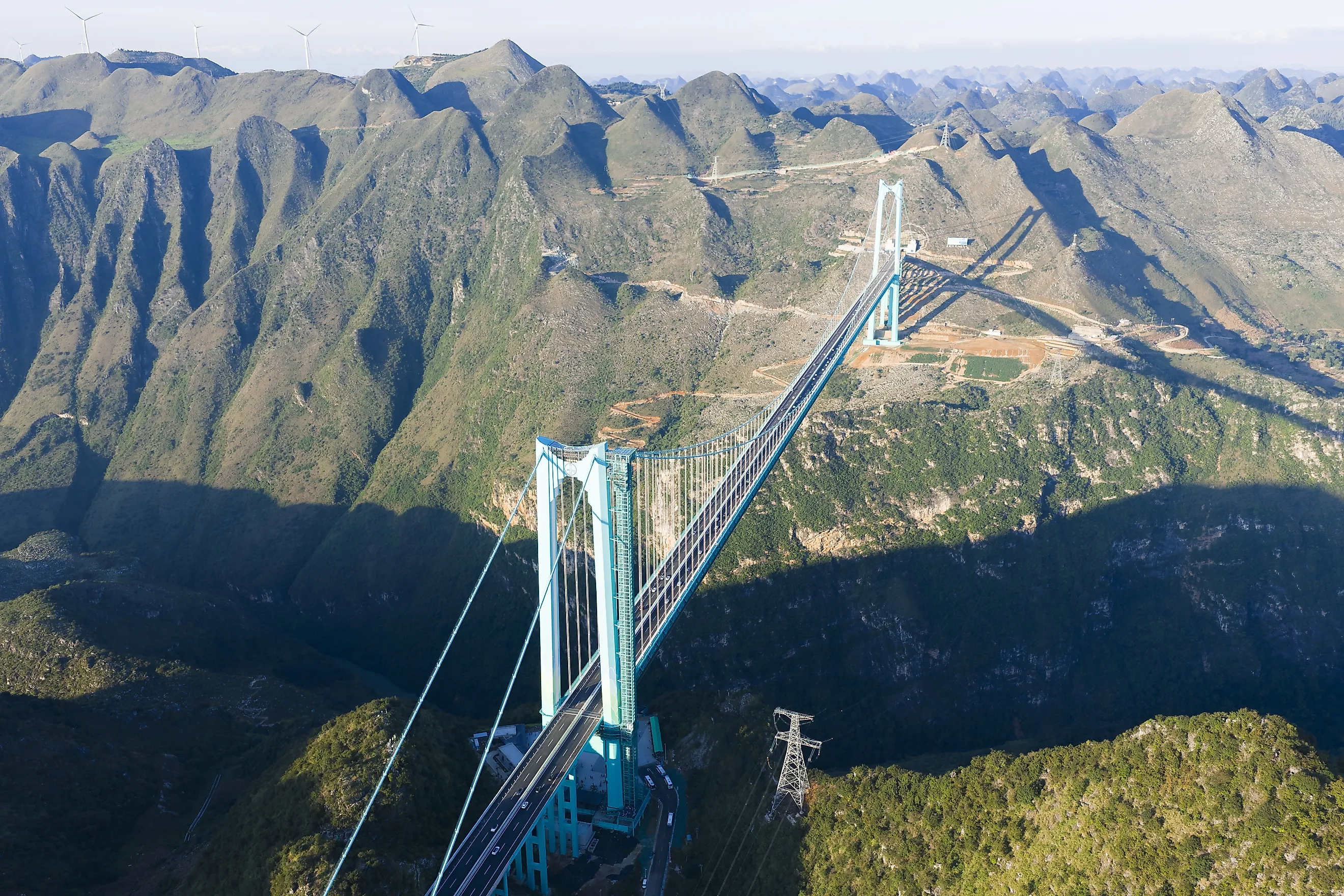
The answer changed recently enough that most reference sources are still catching up. Until September 2025 the record belonged to the Duge Bridge in southwestern China, which had held it since 2016. It now belongs to the Huajiang Grand Canyon Bridge, roughly 120 miles downstream on the same river, whose deck sits 625 meters above the water. That is 2,051 feet, which is higher off the ground than the Empire State Building is tall. Guinness World Records sent an adjudicator, measured it repeatedly, and certified the figure at 626.01 meters in April 2026.
The complication is that "highest" and "tallest" are separate records with separate holders, and the bridge that wins one does not win the other.
The Huajiang Grand Canyon Bridge

It crosses the Beipan River in Guizhou province, China, in a gorge locals call Earth's Crack, carrying the Liuzhi to Anlong Expressway. Construction started in 2021 and the bridge opened to traffic on September 28, 2025, which is under four years for a structure of this scale.
The specifications are worth laying out. Total length is 2,890 meters, about 1.8 miles. The main span between towers is 1,420 meters, or 4,660 feet, which is its own world record for a mountain bridge. The two towers are unequal because the terrain is: 262 meters on the steep north rim, 205 meters on the south. Roughly 22,000 tons of steel went into it, somewhere near three Eiffel Towers' worth.
Before the bridge opened, engineers ran a load test by driving 96 trucks across the high-stress sections over several days while sensors measured deflection.
The practical result is the part that matters locally. A crossing that took about two hours on switchback mountain roads now takes two minutes.
Highest And Tallest Are Different Records

This trips up almost everyone, including a fair number of published sources.
Deck height measures the drop from the road surface to the ground or water below. Structural height measures the bridge itself, from the top of its tallest tower down to where its piers emerge from the ground. A bridge spanning a deep gorge can have modest towers planted on the rims and still hang its deck a very long way above the river. That is exactly what Huajiang does, which is why it is the highest bridge in the world and not even in the top twenty tallest.
The tallest bridge by structure is the Changtai Yangtze River Bridge in Jiangsu, at 352 meters, which also opened in September 2025. It took that title from the Millau Viaduct in France, which had held it for more than two decades with a mast reaching 343 meters above ground.
Millau is the useful comparison because it scores well on both measures. Its tallest tower sits near the valley floor rather than on a rim, giving it real structural height, while its deck runs about 270 meters above the Tarn. Elegant, and less than half as high as Huajiang.
One River Holds Three Consecutive World Records

Here is the detail that makes this more than a stunt. The Beipan River is the only waterway on earth to have produced three successive holders of the world's highest bridge title.
In 2003 the Beipanjiang Guanxing Bridge became the first suspension bridge anywhere to clear the 1,000-foot height barrier. In 2016 the Duge Bridge, also called the Beipanjiang Bridge, went past 500 meters and was certified by Guinness at 565.4 meters. In 2025 Huajiang cleared 600. Same river, three records, twenty-two years.
The concentration is regional, not coincidental. The area roughly bounded by Kunming, Chengdu, and Yichang contains 90 of the world's 100 highest bridges. Guizhou is a province of deep karst gorges and steep plateaus where nearly every road-building problem is a bridge problem, and the province has become the closest thing civil engineering has to a proving ground.
The American Record Stood For Seventy-Two Years

Before China entered the conversation, the record was American and it belonged to Colorado.
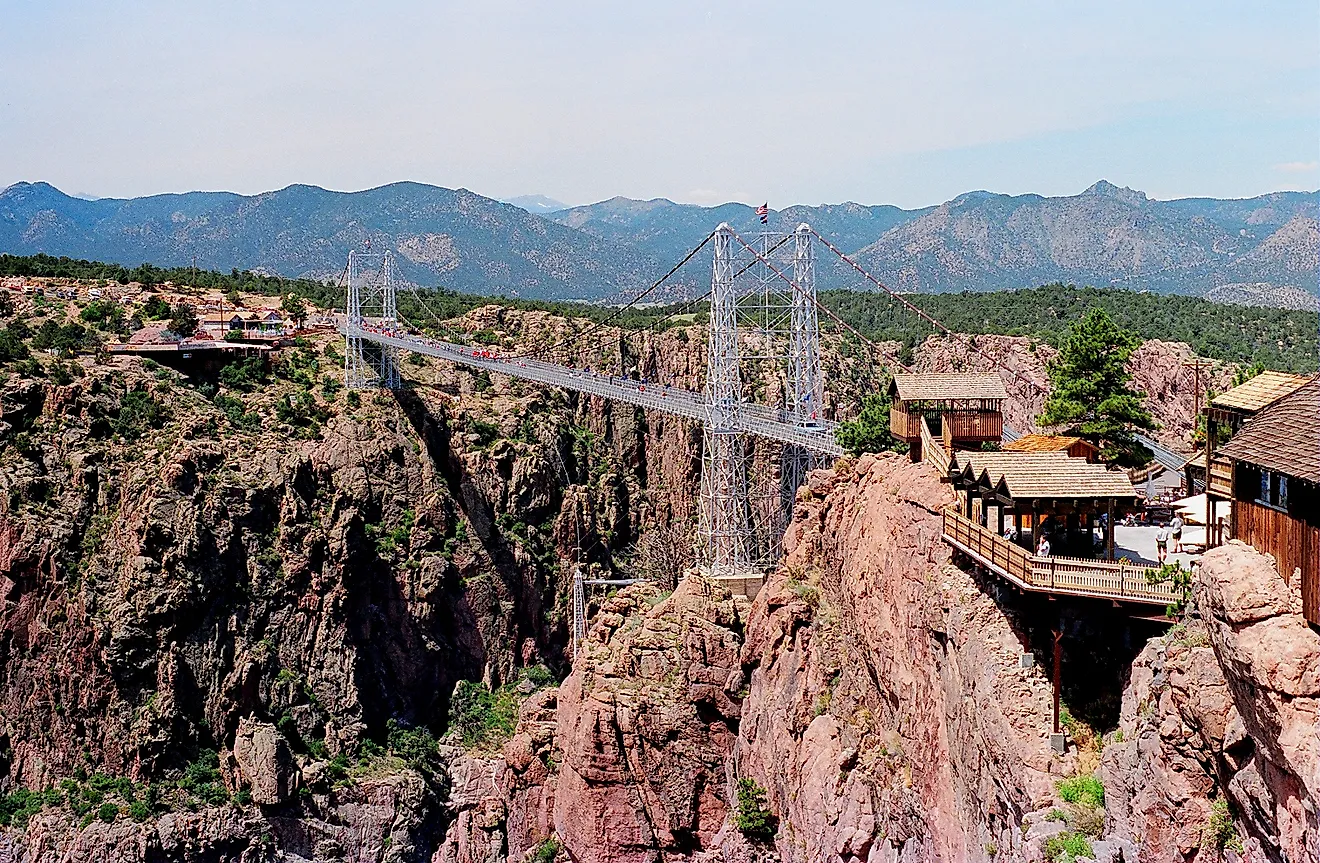
The Royal Gorge Bridge near Canon City hangs 955 feet above the Arkansas River. Crews built it in about six months during 1929 at a cost of $350,000, and it opened that December. It is a suspension bridge with a timber deck, 1,260 feet end to end, and it was built as a tourist attraction rather than a transport link, which it remains.
It held the world's highest bridge title from 1929 until 2001, when the Liuguanghe Bridge in China passed it. Seventy-two years is a long run for any engineering record. It went onto the National Register of Historic Places in 1983 and is still the highest bridge in the United States, with the New River Gorge Bridge in West Virginia second at 876 feet.
What Comes Next
Records like this one tend to fall to whoever has the deepest canyon and the strongest reason to cross it, and Guizhou is not finished. The province treats its bridges as destinations as well as infrastructure, and Huajiang opened with visitor facilities attached: glass viewing platforms, a skywalk, and plans for bungee jumping from a deck a quarter of a mile above the river. Any of those instantly become the highest of their kind anywhere.
The bridge also arrived with an economic argument. It carries an expressway through the Bouyei-Miao Autonomous Prefecture, a region long isolated by the same terrain that made the crossing famous, and the villages at the foot of the towers are now on a tourist route rather than at the end of a mountain road. TIME named it one of the world's greatest places for 2026, which is a strange honor for a piece of highway and a fair reflection of how it is being used.
What The Record Actually Measures

A high bridge is really a measurement of the terrain underneath it. Huajiang's towers are not extraordinary by modern standards. The gorge is.
Which is why these records cluster where they do. You cannot build the world's highest bridge in flat country at any budget, and you will not build one across a shallow valley either. You need a canyon deep enough to justify the crossing and a reason to want the other side badly enough to pay for it. Guizhou has both, along with a national policy of connecting remote provinces to the rest of the country.
The engineering answer to "how high can a bridge go" is therefore not really about engineering. It is about how deep the nearest gorge is, and whether anyone needs to get across it.