The Florida Town Where The Truman Show Was Filmed
When Peter Weir, the Australian director of Dead Poets Society and Witness, needed a town that looked a little too perfect for his next film, he found just the place in the Florida Panhandle.
That town was Seaside, an 80-acre planned community in Walton County that was to become the fictional Seahaven Island, the dome-enclosed television set that Jim Carrey's Truman Burbank spends The Truman Show trying to escape.
Filming began on December 9, 1996, wrapped up in Seaside in March 1997, and by the time the movie opened on June 5, 1998, Seaside was on the radar of moviegoers the world over.
Twenty-eight years later, this classic of American cinema still brings fans to town.
The Town That Looked Like a Film Set

Screenwriter Andrew Niccol's first draft of The Truman Show was set in a grim version of New York City but Weir wanted something brighter. A place so pleasant that audiences would have no problem imagining that millions of people tuned in to watch one man's uneventful life around the clock.
Paramount Pictures, the studio behind the film, reserved soundstages at Universal Studios to build the fictional Seahaven indoors, and the production scouted Florida's Atlantic coast but found nothing that fit the bill.
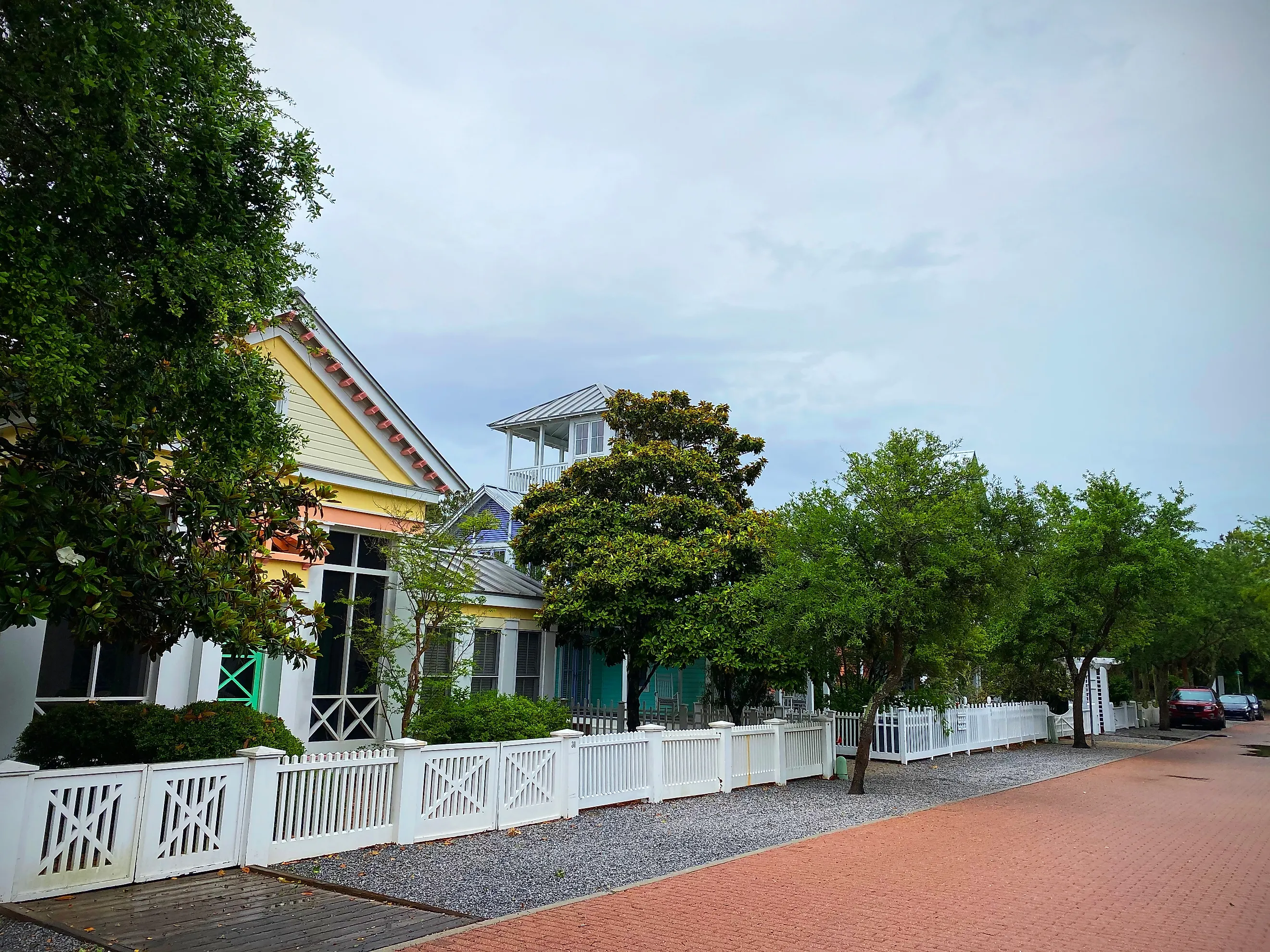
The answer came from Weir's wife, Wendy Stites, the film's visual consultant, who showed him an article about Seaside in an Australian architecture magazine. The town had been built from scratch since 1981 under a design code that called for white picket fences, front porches, and brick streets. Add the pastel-colored cottages, and it looked like a set dressed for television.

Weir flew over Seaside in a helicopter, decided on the spot, and opened pre-production offices in town. Paramount pressed for a cheaper location, but Weir refused to budge: he knew he'd found his Seahaven. With a budget of $60 million in place, film crews arrived in August 1996 to transform Seaside into Seahaven. Principal photography, the main shoot with the lead actors, began that December.
Keeping It Local

The production filled its background roles locally. Town founders Robert and Daryl Davis appear as a couple seated at a patio table, and Charles and Sarah Modica, whose Modica Market grocery store doubles as Seahaven's market, along with their son Charlie, share a scene with Carrey and Noah Emmerich, who plays Truman's best friend, Marlon.
The cast and crew stayed through the winter months, a time when the town is normally at its quietest. It wasn't until March 1997 that the production moved to Los Angeles to finish the studio work.
At the Seaside wrap party, Carrey climbed on stage with a local band led by Tom King, owner of Central Square Records, the town's record store, and sang Mustang Sally, the Wilson Pickett soul standard. It was a fitting tribute to a town that had spent the winter playing host to Carrey and his fictional character, and to the locals who had helped make it all happen.
Finding Truman's House
Seaside's best-known filming location is a privately owned yellow-and-white cottage at 31 Natchez Street. One of Seaside's original homes, it's located on the western edge of town, and in the movie is shared by Truman and his wife Meryl. It's where Carrey steps through a green front door each morning to greet his neighbors with the line, "Good morning, and in case I don't see ya, good afternoon, good evening, and good night."
The owners have kept the fictional house number, 36, above the door. They've also named the property The Truman House in tribute to the film, and you can see the sign by the gate. It's worth noting that the house isn't open to visitors, so be courteous and only take photos from the brick street out front.

Remember the Modicas? Their grocery store and deli, Modica Market, is still running on Central Square, the town's main square, and has been open since March 17, 1989. Pop in, and you'll see a framed poster from the film still on display inside.
The Seaside Post Office on the same square, a white columned building that the town's developers describe as one of the most photographed post offices in the country, turns up in Truman's daily routine.
Around Town
The Tupelo Gazebo just east of Central Square also turns up in Truman's routine. Built in 1984 as Seaside's first public building, it's the spot where town founders Robert and Daryl Davis were married.
Ruskin Place, a lawn lined with three-story townhouses with galleries and boutiques on the ground floors, was another backdrop. It lies between Central Square and the Seaside Chapel, the town's interfaith church, built after filming.
Every scene featuring the beach and ocean was filmed on an undeveloped stretch of sand between Seaside and Grayton Beach State Park, 1.4 miles west of town. This parcel of land is now occupied by the WaterColor Inn & Resort, whose restaurant, Fish Out of Water, overlooks the same sand dunes.

The marina where Truman tries to board the Seahaven ferry and freezes at the sight of open water is Tucker Bayou at Point Washington, five miles north of Seaside on Choctawhatchee Bay. It's located next to Eden Gardens State Park, the former estate of the Wesleys, a Point Washington lumber family.
Out With the New, In With the Old
The story of just how picture-perfect Seaside came to be is as compelling a tale as how the town came to be in a movie.
In 1946, J.S. Smolian, owner of the Pizitz department store in Birmingham, Alabama, paid $8,000 for 80 acres of scrub and dunes next to Seagrove Beach, intending to build a summer camp for his employees.

The camp never happened, but the family kept returning every summer, and in 1978 Smolian's grandson, Robert Davis, a Miami developer, inherited the land. Davis and his wife, Daryl, moved to nearby Grayton Beach while they worked out what to do with the property.
Rather than put up just another row of condos like those then going up along the Panhandle in Destin and Panama City Beach, they opted to go in a completely different direction.
Building a Town From Scratch
The Davises hired two young Miami architects, Andres Duany and Elizabeth Plater-Zyberk, who then toured small towns across the South, studying how streets, porches, and squares worked in places laid out before the automobile.
Their plan followed a point made by the urban theorist Leon Krier: 80 acres is the area inside a quarter-mile radius, the distance most people will walk without thinking about it.

Construction began in 1981 with two houses and a single street, and the master plan and urban code were in place by 1982. The result is what Seaside's developers call the birthplace of the New Urbanism movement, an approach to planning that favors walkable neighborhoods of mixed homes and shops over the car-dependent suburbs.
The Seaside Design Code still sets the rules about what can (and can't) be built. White picket fences are in, though no two on the same street may share a picket design, and lawns that require irrigation are out. Streets are also aligned to frame views of the Gulf of Mexico and it works. Seaside now has more than 300 homes.
Pretty Pavilions and Other Cool Features

The structures that stand out most in the movie's wide shots are those pretty beach pavilions. Nine of them line Seaside's Gulf front, each designed by a different architect, and each owned by the homeowners of the street it serves.
One of two exceptions is the Coleman Pavilion, the white obelisk-shaped tower at the foot of Central Square. It belongs to the Seaside Development Corporation, the Davises' company, and is the main public access from the town center to the beach.
The tallest building in town is the Seaside Chapel, a nondenominational interfaith church completed in 2001 to a design by Scott Merrill, Seaside's town architect from 1988 to 1990. It's white with board-and-batten walls and a 68-foot bell tower, and its interior features heart pine floors cut from the dense center of old longleaf pines.

The seaside chapel that was featured in the Truman Show. Editorial credit: Andriy Blokhin / Shutterstock.com
Several smaller details are worth looking at. Central Square is planted with 52 Medjool date palms. They were cloned from a single tree so that they'd grow at the same rate. Krier Plaza is a Gulf-view lot that could have been sold for shops but was left as a public space with no retail at all. The Seaside Amphitheater, the lawn where movies are screened and concerts hosted, doubles as a stormwater detention basin, a low area built to hold rainwater after heavy storms, so the streets don't flood.
Airstream Row arrived three years too late for the film shoot, but you can't talk about Seaside without it. This line of vintage aluminum trailers serves food along Scenic Highway 30A, the coastal road through South Walton's beach towns. Six vendors have set up shop on the row, including Frost Bites, Barefoot BBQ (with two trailers), and Crêpes du Soleil.
A Lasting Legacy
Remember Charlie Modica? He was in his mid-30s when he appeared in the movie stocking shelves in his parents' grocery store and has since credited the movie with the crowds that fill Central Square today. And you'll see them pretty much everywhere around town.
When Truman finally walked out through a door in the painted sky, the real town that played Seahaven was only 15 years old and was known mostly to architects and planners. The crews dressed it for the cameras, but the picket fences, the brick streets, the post office, and the Tupelo Gazebo were already there. Which is why Peter Weir picked it over a soundstage and Seaside has been basking in its fame ever since.