8 Most Rattlesnake Infested Areas in Arkansas
Rattlesnakes are coiled and hidden in every corner of Arkansas, from low elevation bluffs over the Arkansas River in the southeast to rocky outcrops on the slopes of the Ouachita Mountains in the west. There are three different species of rattlesnakes in the state whose presence you should be aware of when recreating outdoors: the Western Diamondback Rattlesnake, the Timber Rattlesnake, and the Western Pygmy Rattlesnake. If you are heading into rattlesnake-infested areas like Rattlesnake Ridge Natural Area and the Ouachita National Forest, move carefully, watch where you step, and know which snakes you might meet there.
Rattlesnake Ridge Natural Area

As its name would suggest, Rattlesnake Ridge Natural Area is a haven for Rattlesnakes. This natural area is both a preserve for rare plant and animal species, and a recreational multi-use area with six miles of trails for both hiking and mountain biking at all levels. The ridge is one of the most striking rocky summits in the eastern Ouachita Mountains, composed of sandstone, stretches three-quarters of a mile wide, and rises 920 feet above sea level. From the summit, it grants panoramic views of Lake Maumelle, Pinnacle Mountain, and Shinall Mountain.

The ridges and uplands of the Ouachita Mountains provide habitat for the Western Diamondback Rattlesnake, a species of state conservation concern. Western Diamondbacks are heavy-bodied rattlesnakes with gray-brown backs marked by dark diamond shapes outlined in pale scales, ending in a bold black-and-white banded tail with a prominent rattle.
Ouachita National Forest

The Ouachita National Forest spans 1.8 million acres across central Arkansas and southeastern Oklahoma, making it the largest and oldest national forest in the southern United States. It is composed of rolling hills, lakes, rivers, and streams. The forest contains recreational areas, wilderness areas, national and wild scenic rivers, and 700 miles of trails.

But be careful on the trails because the Western Pygmy Rattlesnake has been observed on the trails through the forest. The Western Pygmy Rattlesnake is a small, gray snake with dark spots and often a thin reddish-orange stripe down the back. They are found statewide but prefer forested areas with dense thickets for ground cover, as they are generally shy animals that rely on camouflage and cover to avoid detection by predators.
Dale Bumpers White River National Wildlife Refuge

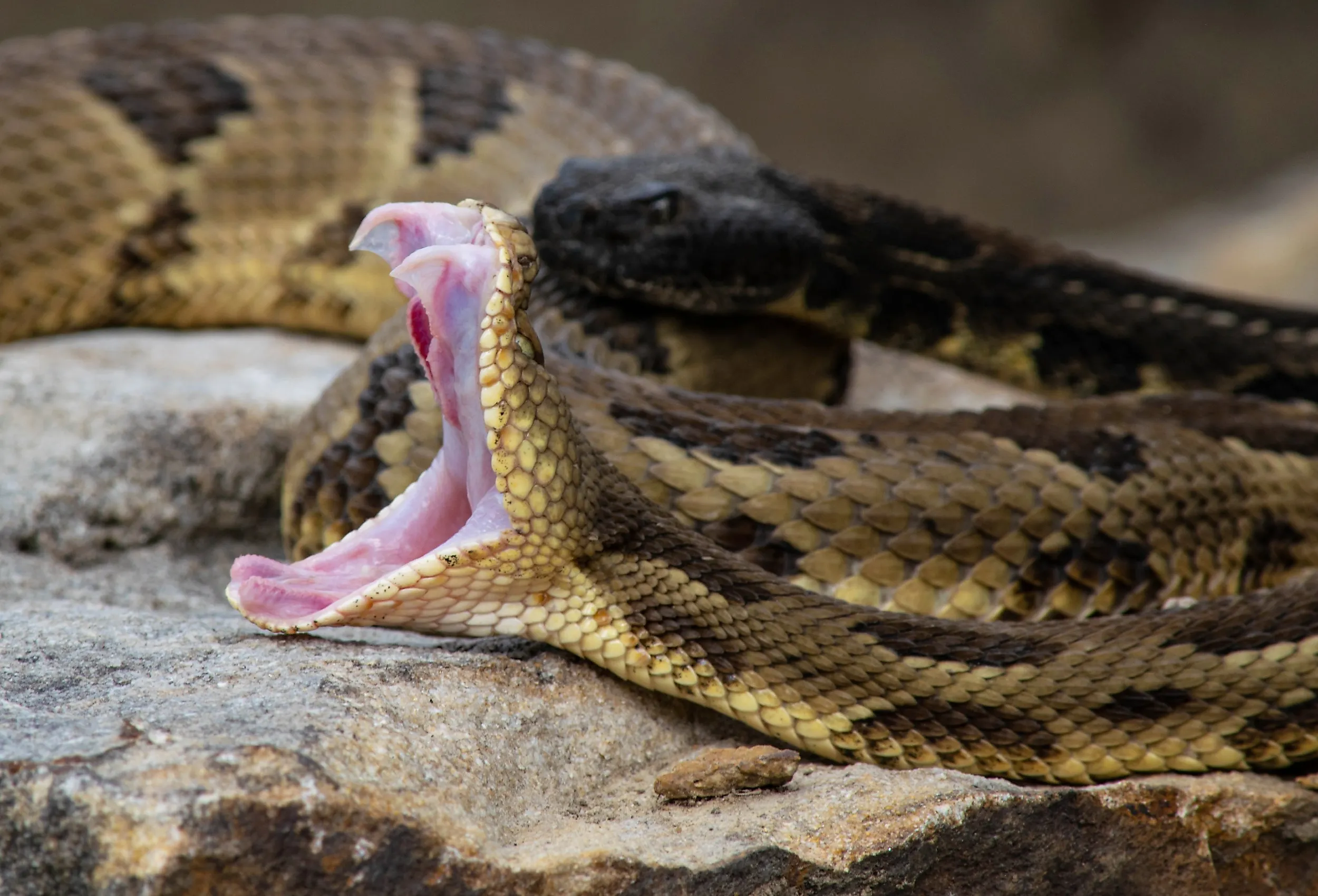
Dale Bumpers White River National Wildlife Refuge is the largest contiguous block of bottomland hardwood forest under single ownership in the United States. It spans 160,000 acres across the floodplain of the White River, near its confluence with the Mississippi River. Recreational activities include camping, fishing, hiking, and wildlife observation, as the refuge is home to Arkansas’s only native population of Black Bears and at least four bald eagle nests. Snakes are also commonly seen, including the Timber Rattlesnake, which is accustomed to the bottomland hardwood forests of the refuge. Timber Rattlesnakes are usually yellowish-brown to gray with dark bands, but some are also black.
Petit Jean State Park

Petit Jean State Park is Arkansas’ first state park and one of the most popular in the state. Located on Petit Jean Mountain, the park has many natural features, including forests, ravines, streams, vistas, and formations such as the 70-foot Cedar Falls, accessible via a 2-mile round-trip hike. The park is accessible year-round, hosting events throughout the year, including Eagle Awareness in January, Fun and Games Day for Fourth of July Celebrations, and a Christmastime Open House in December. The Seven Hollows Area provides habitat for a variety of snake species, including Western Diamondback Rattlesnakes, which have been documented on Petit Jean Mountain.
Buffalo National River

The Buffalo National River was the first National River to be designated in the United States. As it flows freely for 135 miles, it is therefore one of the last remaining undammed rivers in the lower 48 states. The river rises in the Boston Mountains of the Ozark Plateau and flows from west to east before it enters the White River. Although it is a national river, the park includes land as well as the river itself, amassing a total size of 94,392 acres. Over 100 miles of public trails have been created for public use, including specially designated horseback riding trails. Several venomous snakes are found throughout the park, including copperheads, cottonmouths, and rattlesnakes.
Greers Ferry Lake

Greers Ferry Lake is rooted in the foothills of the Ozark Mountains and is one of the top five largest lakes in Arkansas. The lake was created as a result of the Greers Ferry Dam on the Little Red River. The concrete dam was built between 1959 and 1962 primarily for flood control purposes, although now it also operates as a hydroelectric power plant. The lake is popular among outdoor enthusiasts who love getting on the water for great fishing, boating, and water sports.

Greers Ferry Lake is known to have occasional visits from Timber Rattlesnakes. Although it is not typical Timber Rattlesnake habitat, they are known to occasionally stray from the mountainous terrain they are suited to and forage in wetlands and wetland edges such as rivers, lakes, and streams.
Arkansas River Valley

The Arkansas River Valley is one of six natural divisions of Arkansas, paralleling the Arkansas River for most of its length. The Arkansas River rises in the Rocky Mountains and flows east-southeast for 1,460 miles before it enters the Mississippi River in Arkansas. The Arkansas River Valley is up to 40 miles wide in sections with isolated, flat-topped, steep hills. The eastern end of the valley is forested, whereas the western end is characterized by open woodland, savanna, and prairie.
The Timber Rattlesnake is found in the lower elevations of the Arkansas River Valley. Timber Rattlesnakes occupy habitats that are rich in dense forests with ample leaf litter that aids in camouflage. Whereas, rocky outcrops act as basking and denning sites where they will hibernate communally. Western Diamondback Rattlesnakes also have a sparse distribution on the mountainous portions of the Arkansas River Valley.
Boston Mountains

The Boston Mountains are part of the Ozark Plateau in north-central Arkansas, stretching 200 miles into Oklahoma. They are typically rugged mountains about 30 to 35 miles wide with gorge-like valleys. The rocks that make up the Boston Mountains are mostly sandstone and shale, which were deposited between 290 and 323 million years ago. The tops of the mountains, cliffs, and steep slopes are formed from sandstone, as this is more resistant to erosion than shale.

The slopes of the Boston Mountains are forested and difficult to navigate, with much of the mountain still sparsely populated. Western Diamondback Rattlesnakes have been documented in the southern Boston Mountains and favor steep rocky gorges and hills.
Reduce the Risk of Rattlesnake Encounters
These eight locations across Arkansas showcase how adaptable rattlesnakes are, capable of inhabiting many different habitats from the shores of Greers Ferry Lake to the steep, rocky slopes of the Boston Mountains. While snakes of any kind, not just the venomous ones, can ignite fear in people, observing one in the wild is actually a sign of a healthy ecosystem, as snakes act as natural pest control for vermin like mice and rats, and also as prey to other predators like eagles.
If you want to reduce the risk of rattlesnake encounters, then always make sure you are wearing the appropriate footwear, keeping your hands and feet out of places you can’t see inside of, and if you do spot a rattlesnake when hiking through places like the Ouachita National Forest, absolutely do not disturb.