8 Best Attractions To Visit In Texas
As the second-largest state in the United States, Texas provides many opportunities for access to attractions and activities, like Gulf Coast beaches and Hill Country hiking. You can begin in a big city like Dallas or go to see the famous landmarks, such as the Alamo. Far-off areas like Big Bend National Park seem completely different from cities like San Antonio or Houston, yet both types greatly influence the way people get to know Texas. If you are heading outside or soaking up some Texan culture, these places spell out what sets the Lone Star State apart. Check out eight of the best attractions in Texas.
Big Bend National Park

Early in the twentieth century, government officials shifted their focus toward an out-of-the-way part of West Texas destined to become Big Bend National Park. Early conservation efforts focused on documenting the region’s rare desert ecosystems along the Rio Grande and raised concerns about the impact of mining and livestock grazing on the landscape. Over time, political momentum to protect the area crawled forward, and Congress ended up officially approving the park in 1935. Public access followed in 1944, once land purchases and New Deal conservation projects established the park’s basic infrastructure.
Along the southern edge of the state, this park occupies a wide bend of the Rio Grande, which also marks the Mexican border. Even now, its isolation continues affecting travel inside Big Bend National Park in a major way. There are long drives between sites and limited services are available throughout.
As you step into Santa Elena Canyon, set beside the Rio Grande, towering limestone cliffs loom, tightly framing the river’s path. The Ross Maxwell Scenic Drive winds through the park’s western side, passing dramatic desert scenery and exposed volcanic formations. Then, smack in the middle of the park, the Chisos Mountains shoot up from the desert, forming a tough central mountain mass right at the heart of Big Bend.
The Alamo

Long before it became a symbol of sacrifice, the Alamo began as Mission San Antonio de Valero, founded in 1718 as part of Spain’s colonial mission system. Tensions rose after Anglo-American settlers and Tejano allies rejected President Antonio López de Santa Anna’s move toward centralized power. By late 1835, Texian forces seized the former mission and fortified it. In early 1836, Mexican forces surrounded the Alamo and began a siege that lasted 13 days. The final assault ended with the deaths of nearly all Texian and Tejano defenders inside the. News of the defeat spread quickly and became a rallying cry that reshaped the course of the Texas Revolution.
Nowadays, you will find the Alamo in downtown San Antonio, integrated right into the busy city opposed to sitting off as an isolated landmark. Inside, interpretation includes the site’s Spanish mission origins and its later military history, expanding beyond the famous battle. Within, rough limestone walls remain exposed, placing visitors inside the same structure that stood during the siege. On the other side of the plaza, the Long Barrack galleries showcase documents and personal belongings dug up right from the site. At plaza level, markers set into the pavement trace where the Alamo’s original walls once stood and identify buildings that no longer exist, like the Low Barrack and the Alamo palisade.
San Antonio River Walk

Following a huge flood in 1921, municipal leaders gave support to a plan to control a curve of the San Antonio River flowing through the center in downtown. Robert H. H. Hugman, an architect, would later pitch lowering the walkways beneath street level rather than simply capping the river, and in the 1930s, the Works Progress Administration crews got rolling to make it happen. What was previously a muddy channel changed into a corridor for pedestrians bordered by stone bridges and stairways. Thus, the River Walk came into being.
The passage runs roughly 15 miles through the city with its most visited stretch looping past Commerce Street and Houston Street. A river barge tour, like the GO RIO River Cruises, is a popular option and offers a slow look at how downtown has grown along the water. Here you pass theaters and early hotels that helped shape the city’s core.
A few minutes heading south brings you to La Villita Historic Arts Village. Here, adobe-style buildings — some of the oldest in San Antonio — now house artist studios and shops. Along the River Walk, Dinner often consists of getting a riverside seat at restaurants such as Boudro’s Texas Bistro, a local favorite, where the guacamole is being prepared directly at your table. The spot also sets you up with a view beneath the Market Street Bridge. Once night falls, light bounces off the cypress trees and old stone walls and the whole area feels truly unforgettable after the sun sets.
Enchanted Rock

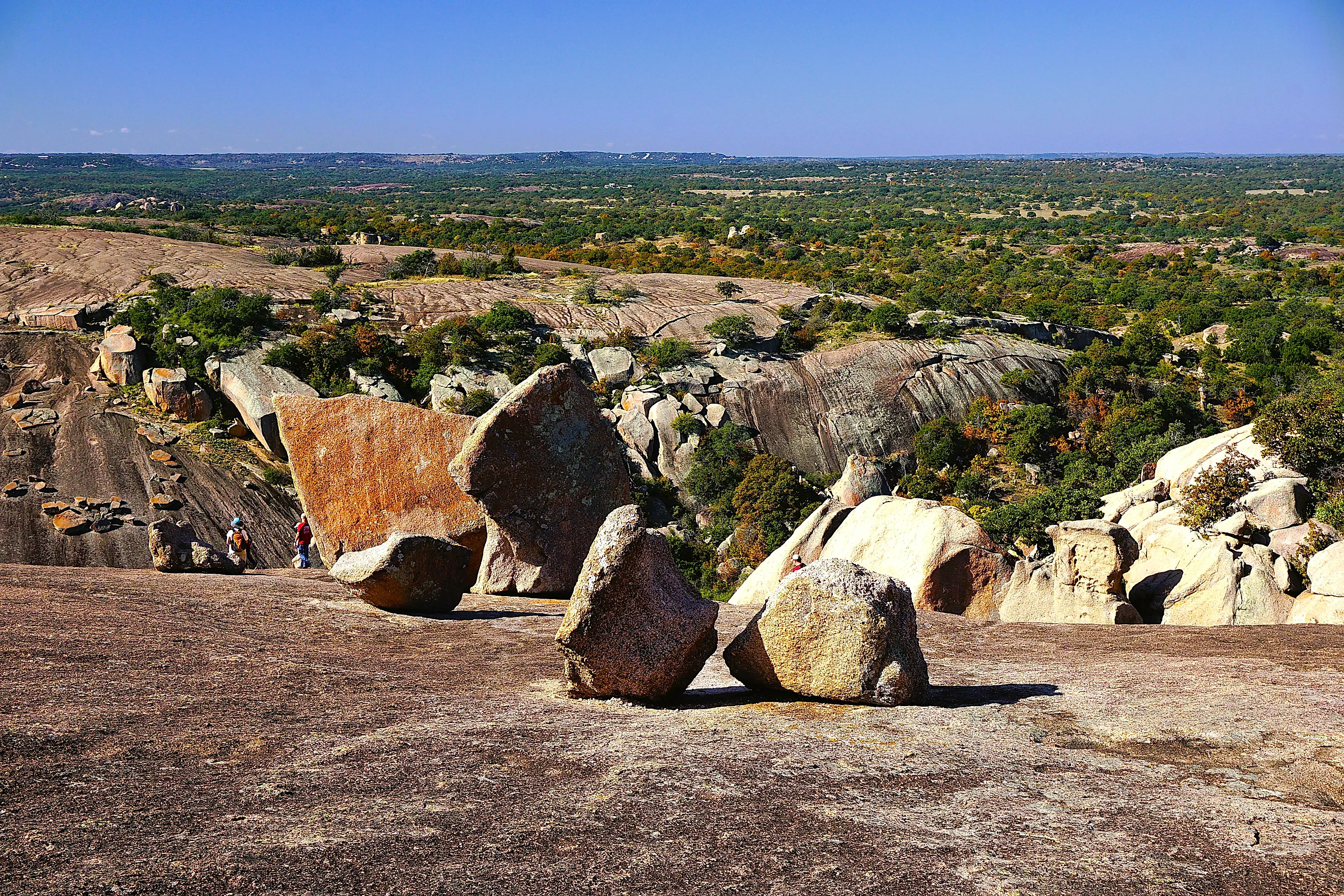
Long before you reach Enchanted Rock, you sure will notice it. Pressing up above the surrounding forests, Enchanted Rock State Natural Area rests on an enormous pink granite dome that is hundreds of feet high. It was first visited for millennia by Indigenous peoples and later explored by Spaniards and settlers. Over time, legends of spirits gave it its name. The park sprawls across more than 1,600 acres, planted just north of Fredericksburg. People often take the Summit Trail, a short but demanding hike of about 0.8 miles round trip that climbs directly up the granite dome.
When people reach the top, they can stand on the grand open space where clear views spread across all directions in the Hill Country. On the south end of the natural area, the snug paths in Echo Canyon, carved out by dropped granite slabs, actually feel colder than the area's wide open spots. When rain shows up, you might catch fleeting puddles building up in those rocky pockets, making room for mysterious aquatic critters such as fairy shrimp. Technical climbing is allowed with the proper permit, most commonly on the sun-facing main dome, though some climbers choose nearby features such as Little Dome.
NASA Johnson Space Center

NASA Johnson Space Center stands as one of Texas’s most compelling attractions because it puts visitors face-to-face with real spaceflight history. The complex anchors human space exploration in the United States and the scale feels immediate. The site’s Historic Mission Control is not a replica. It is the Apollo-era control room used to guide Apollo 11 to the Moon and is now preserved as a historic space. Nearby, tram tours roll past astronaut training pools and massive rocket hardware still bearing marks from testing.
Inside you can see the Saturn V rocket running almost the whole length of a football field, with visitors always pausing to stare. At the Lunar Samples Vault, visitors can interact with material brought back from the Moon. Also, the International Space Station Gallery features actual-size modules, showing how tight and packed astronauts’ living conditions really are, month after month. Rolling out into Independence Plaza, you will spot the shuttle replica Independence riding atop NASA 905, the Shuttle Carrier Aircraft. Visitors walk through the aircraft cabin and then into the shuttle’s flight deck. The view from the top deck looks across the full Johnson Space Center campus.
Padre Island National Seashore

Padre Island National Seashore was established to protect a long stretch of Gulf shoreline from overdevelopment and private acquisition. Congress approved the park in 1962 following years of discussion about development pressures on Padre Island. The National Park Service started to open parts for the visitors during the late 1960s, with protection focused on the island’s natural systems and wildlife.
The seashore starts south of Corpus Christi at Malaquite Visitor Center, and continues further down the island for miles. On the Gulf side, North Beach is the main access point for people hoping to drive on solid sand when weather permits. Visitors planning to drive on the beach should have a suitable vehicle, and certain activities, such as overnight camping, require a permit.
On the bay side, the shallow, clear waters of Laguna Madre gives the chance for some kayaking during the morning, especially close to the Bird Island Basin, a popular windsurfing and birding spot. During sea turtle nesting season, check the visitor center for hatchling release information since the Kemp’s ridley sea turtle nesting activities are considered some of the park’s most important projects.
Fort Worth Stockyards

Of course, you can't talk about Texas and leave out the cowboys and longhorns. The Fort Worth Stockyards developed in the late 19th century, becoming a major center for cattle shipping and trade connected to the Chisholm Trail. Fort Worth eventually became a key railhead for cattle drives heading north to markets. Traders could hop on the rail lines — a big reason everybody still calls it “Cowtown.”
Nowadays, the Stockyards sit north of downtown Fort Worth, set apart from all the newer modern parts of the city, with its own old brick streets and what used to be the bustling livestock buildings. Exchange Avenue runs through the center of the district and remains its main draw. Longhorn cattle drives happen twice every day, winding along a short trail past all sorts of busy shops and places to eat.
Built back in 1908, Cowtown Coliseum gets busy on weekends, with rodeos packed with things like bull riding and barrel racing. The Livestock Exchange Building anchors the neighborhood and features displays showing how cattle auctions used to run. For something a bit different, Billy Bob’s Texas fills an old livestock barn, working as a popular music spot where people can hit the dance floor or grab drinks. Lastly, you can swing by the Texas Cowboy Hall of Fame, which highlights rodeo pros and Western artists who are part of the area’s work-driven story.
Palo Duro Canyon State Park

These days, people call Palo Duro Canyon Texas’s own version of the Grand Canyon. Over the years, all sorts of people have passed through its lands. First, Indigenous people strolled through the canyon depths. Later, ranchers came in and used the canyon cliffs as a shield for cattle and to create pasture. You can find the park over in the Texas Panhandle, not far from the town of Amarillo, where the Prairie Dog Town Fork of the Red River carved a chasm straight into the High Plains.
Lighthouse Rock is the park’s standout landmark, jutting solo from the canyon floor with a top so slender it instantly calls to mind a lighthouse. You will spot it along the Lighthouse Trail, which goes straight to the base and pulls in the bulk of hikers. The trail stretches about three miles one way across the open canyon floor before climbing to the base of the canyon’s iconic stone formation.
Capitol Peak is a challenging mountain-biking trail and gives an opportunity to see wide views over the red rock formations of the canyon and also the surrounding plains. Pioneer Amphitheater sits right among the canyon walls, and hosts the Texas Outdoor Musical during summer nights with the rocky scenery playing its part as a beautiful background.
Texas will leave a strong impression long after your trip ends. Each of these places provide a clear window into the state’s unique character and historical past. From remote vistas to places packed with history in urban cores, these spots hammer home just how diverse Texas is, and explain why people end up returning nonstop. If you want to check out the top Texas destinations, do not pass up these picks.