The 7 Can't-Miss Towns In Australia
Australia is home to some of the most beautiful scenery in the world, from Southern Ocean headlands to reef-fringed tropics and wine-country coasts cut by limestone caves. These are places where the draw is specific and measurable, finishing the 1,000-kilometre Bibbulmun Track in Albany, walking straight from Hastings Street into Noosa National Park, or standing above 50-metre cliffs in Margaret River before lunch at a cellar door. This article brings together seven towns that stand out for coastal exposure, cultural depth, or how much they fit into a single postcode. If you’re planning a trip and want destinations with clear reasons to anchor an itinerary, start here.
Albany

Albany was established in 1826, years before Perth, and remains the oldest colonial settlement in Western Australia. What distinguishes Albany is not just its history, but how closely it sits to some of the state’s most exposed coastline. At The Gap and Natural Bridge in Torndirup National Park, a steel walkway extends out over a 40-metre drop into a tight ocean channel. Waves roll in from the Southern Ocean and hit the rock walls without anything slowing them down. The sound is constant. A few minutes' walk away, the Natural Bridge shows how the granite has been cut through, leaving a thick arch over the water.
Albany is also where the Bibbulmun Track ends after running 1,000 kilometres from Kalamunda. The final stretches near town pass through low coastal scrub with open sea views before moving into taller forest. Many walkers finish their journey here and walk down to the water. The town’s history is laid out at the Museum of the Great Southern, which covers Noongar culture, early settlement, and Albany’s link to the first ANZAC convoy in 1914. Not far away, The Blowholes send air and spray up through narrow cracks in the rock when the swell is strong. The noise travels across the headland before the burst of water appears.
Leura

Leura is nearly 1,000 metres above sea level on the edge of the UNESCO World Heritage-listed Blue Mountains. At Sublime Point Lookout, a short bush track crosses a narrow bridge over a steep ravine before reaching a wide sandstone platform suspended above the Jamison Valley. The Three Sisters are visible from here, but from a side angle.
For those heading down, the Federal Pass drops from Leura Cascades through Fern Bower and into Leura Forest, running roughly 13 kilometres along the base of the cliffs. Built in 1900, it passes Linda Falls and Lila Falls, with sections of dense rainforest that sit in deep shade beneath the sandstone walls. Back above the escarpment, Everglades House and Gardens covers 5.2 hectares of terraced grounds designed in the 1930s by Paul Sorensen, with dry-stone walls, a grotto, a garden theatre, and open views to Mt Solitary. Not far away, Bygone Beautys Treasured Teapot Museum houses more than 5,500 teapots in a historic cottage, where traditional silver service high tea is still served on weekends.
Margaret River

Margaret River is in a pocket of Western Australia containing ancient limestone cave systems, one of Australia's most celebrated wine regions, 50-metre granite sea cliffs, and a world-class surf coast. Lake Cave is the most striking of the six show caves along Leeuwin-Naturaliste Ridge, accessed by descending a staircase through a sunken karri forest doline. The cave holds a permanent underground lake, so still it mirrors the stalactites hanging above it, creating a crystal double image that is genuinely unlike anything else in the country.
The surrounding landscape allows foot tours via the Cape to Cape Track, a 123-kilometre coastal walk between the lighthouses at Cape Naturaliste and Cape Leeuwin, rated one of Australia's top multi-day trails. The section past the Wilyabrup Cliffs, where 50-metre granite faces drop directly into the Indian Ocean, is as raw and dramatic as coastal walking gets. For the wine side, Vasse Felix is the obvious starting point, established in 1967 as the Margaret River region's first winery. It houses both a serious cellar door and a gallery of Australian art, with tastings that trace the full arc of the region's winemaking evolution. On Saturday mornings, the Margaret River Farmers Market draws locals and visitors alike with stalls selling regional produce, local cheesemakers, olive oil producers, bakers, and small-batch growers. It is widely regarded as one of Western Australia’s best regional markets.
Noosa Heads

Noosa Heads is one of the few places in Australia where you can walk from a UNESCO Biosphere Reserve into a World Surfing Reserve, then have lunch on one of the country's most celebrated dining strips without getting in a car. The Noosa National Park Coastal Walk starts at the edge of town and runs along the headland for up to 11 kilometres return. It passes Tea Tree Bay and Granite Bay before opening into Alexandria Bay. Dolphins are regularly seen tracking the shoreline, and during whale season, migrating humpbacks pass within view of the higher lookouts.
Upstream, the Noosa Everglades stretch roughly 60 kilometres through the upper reaches of the Noosa River. Often called the River of Mirrors, the dark, tannin-stained water reflects the surrounding paperbark forest with near-perfect clarity. It is one of the few everglade systems in the world outside North America and supports around 44% of Australia’s bird species. Kayak access from Elanda Point places visitors directly into that still, narrow waterway. Back along the coast, the Noosa World Surfing Reserve protects the long right-hand point breaks at First Point and Tea Tree Bay, breaks that have shaped the town’s identity. Just behind it, Hastings Street runs for roughly 600 metres under pandanus and palms, with restaurants and cafés opening directly toward the sand, especially busy as the light fades over Main Beach.
Yamba

At the mouth of the Clarence River on the NSW North Coast, Yamba has a stretch of coastline and surf culture that earned it a spot among Australia's best surf towns. Angourie Point Beach and Reserve is the centrepiece of that surf reputation, designated as NSW's first National Surf Reserve in recognition of its significance to Australian surfing history since the 1960s. The point break here draws serious wave riders while Spooky Beach on its southern edge offers some of the best snorkelling in the region. Just inland from Angourie, the Blue and Green Pools are the town's most genuinely surprising attraction, former rock quarries that accidentally struck an underground freshwater spring in the 1890s, now deep, clear swimming holes framed by towering rock faces that locals dive from daily, sitting just metres from the ocean in a bush reserve that carries cultural significance for the Yaegl people.
The Yuraygir Coastal Walk begins at Angourie Point and stretches 65 kilometres south through Yuraygir National Park, one of the longest stretches of undeveloped coastline in NSW, passing isolated beaches, rocky headlands, quiet lagoons, and native forest with almost no infrastructure along the way. For something laid-back, the Clarence River Ferry runs between Yamba and the sleepy fishing village of Iluka across the river mouth, a short crossing that feels a world apart.
Hahndorf

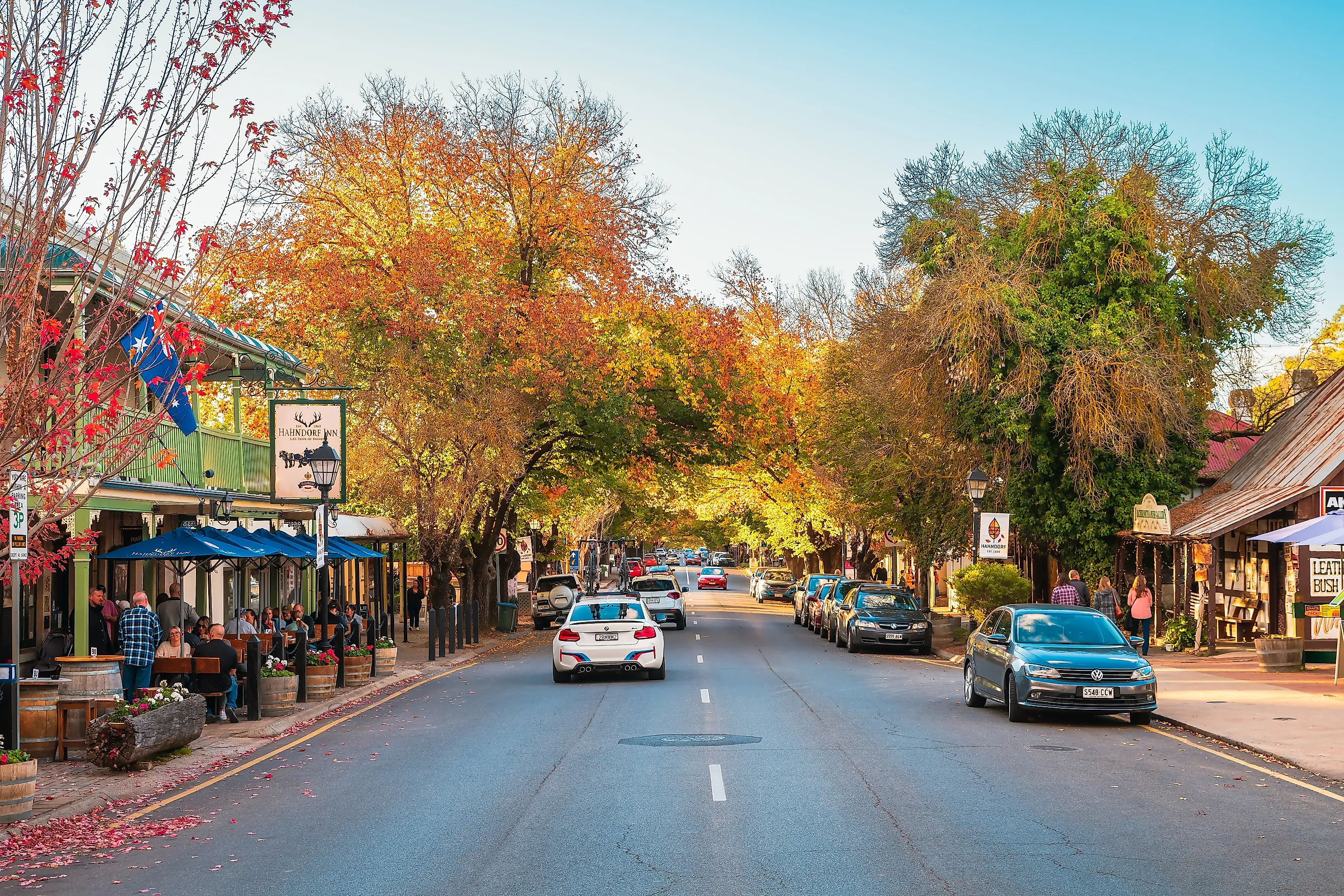
Hahndorf’s tale began in 1839, when Lutheran families from Prussia stepped off the ship Zebra and settled in the Adelaide Hills of South Australia. Just outside town, The Cedars keeps the home and working studio of Sir Hans Heysen much as he left it in 1968. The property covers 160 acres, including the same gum trees that appear in his paintings. Inside the studio, unfinished canvases and paint marks remain in place, giving a clear sense of how he worked.
Back in the village, Hahndorf Academy occupies an 1857 schoolhouse where children once learned German and English side by side. The upstairs classroom still holds its timber desks and pot-belly stove. Exhibits detail the journey from Prussia and how those early farmers reshaped the surrounding hills. That farming thread continues at Beerenberg Farm, a property run by five generations of the Paech family, with strawberry picking from November through April.
Port Douglas

The Queensland gem of Port Douglas delivers what few Australian towns can: direct access to both the Great Barrier Reef and one of the world’s oldest tropical rainforests. Four Mile Beach runs the entire length of town with consistent swimming conditions year-round. During stinger season, from November to May, netted swimming enclosures are set up for safe ocean access. That same dual-environment appeal continues at Rainforest Habitat Wildlife Sanctuary, an eight-acre wildlife park designed around walk-through environments. Cassowaries move through the rainforest section, while tree kangaroos occupy elevated platforms that mimic canopy life. In the wetlands, breakfast sessions bring flocks of parrots directly to the tables.
The heritage side of Port Douglas centers on St Mary's by the Sea, a tiny 1910s timber chapel perched on rocks where king tides send waves crashing against its foundations, creating one of Queensland's most dramatic church settings. Everything concentrates along Macrossan Street, where multiple walkable blocks host reef tour operators offering same-day departures to Agincourt Reef's ribbon formations, restaurants serving locally caught coral trout, and the 1879 Court House Museum, which displays the town's pearling and gold rush origins.
Tourists Can’t Miss These Towns When Visiting Australia
From reef-edge towns to highland villages founded in the 1830s, these can’t-miss towns in Australia prove that small places can hold outsized experiences. Paddle the tannin-dark water of the Noosa Everglades in the morning, then watch long right-handers peel in by afternoon. Walk beneath the sandstone cliffs near Leura or stand above the Southern Ocean in Albany. Each town earns its place through substance, not hype, and each one is worth planning around.