7 Wonders of the Modern World
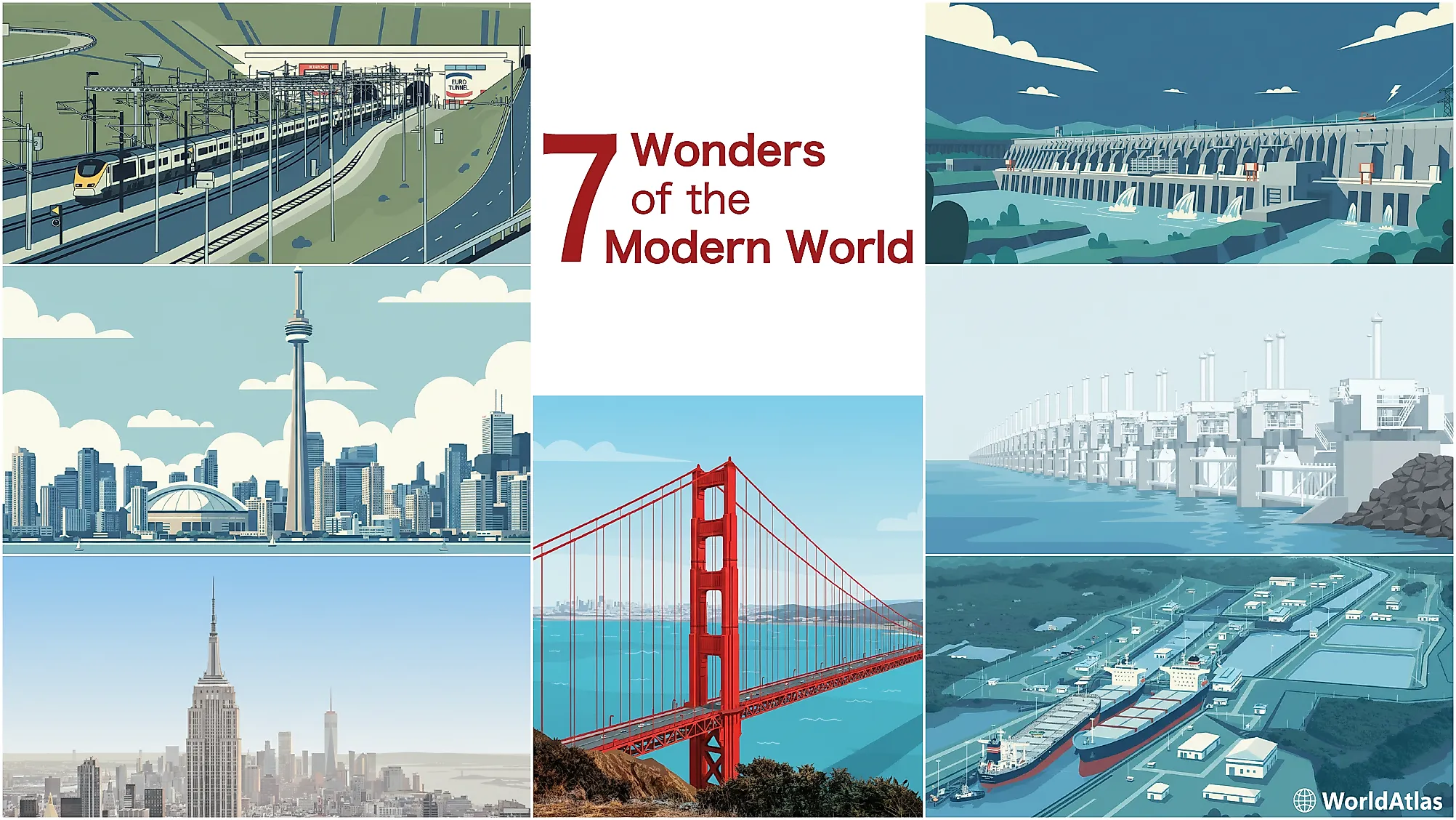
The seven wonders of the modern world are among the most significant engineering accomplishments of the human race in recent history. These are the Channel Tunnel, CN Tower, Empire State Building, Golden Gate Bridge, Itaipu Dam, Netherlands North Sea Protection Works, and the Panama Canal. Similar to the historic wonders of the world, which showcase immense historical significance and technical achievement, these structures take it a step further by highlighting modern engineering capabilities, industrial materials, and large-scale planning.
As such, the list was created by the American Society of Civil Engineers (ASCE) as a tribute to the greatest civil engineering achievements of the modern age. This article explores each of these wonders and explains what makes them unique, innovative, and influential in engineering.
The Seven Wonders Of The Modern World
| Name | Location | Built / Completed |
|---|---|---|
| Channel Tunnel | United Kingdom - France | Opened 1994 |
| CN Tower | Toronto, Ontario, Canada | Completed 1975 |
| Empire State Building | New York City, United States | Completed 1931 |
| Golden Gate Bridge | San Francisco, California, United States | Opened 1937 |
| Itaipu Dam | Brazil - Paraguay | Completed 1984 |
| Netherlands North Sea Protection Works | Netherlands | Built mainly 1954-1997 |
| Panama Canal | Panama | Opened 1914 (expanded 2016) |
Channel Tunnel

The Channel Tunnel is a railway tunnel that runs beneath the English Channel. It connects Folkestone in the United Kingdom with Coquelles in northern France and spans 50.46 km (31.35 mi), of which 37.9 km (23.5 mi) is underwater. This is the largest underwater section of any tunnel in the world, reaching a depth of 75 meters (246 ft) below the seabed and 115 meters (377 ft) below sea level. In addition, it is the third-longest railway tunnel in the world, making it clear why the American Society of Civil Engineers listed it as a modern wonder of the world.
This engineering marvel was first opened in 1994 after nearly two centuries of proposals and planning. However, the actual construction phase took place between 1988 and 1994. The tunnel was built through a layer of chalk marl, a stable geological formation chosen for its strength and low water permeability, which helped reduce seepage from the surrounding seabed. Construction involved large tunneling machines operating from both the British and French sides, with teams working toward each other and meeting precisely beneath the Channel.
As of 2026, the tunnel supports trains at up to 160 km/h (99 mph), connecting high-speed rail networks between the two countries. According to estimates, around 20 million passengers travel through the Channel Tunnel every year, making it one of the most important transportation links in Europe.
CN Tower

The CN Tower is a communications and observation tower in Toronto, Ontario, Canada, that stands out as a national landmark. Conceptualized in 1968 by the Canadian National Railway to improve radio communication in the metropolis of Toronto, the project began construction in 1973. It took a total of 40,500 cubic meters (53,000 cu yd) of concrete to build the tower, and construction was completed two years later in 1975. At the time, it was the world’s tallest free-standing structure, a record that it held for 32 years until the Burj Khalifa overtook it in 2007.
Engineers designed the CN Tower to withstand powerful winds and seismic activity, allowing it to sway safely during storms and minor earthquakes without structural damage. The tower can move several centimeters in high winds, a feature that prevents stress fractures and long-term fatigue. Today, the CN Tower also serves as a major tourist attraction. It features a glass floor that allows visitors to look straight down from hundreds of meters above the ground, as well as one of the highest observation decks in the world, offering panoramic views of Toronto and Lake Ontario.
Empire State Building

Located in New York City, the Empire State Building is an Art Deco-style skyscraper renowned as one of the most iconic landmarks in the country. Planning for the structure began in the late 1800s, and construction began in 1930. Within one year, the entire 102-story building was constructed during the Great Depression. It was designed to function as a “vertical city” with offices, elevators, and utilities, and was the tallest building in the world at the time. The Empire State Building remained the tallest in the world until 1970, when the North Tower of the World Trade Center was topped out. It later regained this status following the September 11 attacks and remained the tallest for 11 more years.
In addition to its construction speed, the Empire State Building was built using a steel-framed system that became the blueprint for future skyscrapers worldwide. This structural approach allowed the building to rise rapidly while maintaining long-term strength and stability. In 1945, the building was struck by a U.S. military bomber due to heavy fog. Despite the impact, the Empire State Building suffered limited structural damage and reopened within days, highlighting the durability of its design.
Golden Gate Bridge

The Golden Gate Bridge is a suspension bridge in San Francisco, California. It spans 1.6 km (one mile) long Golden Gate Strait, connecting San Francisco Bay and the Pacific Ocean. The bridge was planned to replace the old ferry service and offer a faster means to connect the areas. The proposal process took place throughout the early 1900s, and construction officially began in 1933. The project cost over $35 million ($630 million in 2024 dollars) and was designed to withstand strong winds and earthquakes. The bridge was opened in 1937, measuring 2.74 km (1.7 mi) in length and 227.4 meters (746 ft) in height, making it the longest and tallest suspension bridge in the world. It held both titles for over twenty-five years until newer bridges surpassed it in length and height.
Engineers incorporated flexible design elements that allow the bridge to sway during high winds and seismic activity, helping it survive major earthquakes, including the 1989 Loma Prieta earthquake. The bridge is also instantly recognizable for its International Orange color, chosen to improve visibility in fog while blending with the surrounding landscape. Today, the Golden Gate Bridge carries over 100,000 vehicles per day and remains one of the most photographed and visited bridges in the world.
Itaipu Dam

The Itaipu Dam is a hydroelectric dam on the Paraná River located between Brazil and Paraguay. The dam was built in 1984 as a joint project by both countries north of the Friendship Bridge. It spans a whopping 7,919 meters (25,981 ft) and is made out of reinforced concrete and steel. With its immense size and twenty generating units, the dam is one of the largest hydroelectric energy producers on the planet. As of 2020, it produced the second-largest amount of electricity of any hydroelectric power plant in the world, just behind the Three Gorges Dam in China. It generates electricity using the flow of the Paraná River, the second-largest river system in South America.
The dam’s electricity production is so significant that it accounts for 90% of Paraguay's electricity consumption and around 15% of Brazil's production. Beyond power generation, the Itaipu Dam is known for its massive scale and long-term reliability. It remains one of the most important hydroelectric projects ever completed.
Netherlands North Sea Protection Works

The Netherlands North Sea Protection Works is a vast system of dams, dikes, storm surge barriers, and coastal defenses built to protect the country from flooding. Much of the Netherlands lies below sea level, making flood control a key safety concern. Construction of these defenses began in the twentieth century and expanded significantly after the devastating North Sea Flood of 1953, which killed thousands of people. Together, these structures form one of the most ambitious water management systems ever created, designed to hold back the North Sea while still allowing rivers and shipping routes to function normally. They are aimed at protecting against 1-in-100,000-year storms and protecting vital areas of human civilization from natural damage.
The system is divided into multiple projects, with the largest being the Delta Works, which protects large areas of land around the Rhine-Meuse-Scheldt delta. Construction took place between 1954 and 1997 and includes dozens of dams, locks, levees, and sluices designed to shorten the coastline and reduce the risk of future flooding. The project protects major regions such as South Holland and represents one of the most complex hydraulic engineering efforts ever undertaken. According to 2012 estimates, the Delta Works cost approximately $13 billion to complete.
Panama Canal

Located in Panama, the Panama Canal is an artificial waterway connecting the Caribbean Sea with the Pacific Ocean. The stretch is 82 km (51 miles) long and offers ships a route between the Atlantic and Pacific Oceans without circumnavigation. To this end, it reduces global shipping distances by thousands of kilometers and is one of the most influential trade routes in history. According to estimates, the canal moves over 200 million tons of cargo worth approximately $270 billion per year.
While early ideas for a project like the Panama Canal date back to the 1500s, construction began in 1881 under French leadership. However, the project failed due to engineering challenges like the tropical climate and diseases, leading to mass worker fatalities. The project was later taken over by the United States in 1904 and successfully completed in 1914 after major advances in sanitation and engineering.
Due to its length, the Panama Canal uses a lock system to transport ships, lifting them at the entrance into the artificial Gatun Lake and then lowering them at the other end. Previously, the locks were 33.5 meters (110 ft) wide, but newer locks constructed in 2016 as part of an expansion project are even wider, spanning 55 meters (180 ft). The new locks allow Post-Panamax ships, which are up to 49 meters (161 ft) wide, to pass through.
The Seven Modern Wonders Of The World
These seven modern wonders show what large-scale engineering can achieve through innovation and planning. From tunnels under the sea to massive dams and flood defenses, each structure solved a real problem using advanced design and materials. Some improved global travel and trade, while others protect millions of people from natural forces. Together, they show how engineering shapes daily life in ways people often overlook. Even decades after completion, these projects still operate on a scale few structures ever reach, proving their lasting importance in the modern world.