7 Best Natural Wonders To Visit In Texas This Year
Texas is home to a wide range of natural wonders, including intricate underground caverns and sprawling sandhills. Whether you are roadtripping or you simply hope to better explore a bit more of your home state, we will be covering 7 must-see natural wonders you can find here that will have you in awe. In Santa Elena Canyon, you can kayak on the Rio Grande while admiring the beauty of the rising canyon walls around you that were carved by nature over millions of years. The Hamilton Pool is another Texas wonder that is sure to capture your wonder with its unique karst topography and a waterfall plunging into a deep pool that was once a mysterious underground river. The list below paints a picture of how awesome Texas's outdoor scenery can be.
Santa Elena Canyon

Santa Elena Canyon is easily one of the most striking geological features along the Rio Grande in West Texas. Carved over millions of years, the canyon cuts through resistant layers of stone, forming vertical walls that rise approximately 1,500 feet. Although at its narrowest point, the river channel is less than 30 feet wide, creating a sharp contrast between scale and space that has to be seen to be believed. This canyon also marks part of the boundary between the United States and Mexico, with one wall in Texas and the other in Coahuila.
If you want to visit for yourself, note that seasonal water flow can vary significantly, from shallow crossings in drier times to strong currents after rain that can be deadly. Moreover, the surrounding desert landscape is worth exploring as well, so long as you bring plenty of water and sun protection.
Hamilton Pool

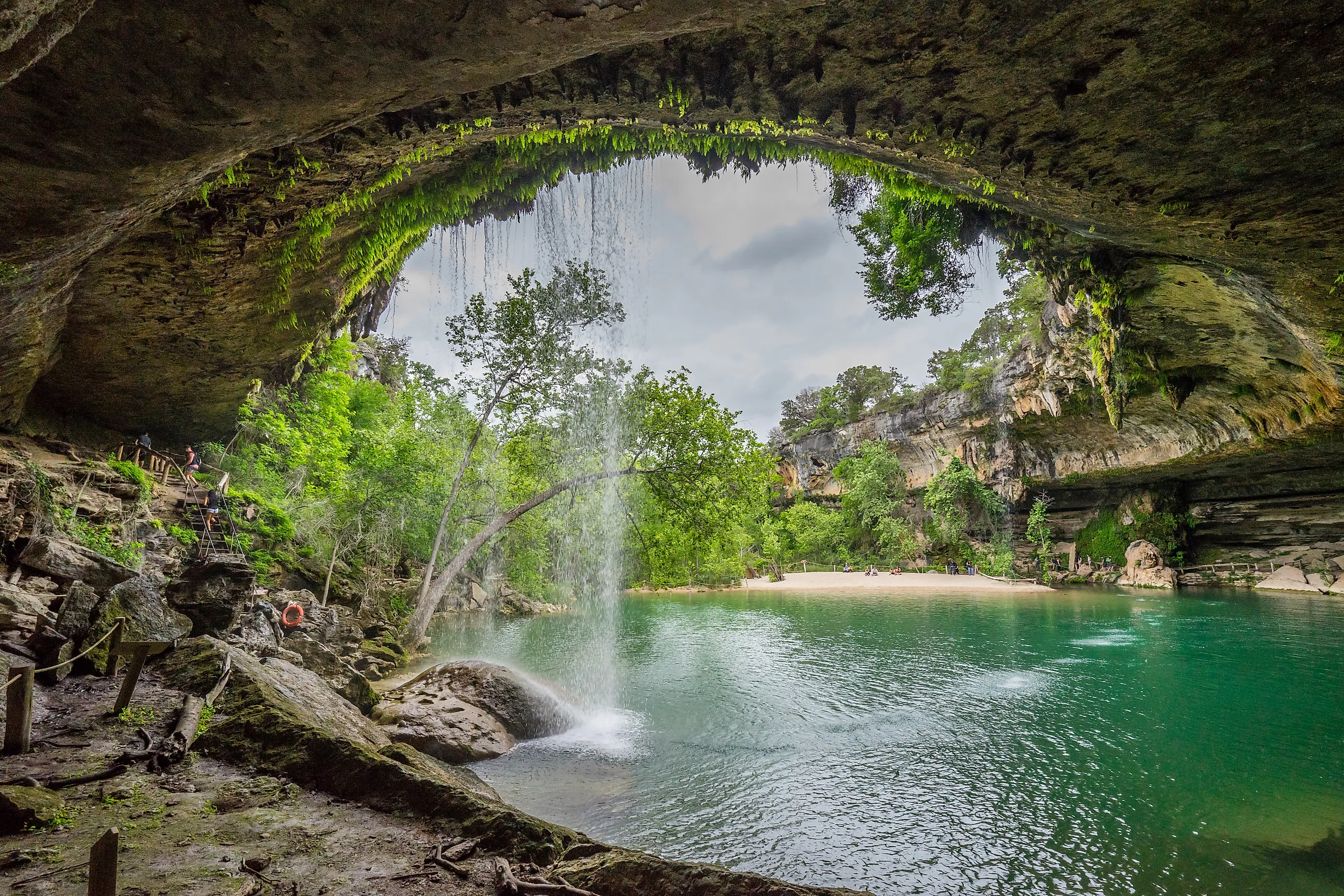
The Hamilton Pool Preserve is a collapsed grotto formed thousands of years ago when the dome of an underground river chamber gave way. Located just west of Austin, this site sits within the Edwards Plateau, a region well-known for karst topography shaped by erosion of soluble rock layers over time.
The result today is a circular pool surrounded by steep walls and a partially intact overhang. Notably, a 50-foot waterfall flows over the rim, fed by Hamilton Creek. Also, keep in mind that this cascade is perhaps more picturesque after heavy precipitation, with flow levels varying quite drastically based on recent rainfall (or lack thereof).
The pool’s deeply blue, mineral-rich water maintains a relatively consistent temperature, though clarity can change after storms due to runoff. The same mineral deposits have also created uniquely textured rock surfaces and small stalactite formations beneath the overhang.
Enchanted Rock

The Enchanted Rock, which is protected by the Enchanted Rock State Natural Area, is a massive pink granite dome formed over a billion years ago and exposed through erosion of surrounding rock layers. Rising about 425 feet above the surrounding Texas Hill Country terrain, it is part of a larger batholith that extends underground across much of the center of the state.
Its surface expands and contracts with temperature changes, sometimes producing audible cracking sounds. Local native tribes have attributed these noises to various spirits casting magic at the site, hence the name. Its granite composition also supports a plethora of unique plant life adapted to thin soils and extreme heat. Moroever, there is a collection of other, smaller domes nearby, along with rocky outcrops and seasonal vernal pools that form in shallow depressions.
As one of the largest exposed granite formations in all of the United States, Enchanted Rock provides a clear, tangible insight into the region's Precambrian geological history that the whole family can appreciate.
Caddo Lake

Caddo Lake is a naturally formed body of water and has an adjoining wetland covering roughly 25,400 acres along the Texas-Louisiana border. Besides its size and the Caddo Lake National Wildlife Refuge protecting much of it, what makes this lake stand out is the fact that it is also one of the few natural lakes in Texas, created by a massive log jam on the Red River in the early 1800s that blocked drainage and flooded surrounding lowlands.
Today, Caddo is defined by the dense stands of bald cypress trees around its shores, many beautifully draped in Spanish moss, along with extensive bayous and sloughs that have created a maze-like water system popular with canoeists and kayakers. More importantly, it is a vital habitat for countless fish, amphibians, bird species, snakes, turtles, and even a population of American alligators.
Palo Duro Canyon

Palo Duro Canyon, the second-largest canyon in the county, stretches approximately 120 miles long, 20 miles wide at some points, and reaches depths of around 800 feet. Its layered rock formations display vivid reds, yellows, and browns, revealing nearly 300 million years of geologic history just south of Amarillo.
Carved primarily by the Prairie Dog Town Fork of the Red River, this impressive gorge exposes sandstone, limestone, and shale in its striking cliffs and spires, while the floor supports a diversity of grasslands and riparian habitats, home to prairie dogs, deer, and golden eagles.
The dramatic escarpments and panoramic overlooks you can access along the rim at Palo Duro Canyon State Park make it a must-visit if you find yourself travelling through northern Texas, offering an awesome representation of the Panhandle’s natural history.
Monahans Sandhills

The Monahans Sandhills are an extensive field of wind-sculpted sand dunes spanning nearly 3,840 acres deep in West Texas. Composed of fine, light-colored quartz sand, the dunes reach heights of 70 feet and shift gradually with seasonal winds, creating constantly changing patterns and textures that can give you a different experience on repeated visits.
This is quite the ancient desert ecosystem, formed upwards of 7,000 years ago, and hosts specialized flora such as sand sagebrush and yucca, while also providing habitat for species like the aptly named sand dune sagebrush lizard. You may also come across the occasional blowouts- oasis-like hollows formed by wind erosion- that reveal underlying soil layers and make way for even more plantlife.
Unique in Texas for its scale, the Monahans Sandhills State Park is among the most underrated parks of the American Southwest and a recommended stop if you're either coming from or headed to New Mexico.
Natural Bridge Caverns

The Natural Bridge Caverns are Texas’s largest commercial caverns, meaning they are open for the public to experience in a variety of cool ways. They formed over millions of years as acidic groundwater dissolved soluble limestone, creating underground passages and massive halls you can now tour within, many of which feature chambers big and small, towering stalagmites, and other epic stone formations.
Highlights include the "Ballroom," a rentable event space for concerts and other mass functions 150 below the surface, and the Emerald Lake Passage, showcasing a crystal clear subterranean body of water. The site also preserves a number of delicate flowstones and soda straws, further illustrating the slow yet sometimes beautiful process of mineral deposition.
Located less than 30 miles from downtown San Antonio, this easily accessible cave system makes for a great day trip away from the city. While here, you could also check out Natural Bridge Wildlife Ranch, an expansive zoo/drive-through safari adjacent to the park.
Explore Texas's Wild Side Today
Texas is the second biggest state in the country, covering well over 268,000 square miles of anything from vast desert expanses in the Southwest, to lush pine forests and lively swamps out east, and beachfront property on the Gulf Coast. Each site mentioned above effectively shows off this sizable state’s impressively diverse geology and ecosystems. Regardless of where you venture off to next, exploring any of these landscapes will surely make for a day or two of fun and learning this year.