5 Copperhead Snake Hotspots In Texas
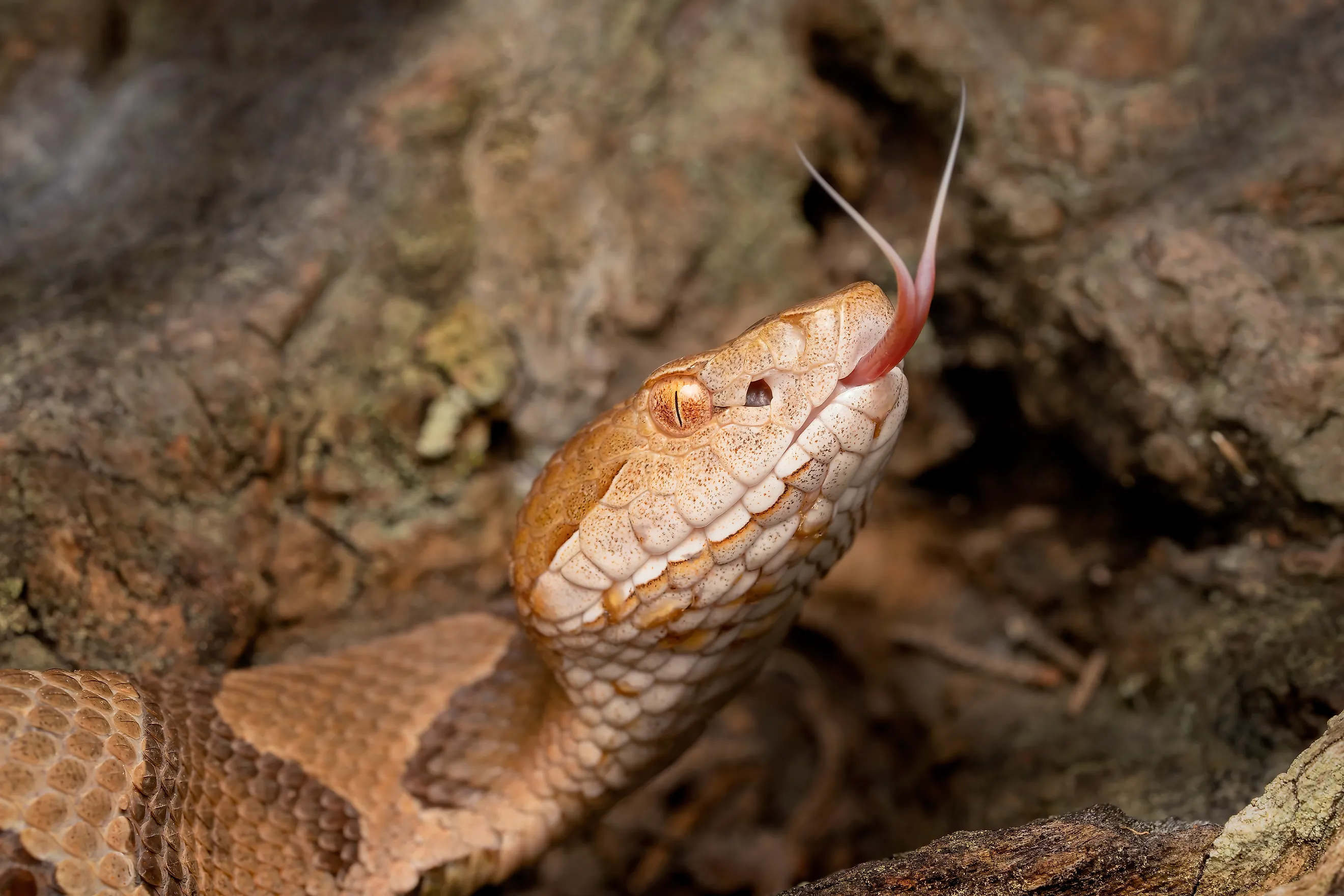
Everything is bigger in Texas, including the snake population. The Lone Star State shelters more serpentine species than any other state. Of those 70ish kinds, two are copperheads: the eastern copperhead (Agkistrodon contortrix) and the broad-banded copperhead (Agkistrodon laticinctus). But do not be deceived by that seemingly low number. Only two species of copperheads are currently recognized, so Texas abounds with both (plus hybrids), which gather in even higher numbers at the following five locales. Know where to go—or where not to go—in copperheady Texas.
River Legacy Parks

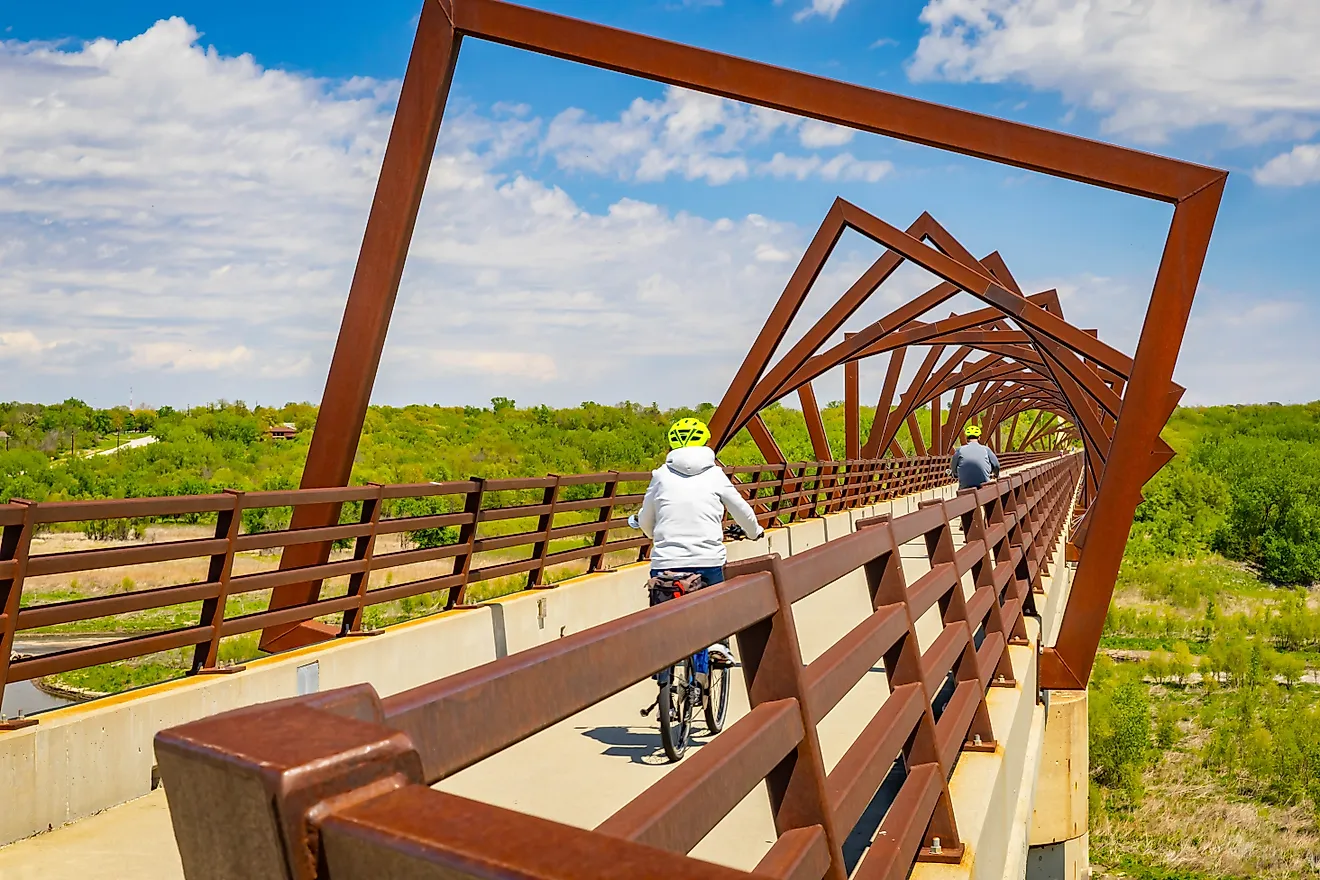
As with virtually all snakes, and animals, in America, copperhead habitat is fragmented. Humans built giant cities across the copperheads' range, leaving small, snaky enclaves smackdab in suburbia. Among them is the River Legacy Park complex in Arlington, TX, which is part of the Dallas-Fort Worth metroplex that boasts more than 8 million people. There are nowhere near as many copperheads in River Legacy Parks, but there are enough that humans must watch their step, even while hiking paved trails. Copperheads like to bask on the paths or camouflage in the adjacent foliage leading to the Trinity River, around which these urban parks lie.

The parks' most common species is the broad-banded copperhead, but they exist in a hybridization zone where the broad-banded and eastern copperhead tend to mix, creating unique patterns between the namesake broad bands of the former and hourglass-shaped bands of the latter. Whether pure or hybridized, copperheads have the weakest venom of all significantly venomous American snakes, comprising rattlesnakes, coral snakes, and cottonmouths. Still, bites do occur and require medical attention. One such incident occurred north of River Legacy Parks in 2025, when a 9-year-old Colleyville boy was bitten in his backyard while reaching for a football. He recovered, just like 99.9 percent of copperhead bite victims. Fatalities are non-existent in modern Texas.
Balcones Canyonlands National Wildlife Refuge

The Balcones Canyonlands National Wildlife Refuge is a preserve in Texas Hill Country that began as the Balcones Canyonlands Preserve. Its original goal was to protect several endangered species, particularly two birds called the golden-cheeked warbler and black-capped vireo, for which the federal government later allocated tens of thousands of additional acres. But those 60,000ish combined acres also protect hundreds of common species, including 30-some species of snakes, among which is the broad-banded copperhead.

Like the River Legacy Parks in Arlington, the Balcones Canyonlands National Wildlife Refuge is considered an urban preserve, since it borders the city of Austin and thus mixes myriad copperheads with myriad cityfolk. It is not the only Austin-adjacent preserve that does so. Between Balcones Canyonlands and downtown Austin are copperhead-heavy parks like the Commons Ford Ranch Metropolitan Park, and St. Edward's Park. The latter saw a bite to a Colorado tourist in 2021. Of course, he recovered, but only after excruciating pain and medical treatment.
McDonald Observatory

You will want to look up if you visit McDonald Observatory, an astronomical research station under some of the most spectacular skies in West Texas, but make sure to look down just as much. McDonald occupies 650 acres in the Davis Mountains of the Chihuahuan Desert, a natural habitat for the broad-banded copperhead. It is the only copperhead that inhabits West Texas, where it blends seamlessly with its sandy, rocky surroundings.

But there are more than just copperheads to watch for on the ground. Rattlesnakes, including the rock rattlesnake and the western diamond-backed rattlesnake, are found at McDonald, as are scorpions and sole-puncturing cacti. To avoid such hazards, staffers recommend that you stay on paths and do not approach wildlife. As an open satellite campus for the University of Texas at Austin, McDonald can be explored at any time of day. However, its visitor center is open Tuesday through Saturday from 12 to 5 PM.
Oak Point Park And Nature Preserve

Yet another urban copperhead hotspot, Oak Point Park and Nature Preserve, sits in Plano as part of the Dallas-Fort Worth metroplex. It covers 800 acres, nearly eight miles of concrete trails, and five miles of soft surface trails along Rowlett Creek between bustling residential neighborhoods. Despite their proximity to peoplekind, copperheads stick largely to the lush confines of Oak Point. They are often spotted on or beside trails, but they seem to rarely venture into people's yards.

Bites are either non-existent or unreported in the area. As with the rest of Dallas-Fort Worth, Oak Point is a hybridization zone where broad-banded copperheads, eastern copperheads, and cross-breeds live. Also living in Oak Point are non-venomous species like the North American racer, western rat snake, rough green snake, plain-bellied water snake, rough earth snake, ring-necked snake, and DeKay's brown snake.
Sam Houston National Forest

Named after the same statesman for whom Texas's largest city, Houston, was named, the Sam Houston National Forest is the Houston of copperhead hotspots. A huge population of copperheads, possibly the largest in Texas, occupies this woodsy preserve, which spans more than 160,000 acres as one of four national forests in the state. But being on the eastern side of Texas, Sam Houston is the exclusive territory of the eastern copperhead. It spends much of its time on the ground but will climb trees in search of prey like cicadas and birds.

Though the eastern copperhead does not overlap with any other copperheads, it does share Sam Houston with other venomous species. They include the northern cottonmouth, pygmy rattlesnake, timber rattlesnake, and Texas coral snake. Unsurprisingly, Sam Houston has far more non-venomous species than venomous ones. Among the harmless snakes you might encounter are the western ribbon snake, prairie king snake, and mud snake.
Aside from its southern section and northern panhandle, Texas is one big copperhead hotspot. Yet dotting the copperheads' Texan range are even hotter spots where either the eastern copperhead or the broad-banded copperhead or both species—and their hybrids—thrive. River Legacy Parks, the Balcones Canyonlands National Wildlife Refuge, McDonald Observatory, Oak Point Park and Nature Preserve, and Sam Houston National Forest are the places to walk along Texas's copperhead road.