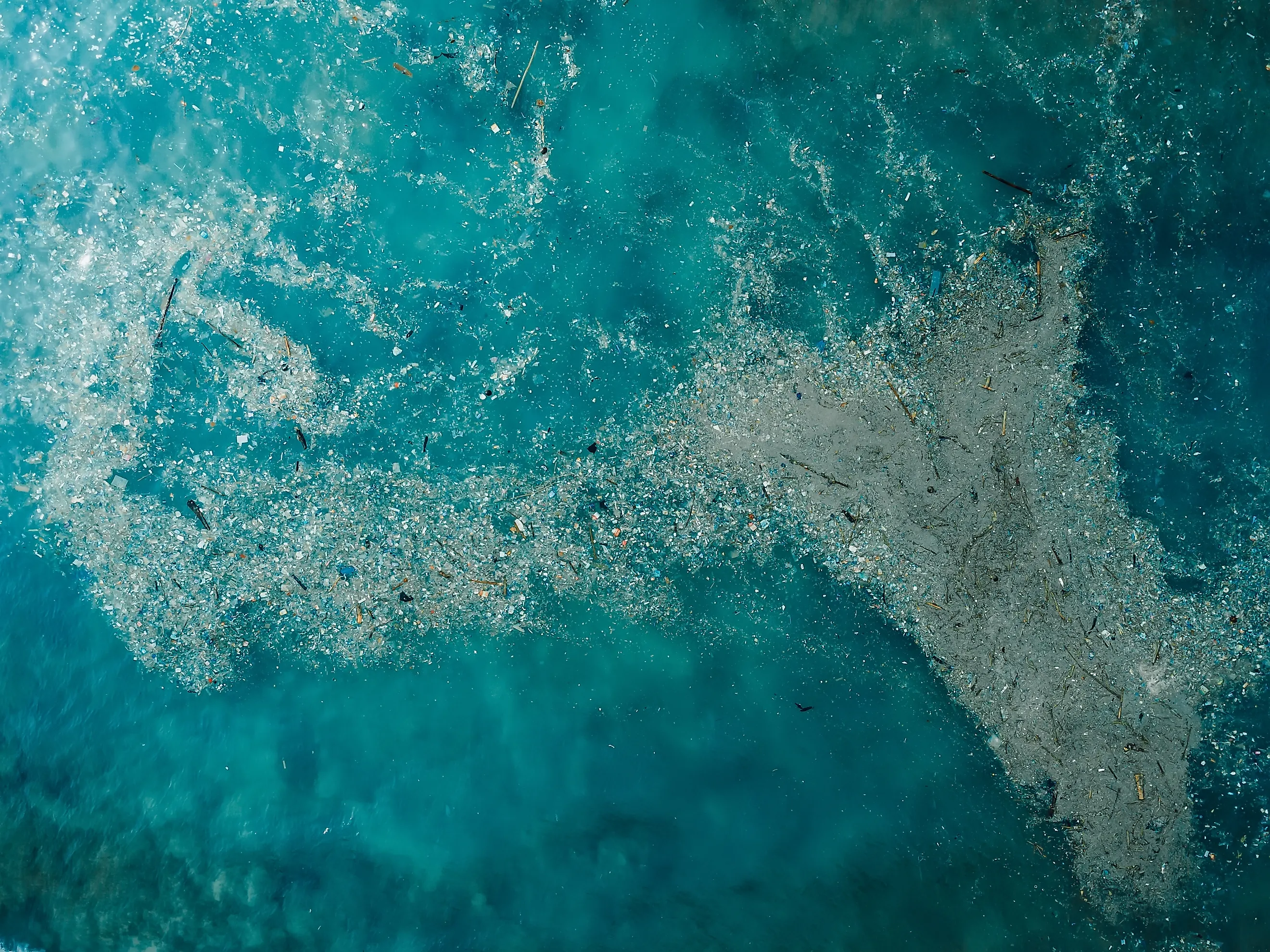
What Happens To Plastic Once It Reaches The Ocean
More than 1,500 feet of black sand and lava rock at Kamilo Beach are speckled with plastic debris. Bottle caps, fishing floats, and toothbrushes turn up alongside fragments too small to identify. This remote shoreline on Hawaii's Big Island sits far from any city. Ocean currents still carry debris here across the Pacific, and locals call it "Plastic Beach." What washes up shows one possible ending for plastic that reaches the sea. A single piece might also drift for years, break into microplastics, feed wildlife, or sink to the seafloor first.
By some estimates, roughly 150 million metric tons of plastic already float in the world's oceans, with another 8 million tons added every year. A single piece can travel through rivers and swirling currents before it gathers in an offshore debris zone. It might wash onto a distant beach, enter a marine food web, or settle in the deepest parts of the ocean.
It Rarely Starts At The Coast

Most ocean plastic does not begin its journey at the beach. According to the National Park Service, a water bottle or plastic bag littered far inland can travel down a storm drain. From there it moves into a creek and through a river system before it reaches salt water. Land-based sources account for the large majority of what ends up offshore, including overflowing trash cans and poorly managed waste. That pattern is documented in The Causes And Effects Of Ocean Pollution.
Rivers carry this debris toward river mouths and out to sea. Once plastic reaches open water, it stops being a local problem and becomes an oceanic one. Currents then move it without regard for coastlines or borders. That holds even for debris starting hundreds of miles inland. A bottle dropped in a Midwestern parking lot can wash down a storm drain and join a tributary. It may reach the Gulf of Mexico or the Pacific depending on the watershed it enters.
Ocean Currents Sweep It Into Massive, Spinning Gyres

Once plastic is floating, wind and rotating currents take over. The National Oceanic and Atmospheric Administration (NOAA) describes these systems as gyres, enormous slow-spinning current patterns that pull floating material toward their centers. Five major gyres circle the globe. One sits in the Indian Ocean, two in the Atlantic, and two in the Pacific. Each has its own accumulation zone of trapped debris.
The Pacific Ocean's North Pacific Gyre is the largest and best studied of these systems. Buoyant plastics resist breaking down, so they can ride these currents for years and drift thousands of miles from where they entered the water. Highly buoyant items like bottle caps and foam fragments tend to travel fastest across the surface because more of their structure catches the wind. Denser debris moves more slowly through the water column. Items sink mainly because of their material density or biofouling rather than weight alone.
Much Of It Collects In The Great Pacific Garbage Patch

Marine debris accumulation locations in the North Pacific Ocean. Editorial credit: NOAA, Public Domain, via Wikimedia Commons
Between Hawaii and California, converging currents concentrate drifting debris into the Great Pacific Garbage Patch, the largest of the world's offshore accumulation zones. A widely cited 2018 study in Scientific Reports estimated the patch covers roughly 1.6 million square kilometers. That is about twice the size of Texas. The same study estimated it holds around 1.8 trillion pieces of plastic weighing about 79,000 tonnes.
The name suggests a solid island of trash you could walk across. The reality looks different. NOAA compares it to pepper flakes swirling in a soup. The material spreads from the surface down through the water column rather than piling on top of it. The same study found that roughly 92% of that mass by weight comes from larger objects. These include derelict fishing nets, ropes, and hard plastic containers. The vast majority of individual pieces by count are microplastics simply too small to see.
Some Of It Washes Up On Beaches Like Kamilo Beach

Not all of the debris stays offshore. Trade winds and converging currents periodically push plastic out of the gyre and onto Hawaiian shorelines. Kamilo Beach on the Big Island's Kaʻū coast is one of the most notorious collection points. Roughly 96% of the debris found there is plastic, much of it discarded fishing gear such as nets, rope, and buoys. A 2003 cleanup led by the Hawaiʻi Wildlife Fund removed more than 50 tons of debris over three days.
In 2020, the U.S. Environmental Protection Agency designated the surrounding waters as impaired due to plastic pollution. Volunteers with the Hawaiʻi Wildlife Fund return regularly because the site refills with fresh debris almost as fast as they clear it. The group estimates that 15 to 20 tons wash up at Kamilo each year.
Sunlight And Waves Grind It Into Microplastics

Plastic that stays in open water breaks apart rather than disappearing. Sunlight, wave action, heat, and salt gradually fragment larger items into smaller and smaller pieces. These eventually become microplastics, generally defined as fragments under 5 millimeters. NOAA's Marine Debris Program is cautious about pinning an exact timeline to this process. The pace depends on the specific type of plastic, its exposure to sunlight and oxygen, and where in the ocean it ends up. Material floating at the surface breaks down at a different rate than material buried in sediment or resting on the deep seafloor.
Researchers agree that some plastics may keep fragmenting into ever-tinier pieces without ever fully vanishing. They do not break down completely the way organic material does. That uncertainty pushes marine researchers to study conditions in the deep-sea settings covered in 10 Strange Discoveries About The Deep Ocean. Plastic buried in cold, dark, low-oxygen sediment appears to degrade far more slowly than plastic tumbling near the surface.
Marine Animals Mistake It For Food

As plastic breaks down and spreads, it increasingly overlaps with where animals feed. Laysan albatrosses nest on Midway Atoll, within Papahānaumokuākea Marine National Monument in the Northwestern Hawaiian Islands. The birds skim the ocean surface for food and scoop up floating plastic along with it. Researchers estimate that adult albatrosses feed roughly 5 tons of plastic to their chicks each year at Midway. Studies cited by the Smithsonian have found plastic in the stomachs of over 97% of chicks sampled. A chick that accumulates around two ounces of plastic in its stomach typically dies. Adults can regurgitate the material, but chicks cannot.
Sea turtles face a similar problem and often mistake floating plastic bags for jellyfish. Entanglement in nets and packaging adds a second, mechanical threat on top of ingestion.
Microplastics Move Through Marine Food Webs

Microplastics do not stop with the animals that swallow them directly. They move through the food web. Zooplankton, the microscopic organisms at the base of marine food chains, cannot distinguish microplastic particles from their natural food. Larger animals that eat contaminated zooplankton then absorb those particles in turn.
A 2024 Portland State University study, published in Frontiers in Toxicology, tested six commercially important species from Oregon's coast and rivers. The set included Chinook salmon, black rockfish, lingcod, and pink shrimp. Researchers found suspected plastic particles in 180 of 182 individual samples. Pink shrimp, a filter-feeding species, showed the highest contamination. Chinook salmon showed the lowest, a pattern researchers linked to how much each species relies on filter-feeding versus active hunting.
The Rest Sinks To The Ocean's Deepest Point

Plastic that does not wash ashore, get eaten, or stay suspended near the surface eventually sinks. Some of it settles at extraordinary depths. Challenger Deep, within the Mariana Trench roughly 190 miles southwest of Guam, plunges to about 35,876 feet (10,935 meters) below the surface. That figure comes from sonar mapping tied to the 2019 Five Deeps Expedition, and it marks the deepest known point in any ocean. During that same expedition, explorer Victor Vescovo documented a plastic bag and candy wrappers resting on the trench floor.
A separate 2018 review drew on the Deep-Sea Debris Database kept by the Japan Agency for Marine-Earth Science and Technology. Across thousands of dives, plastic was the most common debris type recorded. Most of it was single-use items. Researchers have even documented deep-sea amphipods at the bottom of the trench with microplastic fibers in their digestive systems. Challenger Deep lies within the U.S. Exclusive Economic Zone surrounding Guam and the Commonwealth of the Northern Mariana Islands. The Mariana Trench Marine National Monument protects part of that same stretch of ocean.
The Plastic Trail Has No Real Finish Line

Trace it far enough, and a single piece of plastic can end up almost anywhere. It might pile on a remote Hawaiian beach or lodge in an albatross chick's stomach. It could float in a shrimp's tissue or rest more than six miles down in the Mariana Trench. Agencies like NOAA and the National Park Service document each stage of that journey along the storm drain, gyre, and seafloor. Researchers keep finding plastic in places it was never expected to reach. The problem still has solutions. Cleanup projects targeting the Great Pacific Garbage Patch are underway. Coastal cleanups like the ones at Kamilo Beach remove tons of debris every year. Reducing single-use plastic at the source remains the most direct way to keep the next bottle or bag out of this same journey.