The Sea Animals That Never Stop Growing
Picture a shark still growing at 300 years old, or a clam quietly adding rings to its shell for half a millennium. In most of the animal kingdom, growth has a stopping point. Humans, for instance, reach their adult height and stay there, barring rare disorders like gigantism, which caused Robert Pershing Wadlow to reach 8 feet 11.1 inches before his death in 1940. But beneath the ocean's surface, that rule doesn't always apply. Certain ocean creatures never receive the signal to stop growing. Given enough time and the right conditions, their bodies simply keep expanding, year after year, sometimes century after century. This phenomenon, known as indeterminate growth, has produced some of the most astonishing giants in the natural world.
Greenland Shark (Somniosus microcephalus)

The Greenland Shark doesn't grow quickly, but it does grow continuously over its lifetime. It typically grows less than one centimeter each year. But over its 400+ year lifespan, that adds up, resulting in weighing a ton with a 20 to 24-foot body. This shark's habitat is the deep waters of the North Atlantic, as well as the Arctic Ocean. Because these waters are so cold, this shark has a slow metabolism. The Greenland Shark is not aggressive, and partially because people rarely swim in the cold, northern waters, there have not been any confirmed attacks on humans.
Saltwater Crocodile (Crocodylus porosus)

While the Greenland Shark is nonaggressive, that certainly is not the case with the Saltwater Crocodile. These creatures are quite territorial and will attack livestock and humans that venture too close to their brackish wetlands and marine intertidal habitat. They are known to travel great distances, including navigating oceans. They are found in various areas of the world, including Southern Asia and Australia. All crocodiles experience indeterminate growth, but the Saltwater Crocodile is the only one in this family that has adapted to saltwater. Because it has more access to prey in the ocean, it can grow much larger and grow faster. Their long lifespan of 70 to 100 years further ensures a large adult stature. In fact, it is the largest of all the crocodile species.
Red King Crab (Paralithodes camtschaticus)

Some sea creatures just grow a larger body, but that is a bit trickier when encased in a protective shell. It doesn't stop the Red King Crab, however, as it simply molts its undersized shell and the new shell expands and hardens over the soft body. This molting happens many times a year in young crabs but slows to roughly once a year in older crabs. Older crabs do not increase in size at the same rate as younger crabs, either. Once they reach a size based on their habitat, they don't increase much more, but they still can do so. What is interesting is that if a crab loses a leg, it is regenerated during future molts, getting larger with each new molt until full size.
Green Anaconda (Eunectes murinus)

Like the Saltwater Crocodile, the Green Anaconda does not spend all its time at sea. It is considered a semiaquatic boa. It is a huge snake both in length and weight. Some have been recorded at 20 to 22 feet and hundreds of pounds. They are found in northern South America, in both the Amazon River basin and the Orinoco River basin. They also travel onto land and have been known to climb trees. Something unique about them is that the female is much larger than the male, which is the opposite of most creatures in the world. As snakes grow, they shed their skin, and the Green Anaconda is no different. Like other indeterminate creatures, they grow fastest in youth and slow down once sexual maturity is reached. Since they can live anywhere from 10 to more than 20 years, they have plenty of time to reach an incredible size.
American Lobster (Homarus americanus)

There is often a large tank holding lobsters of various sizes at seafood restaurants. Some even have a huge lobster that seems to be the mascot because it would be incredibly expensive and more than one person or even a family could consume. The American Lobster grows larger through molting, just like the Red King Crab does. Its long lifespan of 50 to over 100 years enables it to be quite large. The largest found thus far was one that weighed 44 pounds, 6 ounces, which was found in 1977 off the coast of Nova Scotia, Canada.
Ocean Quahogs (Arctica islandica)

Longevity is often key to achieving large sizes, but there is one that lives considerably longer than the rest on this list, yet isn't extremely large. Ocean Quahogs can live for hundreds of years. This unassuming clam develops a ring on its shell each year as the shell gets thicker and bigger. The growth is very slow, however, so they don't get larger than 10-13 centimeters. The oldest one found thus far was aged 507 years old when found in 2006. We don't know how long it could have lived; however, the decision was made to freeze and preserve it.
Giant Pacific Octopus (Enteroctopus dofleini)

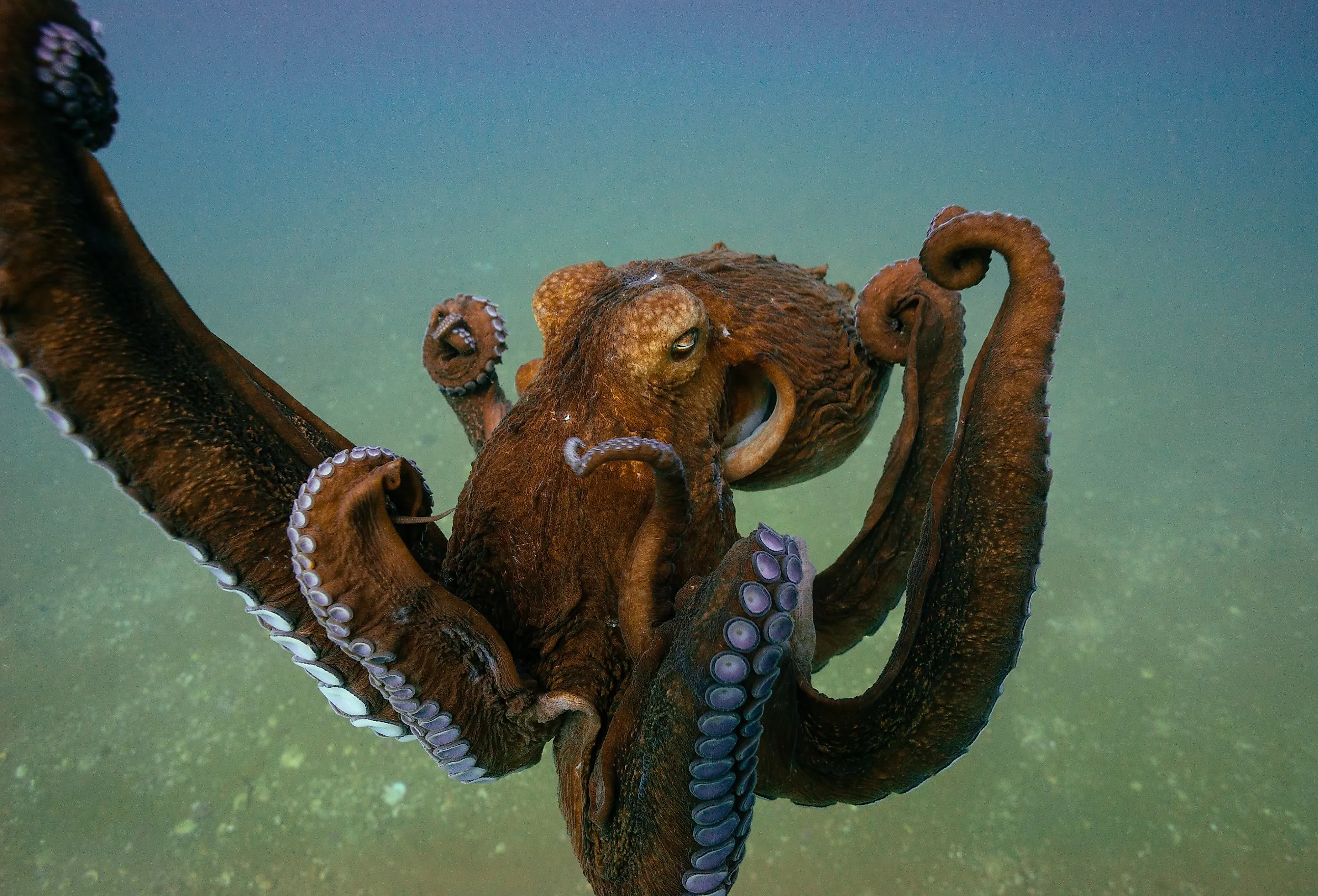
The Giant Pacific Octopus continues growing throughout its life, but it is a relatively short one, of just 3 to 5 years. Despite that, it can reach an arm span of nearly 20 feet and weigh roughly 110 pounds. This Giant Pacific Octopus is the largest among the species. Part of the reason for their short life is that the females put their focus on reproduction, preferring to starve so they can remain constantly supportive of the roughly 50,000 to 100,000 offspring they have in their den. Since this can take six to seven months, she generally dies.
Whale Shark (Rhincodon typus)

Another nonaggressive, indeterminate shark is the Whale Shark. Despite growing slowly in adulthood, these sea creatures are the largest fish in the ocean. They live anywhere from 70 to 100 years, which gives them time to get quite large. An older specimen can easily reach 40 to 60 feet in length and weigh nearly 50,000 pounds. Despite their size, they are quite gentle. In fact, they pose little threat to people. It is said that you could swim right next to one and be completely safe, but as is the case with any large creature, it is best not to test that theory.
The Mysteries of the Sea
The oceans of our planet are still quite a mystery to us. We are discovering new sea creatures every year, including ones that live in the deepest areas. The life forms that remained in the waters when others came up on land have had a different evolutionary path that we are just beginning to try to understand. When you eliminate the constraints that appear on land, such as gravity and more limited food, it stands to reason that unique things can happen. Indeterminate growth and extended lifespans are present in some land creatures, too, but the sea seems to have more than its share. The ocean and its creatures have much to teach us, making it imperative to protect them.