The Ocean Creatures That Can Live Without Sunlight
Every animal in the deep sea has solved the same problem: how to eat when the sun never reaches you. Two answers turn up again and again. Some creatures grow their own food from the chemicals leaking out of the seafloor. The Pompeii worm does this while straddling water hot enough to cook it. Others live on the slow drizzle of scraps sinking down from the sunlit water above. The vampire squid drifts through the blackness and simply catches the fall. Neither group has seen daylight in its entire evolutionary history. The eight animals here sort cleanly into those two strategies, and together they make the case that darkness was never the real obstacle.
Giant Tube Worms

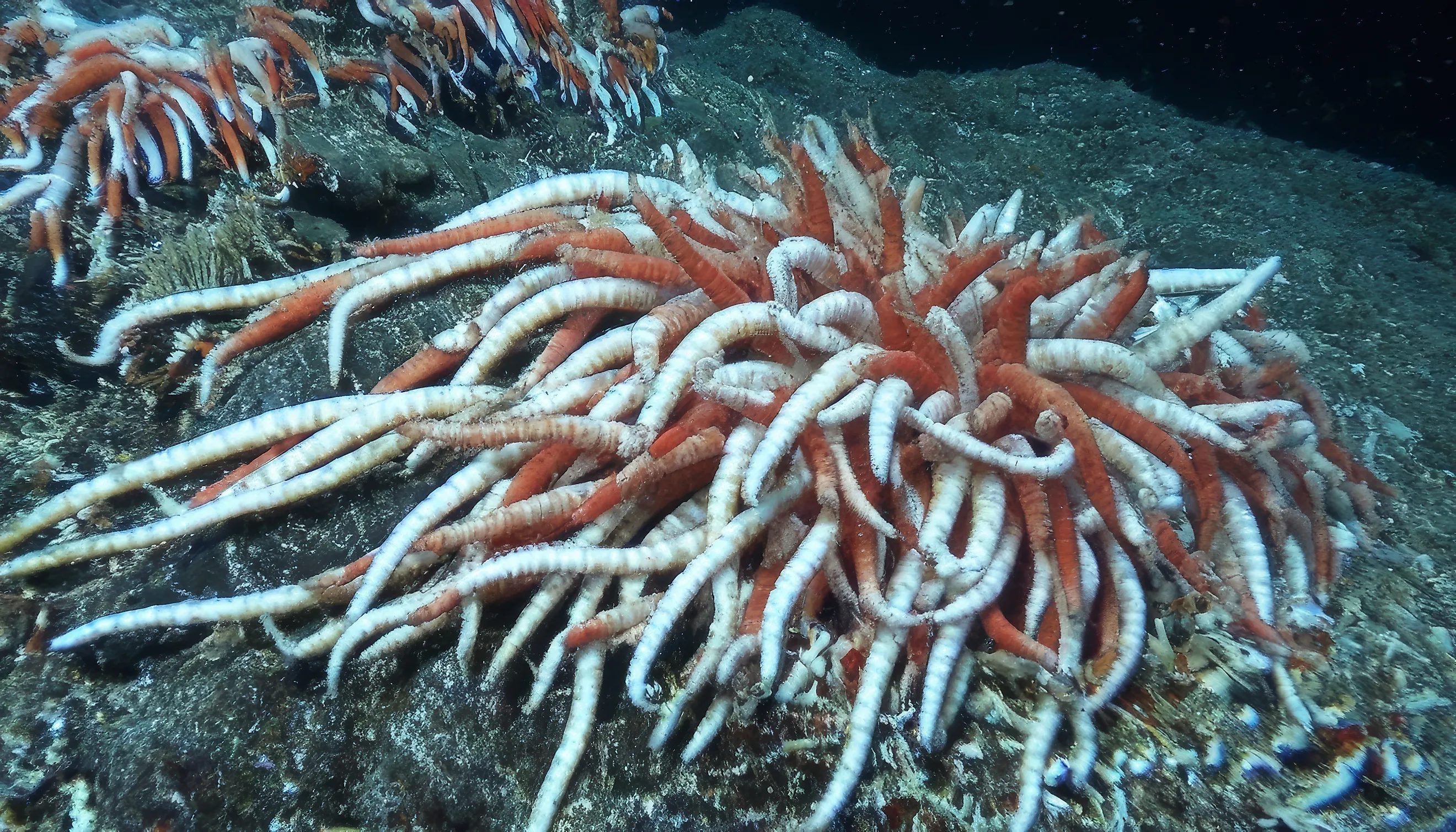
Picture a cluster of white tubes as tall as a person, each one topped with a bright red plume, swaying in warm water a mile and a half down. That red is blood, loaded with hemoglobin, just like ours. A giant tube worm has no mouth and no gut, so it does not feed the way anything on land does. Instead it grows billions of bacteria inside a special organ in its body and lets them do the cooking.
The deal is simple and it works. The worm pipes down the chemicals that gush from the vent, mostly hydrogen sulfide, and hands them to its bacteria. The bacteria turn that chemical soup into food and share it back. Whole reefs of these worms build up around a single vent, and every one of them is eating heat and minerals from the center of the Earth.
Deep-Sea Mussels

Not far from the vents, the seafloor sometimes leaks cold instead of hot. These spots are called cold seeps, where methane and sulfide ooze up through cracks in the mud. Mussels pile onto those cracks by the thousands and run the same play as the tube worms. They keep chemical-eating bacteria in their gills and let that colony feed them.
What makes the mussels matter is what grows up around them. A mussel bed turns a bare patch of seafloor into a neighborhood. Crabs move in to pick through the shells. Worms, snails, and small fish arrive for the shelter and the leftovers. One good seep in the Gulf of Mexico can hold a mussel bed the size of a parking lot, all of it fed by gas from below.
Hydrothermal Vent Shrimp

Some vents swarm with so many shrimp they look like they are boiling. These animals crowd right up to the hot water, packed shoulder to shoulder in the thousands, jostling for the best spot. They are not there for warmth. They are there for the film of bacteria that coats the rocks and their own bodies, and that film is their whole diet.
The trade-off is nerve-racking to watch. The best bacteria grow closest to water hot enough to cook the shrimp alive, so the animals ride a razor-thin line between a full meal and a fatal one. Many species have given up ordinary eyes and grown a light-sensing patch on their backs instead, most likely to read the faint glow the hottest water throws off. In the dark, that glow is the difference between dinner and disaster.
Yeti Crabs

The yeti crab earned its nickname the moment scientists saw it, since its pale arms are covered in what looks like shaggy blond fur. The fur is real and it has a job. Those bristles are a garden, thick with the same chemical-eating bacteria that feed the worms and the shrimp.
Here is the part that makes people grin. The crab actively farms the bacteria, waving its hairy arms slowly back and forth over the seeping gas to keep fresh food flowing to its crop. Then it combs the bacteria off with a specialized mouthpart and eats them. A crab that dances over a methane leak to tend its own harvest sounds made up, and it is one hundred percent real.
Pompeii Worms

If tube worms play it safe, Pompeii worms live dangerously. They build paper-thin tubes right on the walls of the hottest vent chimneys. The worm tucks its tail into water that can hit 176°F while it pokes its feathery head out into water tens of degrees cooler. Straddling that gap makes it one of the most heat-tolerant animals ever found.
The vent fluid itself can rocket past 750°F without boiling, held down by the crushing pressure of the deep. No animal survives that directly, and the Pompeii worm does not try. It works the seam where scorching and freezing meet, wearing a fuzzy coat of bacteria on its back that seems to help buffer the heat and, in true deep-sea fashion, doubles as a snack.
Vampire Squid

The vampire squid has a frightening name and almost no menace behind it. It is about the size of a football, a deep reddish color, with skin webbed between its arms like a cloak. It drifts through a strange middle layer of the ocean where oxygen runs so low that most hunters cannot follow.
That empty layer is exactly where the vampire squid wins. Rather than chase prey it can barely afford to chase, it unfurls two long sticky filaments and simply waits for the marine snow to land. Marine snow is the constant fall of dead plankton, scraps, and waste sifting down from the sunlit sea. The squid gathers it, balls it up with mucus, and eats the drizzle from the world above. It burns energy slower than nearly any animal its size, which is how it thrives where others starve.
Mariana Snailfish

The deepest fish anyone has ever confirmed is a small, pink, scaleless thing with a body so delicate you can see straight through it. The Mariana snailfish lives near the bottom of the Mariana Trench, filmed swimming past 26,000 feet down. At that depth the water presses in with the force of an elephant standing on your thumb, and the snailfish simply goes about its day.
Its trick is not chemistry but company. So few predators can reach these depths that the snailfish has the trench floor nearly to itself. It feeds on tiny shrimp-like crustaceans that scavenge the same scraps sinking from far above, which means the snailfish is really eating the sunlit world at second hand. Down here the top predator is a fish you could cradle in two hands.
Hadal Amphipods

Those shrimp-like scavengers deserve their own moment, because they are the cleanup crew that makes the deepest trenches livable. Hadal amphipods swarm the seafloor below 20,000 feet, exactly the zone that includes the bottom of the Mariana Trench. Lower a bait trap to the deepest seabed and within minutes they boil up out of the dark by the hundreds.
Their whole lives run on patience and timing. Meals are rare this far down, so an amphipod eats fast and hard whenever a dead fish or a scrap of driftwood finally lands. Some trench species grow startlingly large for their kind, stretching to the length of a soda can, a quirk of living where food is scarce and every calorie counts. They turn whatever the ocean drops into the base of the whole deep food web.
Two Ways to Live in the Dark
Line these eight animals up and a clean pattern falls out. The tube worms, mussels, shrimp, yeti crabs, and Pompeii worms all made the same bet: skip the sun entirely and build a life on the chemicals bleeding out of the planet. The vampire squid, the snailfish, and the amphipods took the other road, living on the endless soft rain of scraps from the sunlit surface. Neither group ever sees a sunrise. Both have turned the darkest, heaviest, hungriest place on Earth into a home, which is a far better story than the one where the deep ocean is empty.