The Deepest Point In The Gulf Of Mexico
Say "Gulf of Mexico" and most people picture a warm, shallow bathtub of a sea: shrimp boats, oil rigs, sunburned spring breakers, and water you can practically wade through. And for huge stretches, that's true. But somewhere out in the middle, the seafloor simply gives up, drops off a cliff, and plunges into a crushing, pitch-black abyss almost three miles down. That, my friends, is the deepest point in the Gulf of Mexico, and it has a name, a backstory, and some genuinely nightmarish neighbors. Let's take the elevator down.
The Answer: The Sigsbee Deep

The deepest point in the Gulf of Mexico is the Sigsbee Deep, a roughly triangular basin sitting in the southwestern quadrant of the Gulf, about 200 miles southeast of Brownsville, Texas. As for exactly how deep, scientists have been politely arguing about it for years, with estimates running from around 12,300 feet to about 14,383 feet, or roughly 4,384 meters. Even the modest end of that range is over two miles straight down. To put it another way, if you dropped the Burj Khalifa, the tallest building on Earth, into the Sigsbee Deep, you would still have more than two miles of black water stacked on top of its spire. It is, by a wide margin, the Gulf's basement.
The Man It's Named After Had a Very Bad Day
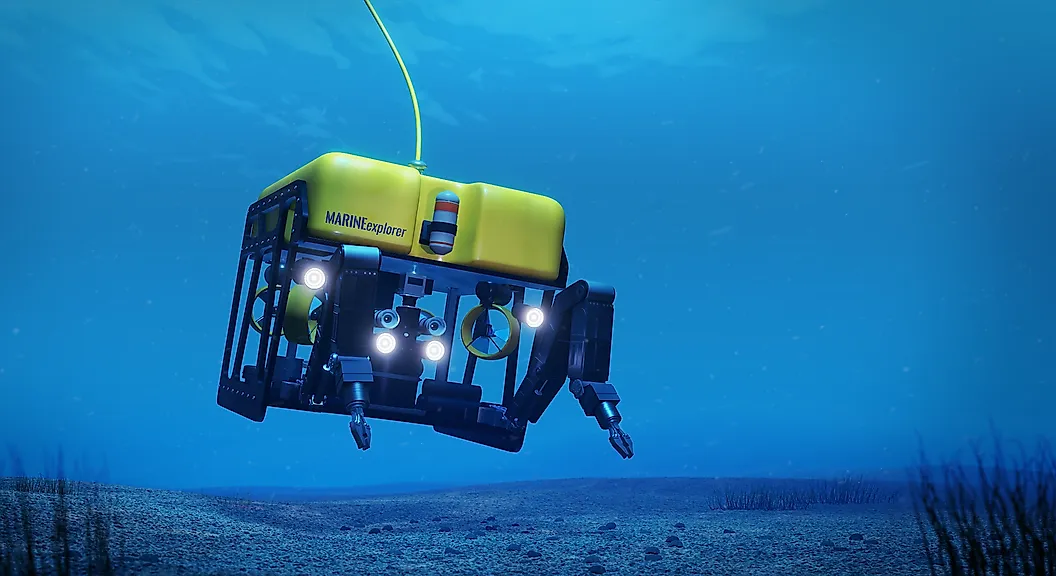
The Deep gets its name from Commander Charles Dwight Sigsbee, a U.S. Navy officer who led the first serious expedition to chart the Gulf floor back in the 1870s. Armed with little more than a fancy sounding machine and a great deal of determination, he produced one of the first realistic maps of any ocean basin on the planet, which is a genuinely impressive resume line. Here's the kicker, though: Sigsbee is far more famous for a different job. He was the captain of the USS Maine, the battleship that mysteriously exploded and sank in Havana Harbor in 1898, an event that helped trigger the Spanish-American War. So the deepest hole in the Gulf is named after a guy whose most famous ship ended up at the bottom of a different one. The ocean has a sense of humor.
How the Gulf Gets This Deep

Here's the part that surprises people. Most of the Gulf really is shallow, because it's ringed by a huge continental shelf, that gently sloping underwater patio where the scuba divers and oil platforms live. Its average depth is only about 5,300 feet. But at the edge of that shelf, the floor doesn't ease downward, it falls off an underwater cliff called the Sigsbee Escarpment, a wall of rock some 4,000 feet tall running for hundreds of miles. Go over that edge and you tumble into the abyss. Weirder still, the whole basin sits on top of ancient buried salt, left behind when the young Gulf repeatedly flooded and dried out hundreds of millions of years ago. That salt slowly oozes and shoves the rock around, creating underwater hills called the Sigsbee Knolls and that giant escarpment. The Gulf floor, it turns out, is basically a slow-motion geology riot.
That salty chaos is also why the deep Gulf is such a magnet for oil companies. The very same underground salt that warps the seafloor helped trap enormous reservoirs of oil and gas beneath it, which is precisely why drilling rigs now operate way out in water thousands of feet deep, and why the Deepwater Horizon disaster in 2010 unfolded over a mile of open ocean rather than anywhere near the beach. The Sigsbee Knolls even made scientific history as one of the very first places where gas hydrates, a genuinely bizarre, ice-like form of frozen methane, were ever discovered sitting on the ocean floor. The Gulf's basement, in other words, is not just deep and weird, it is economically and geologically loaded.
The Gulf's Underwater Lakes of Death
Now for the truly unhinged part. Down on the deep Gulf floor, all that salt does something almost cartoonishly strange: it creates lakes. Underwater lakes. Because the brine leaking out of the seabed is so much saltier and denser than normal seawater, it pools in depressions and just sits there, with its own shimmering "shoreline" and its own rippling "surface," a lake at the bottom of the sea. They would be beautiful if they weren't lethal. One famous example, nicknamed the "Jacuzzi of Despair," is so salty and so loaded with toxic chemicals that any unlucky crab or fish that wanders in is essentially pickled on the spot, its body preserved along the rim like a grim high-water mark. Submarines have filmed these things, and it looks exactly as unsettling as it sounds. So yes, there are deadly lakes underneath the sea. Sleep tight.
And yet, against all odds, the deep Gulf is far from dead. In the permanent darkness where sunlight has never once reached, entire ecosystems flourish around cold seeps, places where chemicals ooze up through the seabed. Instead of running on sunshine like everything in the world above, these communities run on pure chemistry, with ghostly tube worms and dense beds of mussels feeding on bacteria that convert methane and other compounds into food. It is life built on an entirely different rulebook, thriving in a spot that, by every assumption we carry from the sunlit surface, should be completely empty. The bottom of the Gulf is a lot of things, but boring is not one of them.
How It Compares to the Real Monsters

Before the Sigsbee Deep gets too full of itself, some perspective is in order. For a "marginal sea" wedged between three countries, it is genuinely, impressively deep. But stack it against the true heavyweights of the ocean and it starts to look almost cute. The Mariana Trench in the Pacific bottoms out near 36,000 feet, which is more than two and a half times deeper. You could sink the entire Sigsbee Deep into the Mariana Trench and still have room to sink most of it a second time. Even so, the pressure at the bottom of the Gulf's basement still exceeds 6,000 pounds per square inch, more than enough to crush an unprotected human like a soda can under a truck tire. "Not as deep as the Mariana Trench" is doing a lot of comforting work there.
So the next time someone describes the Gulf of Mexico as a shallow, sleepy little sea, you can smile knowingly. Yes, the edges are all sandbars and shrimp nets and sunscreen. But its heart is a cold, black, salt-warped canyon nearly three miles down, ringed by underwater cliffs, dotted with deadly brine lakes, and named for a man whose battleship sank in a completely different harbor. The Gulf is far stranger than its beach-vacation reputation, and honestly, that's the best thing about it. Right below the jet skis and the beach umbrellas, the Gulf of Mexico has been quietly hiding a genuine monster the whole time, and almost nobody ever thinks to look down.