The National Parks With The Most Copperheads
Copperheads live across a huge swathe of the eastern United States, which means a lot of national parks have them, but a handful stand out for a specific reason: they combine deep leaf litter, abundant rock and several million visitors walking through both. The copperhead's whole strategy is holding still and not being seen, so encounters are a function of how many people walk past how many well-hidden snakes. That calculation produces a short list, headed by the most visited national park in the country. None of these parks is dangerous. They are simply where the arithmetic concentrates.
Why Copperheads Are The Ones You Meet
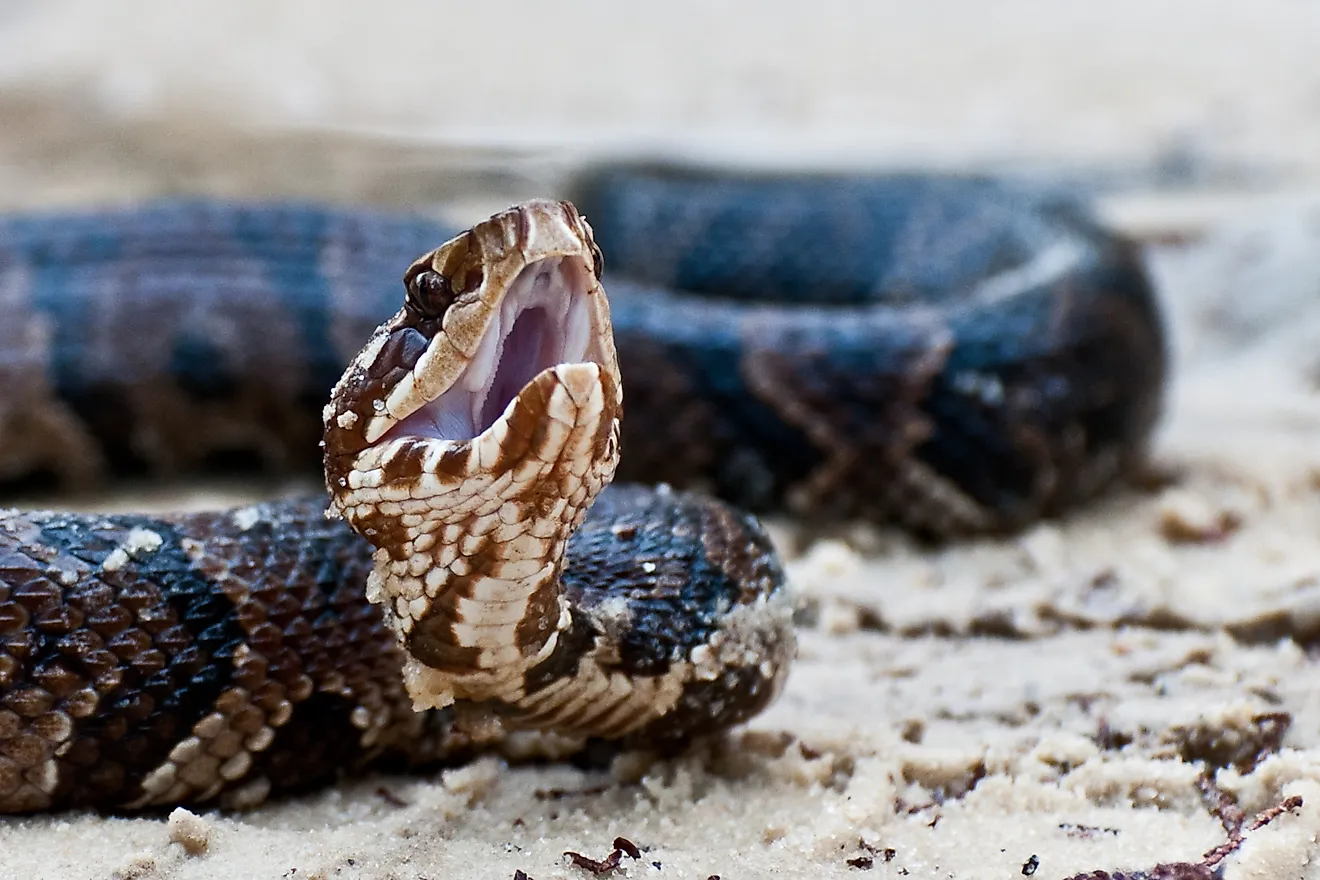
Every other American pit viper gives you something to work with. A rattlesnake rattles, a cottonmouth gapes and shows the white lining of its mouth, and most snakes of any kind simply leave when they feel footsteps approaching.
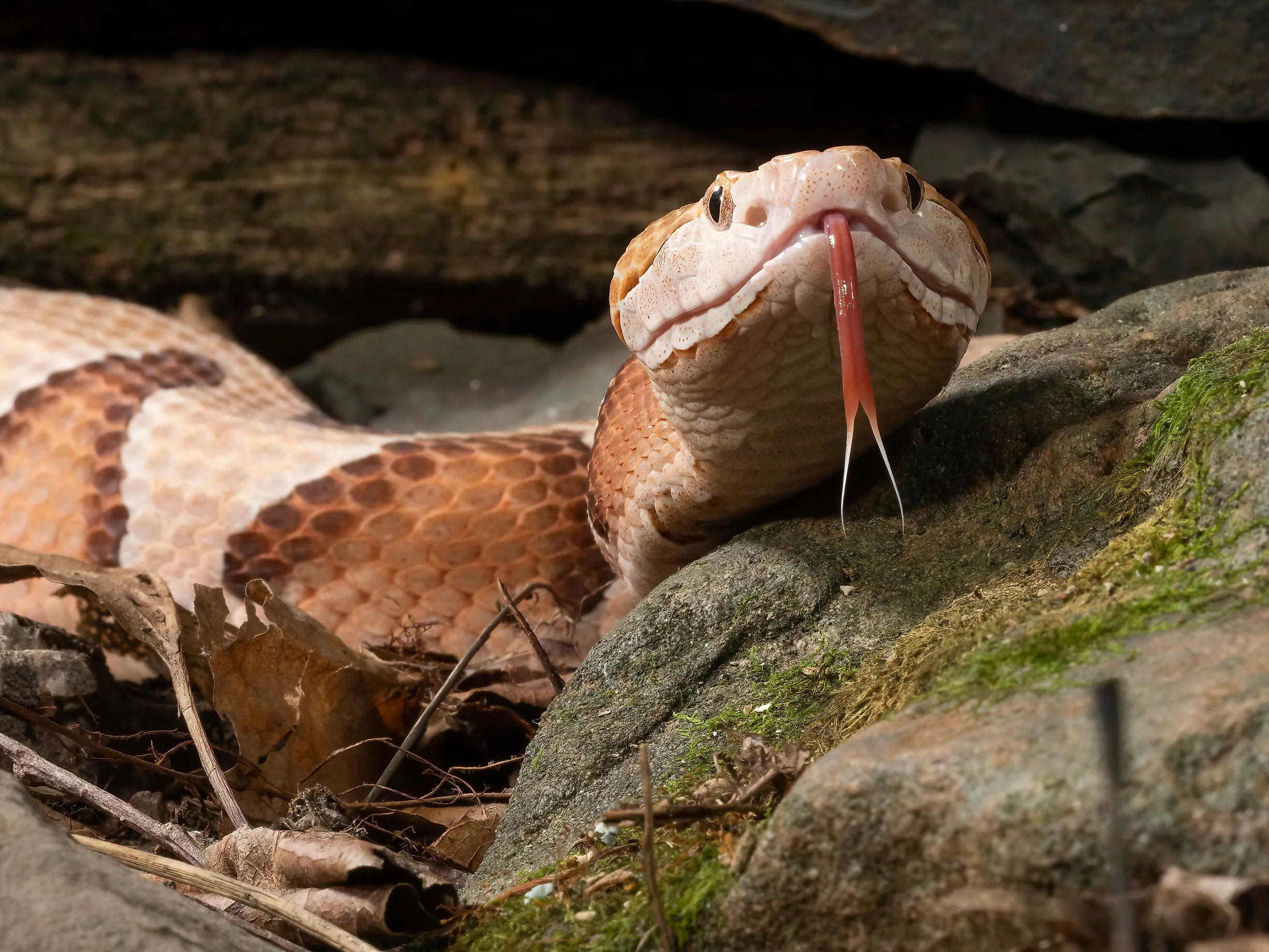
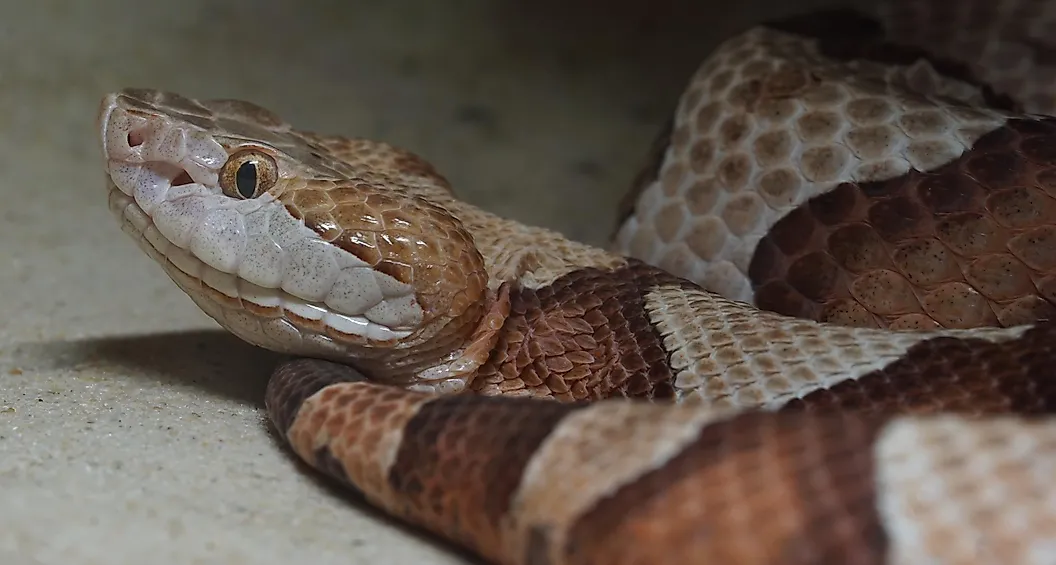
A copperhead does none of that. Its hourglass banding breaks up its outline against dead leaves so effectively that the snake's first and usually only defense is to freeze and let you walk past. That works perfectly until somebody puts a boot down in the wrong place.
The result is that copperheads account for more bites than any other venomous snake in the country while having the mildest venom of any North American pit viper, with a large share of defensive strikes delivering no venom at all.
Great Smoky Mountains National Park

Great Smoky Mountains takes roughly 12 million visits a year, more than any other national park, and it holds exactly two venomous snake species: the copperhead and the timber rattlesnake.
Copperheads here favor the lower elevations, the rocky edges of trails, stone walls around historic structures and the thick hardwood leaf litter that covers most of the park floor. Cades Cove and the lower-elevation trails are where visitor numbers and good habitat overlap most heavily.
With 12 million people and a park whose floor is essentially continuous copperhead habitat, the Smokies lead this list on volume alone.
Shenandoah National Park

Shenandoah runs the same two-species arrangement as the Smokies, copperhead and timber rattlesnake, along a hundred miles of Blue Ridge crest. The park's defining feature for snakes is rock. Talus slopes, boulder fields and the stone retaining walls along Skyline Drive all provide the warmth and crevices copperheads need, and the hardwood forest supplies the leaf litter they hunt in.
Virginia is one of the states where copperheads are most frequently encountered, and Shenandoah concentrates a great deal of the state's best habitat into one long, heavily hiked ridge.
Congaree National Park

Congaree protects the largest remaining tract of old-growth bottomland hardwood forest in the Southeast, and by species count it is the most snake-rich park on this list.
Copperheads share this floodplain with cottonmouths, timber rattlesnakes and the eastern coral snake, which makes Congaree one of the few places where all four venomous groups of the Southeast occur together.
The copperheads conceal themselves in cypress roots and the leaf piles that build up across the bottomland floor, where the camouflage works just as well against wet brown litter as it does against dry oak leaves.
Mammoth Cave National Park

Everybody visits Mammoth Cave for what is underground, which is precisely why the surface is worth mentioning. The park sits on intensely developed karst, and the landscape above the cave system is riddled with sinkholes, limestone outcrops, rock ledges and fissures. That is ideal copperhead country, supplying warmth, cover and overwintering sites in a single landform.
Above ground the park holds more than 80 miles of trail through Kentucky hardwood forest, which is the leaf-litter half of the equation.
New River Gorge National Park

The newest national park in the East is a deep sandstone gorge, which from a copperhead's perspective is an enormous sun-warmed rock pile with a forest on top of it.
The gorge walls provide ledges, talus and boulder fields that hold heat into the evening, and the rock climbing that draws people here puts hands directly onto the ledges snakes use.
West Virginia copperheads are common throughout the state, and the gorge concentrates the terrain they prefer along a narrow, heavily used corridor.
Hot Springs National Park

One of the smallest and oldest units in the system sits in the Ouachita Mountains, in a state where copperheads turn up essentially everywhere. Arkansas is one of the heaviest copperhead states in the country, and Hot Springs combines rocky Ouachita slopes with oak-hickory forest and a trail network that runs right out of a city of 38,000.
The urban edge is the relevant detail. Parks that border neighborhoods generate more encounters than remote ones, because the snakes do not recognize the boundary and the people are already there.
Cuyahoga Valley National Park

This is the northern outlier, and a surprise to most visitors, because nobody associates suburban Ohio with venomous snakes. The northern copperhead reaches its range limit in this part of the state, and Cuyahoga Valley's mix of wooded ledges, sandstone outcrops and river bluffs between Cleveland and Akron provides the habitat. Numbers are far lower than in the southern parks.
What Cuyahoga has instead is people. The park sits between two cities and receives heavy year-round use, which keeps a small snake population in regular contact with a large human one.
What The List Actually Measures

Three ingredients recur in every park above, and the third one decides the ranking. There is leaf litter, where the camouflage works and where the snakes spend most of their time hunting. There is rock, whether gorge wall, karst outcrop or historic stone wall, supplying warmth and winter shelter. And there are visitors, because a park with excellent habitat and nobody in it produces no encounters at all.
That is why the Smokies head the list. It is not that the park has the densest copperhead population in America. It is that no other park puts 12 million pairs of feet onto that much suitable ground.
How Not To Meet One

Because every copperhead bite is defensive and almost all of them land on hands and feet, the advice is short and it works. Look before you put a hand on a rock ledge or reach into a crevice. Step onto logs rather than over them, so you can see the far side. Stay on trail where the ground is visible, keep dogs leashed, and carry a light after dark in autumn, which is when copperheads are most active.
If you do see one, the correct response is to walk around it. A copperhead that has been spotted and given room will stay exactly where it is, which is all it ever wanted.
The Short Version

Great Smoky Mountains leads on sheer volume, Shenandoah on rock and ridge habitat, Congaree on species richness, and Mammoth Cave, New River Gorge, Hot Springs and Cuyahoga Valley each on a particular landform that suits the animal.
The species bites more Americans than any other snake and kills almost none of them, because biting is the last resort of an animal whose entire plan is going unnoticed. These parks are just where the most people walk past the most snakes successfully doing exactly that.