The National Parks With Natural Arches
Utah takes the cake for natural arches. There are over 2,000 natural arches in Arches National Park, with thousands of other arches spread across the state, including six of the world's fifteen largest natural arches. But Utah does not have a monopoly on natural arches. Grand Canyon National Park is home to lesser-known arches that were carved by flowing stream water rather than salt movement. Hawaiʻi Volcanoes National Park contains sea arches formed by erosion from the Pacific Ocean.
Arches National Park, Utah

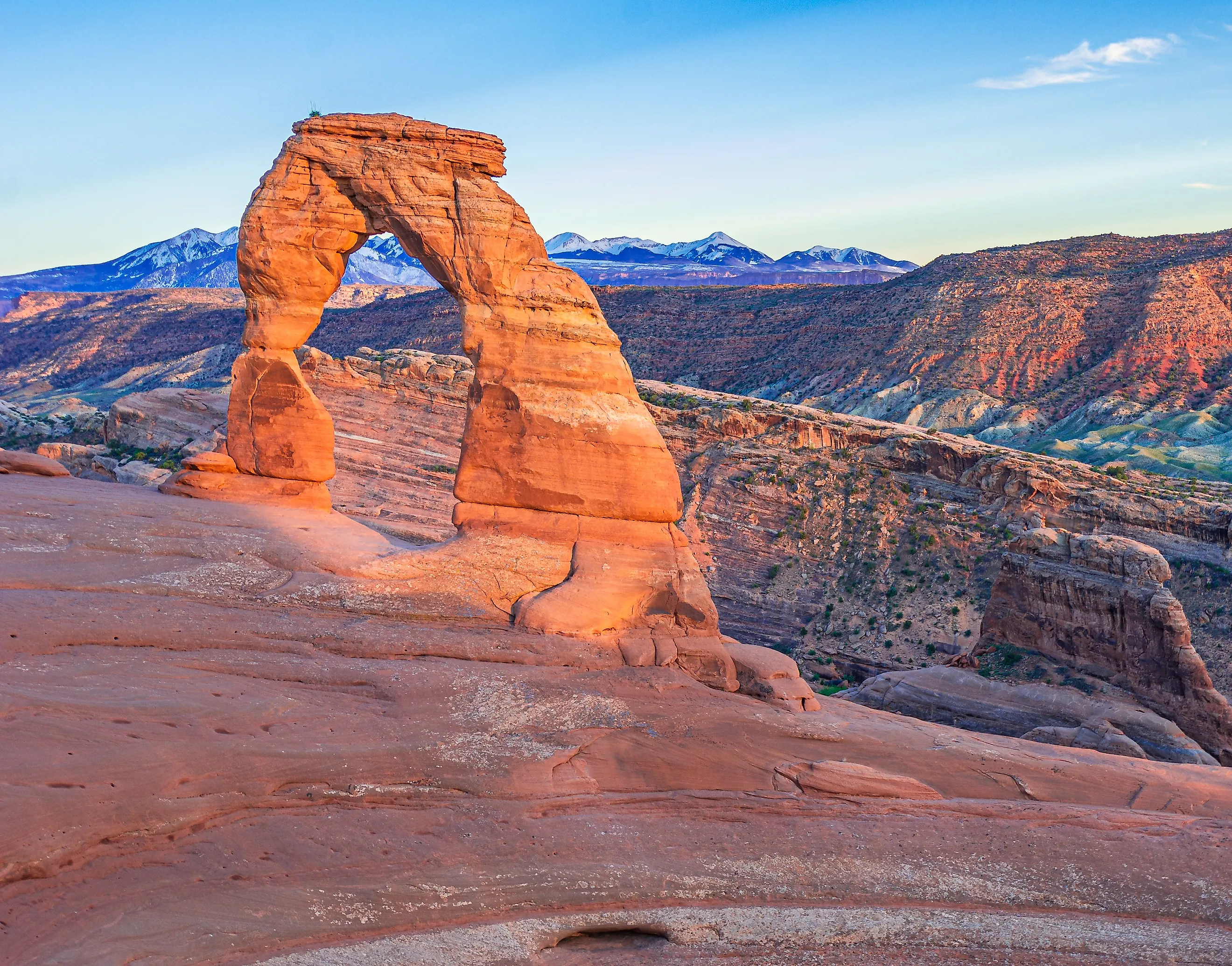
It is in the name. Arches National Park contains over 2,000 natural arches within just 76,000 acres. This makes it the densest concentration of natural arches in the world. Delicate Arch is not only the most notable arch in the park, but also an icon of Utah that appears on the license plate. The opening beneath Delicate Arch measures 46 feet high and 32 feet wide, making it the largest free-standing arch in the park. It is not viewable from the road, so visitors must park their cars at either Delicate Arch Viewpoint Trailhead or Wolfe Ranch Trailhead. Other notable arches include Landscape Arch, the longest natural arch in North America at over 290 feet, and Double Arch, where two bridges stem from the same base stone.
Canyonlands National Park, Utah

Canyonlands National Park's landscape has been eroded by the Colorado and Green Rivers into numerous canyons, mesas, arches, and buttes. There are over 80 natural arches in the park. Mesa Arch is the most popular and most accessible for beginner hikers, families, and small children. The 0.6-mile trailhead is located at the Mesa Arch Parking Area, which is east of the Sky Visitor Center. The lollipop loop trail culminates in the 27-foot-long Mesa Arch, which frames views of Buck Canyon below and the La Sal Mountains in the distance. The arch sits at the edge of a 500-foot cliff. Although the trail is short, sections of it are uneven and require walking up and down stone steps.
Bryce Canyon National Park, Utah

Although Bryce Canyon National Park is best known for having the largest collection of hoodoos in the world, it also has a dozen arches. While most of them are unnamed, the best-known are Bryce Natural Bridge and Red Arch Road Bridge. Despite its name, Bryce Natural Bridge is actually an arch that spans 85 feet. Visitors will encounter it quickly upon entering the park without having to hike to it. A roadside pullout along the park's main highway provides a clear view of the arch just steps from the road. Similarly, Red Arch Road Bridge can also be viewed from the road. In fact, people can drive straight through Red Arch Road Bridge because it is a road tunnel outside the park.
Capitol Reef National Park, Utah

Capitol Reef National Park is situated in the Waterpocket Fold, a 100-mile-long monocline structure that creates a buckle on Earth's surface. The landscape is filled with cliffs, canyons, domes, and over 20 natural arches. Cassidy Arch is one of the largest and can be seen towering 400 feet above the Scenic Drive, a paved road beginning from the visitor center and leading into the park. The Cassidy Arch Trail takes hikers on a 3.5-mile round trip directly to a vantage point above the arch. Hickman Bridge is by far one of the most popular bridges in the park and is only two miles east of the visitor center. The trail itself is a two-mile-long, generally flat trail which ends at Hickman Bridge as well as an additional smaller arch.
Zion National Park, Utah

Zion National Park does not have a lot of arches, but it does have the second-longest arch in the United States. Kolob Arch measures 287 feet long. It is located inside a small canyon within Zion's backcountry. There are two ways to reach Kolob Arch, and both involve hiking a 14-mile round trip from either Kolob Canyons Road Parking Lot or the Hop Valley Trailhead. While the arch is off-limits to hikers, both trails lead to viewpoints of Kolob Arch. Crawford Arch is one of the most visible, suspended almost 1,000 feet in the air from the base of Bridge Mountain. It can be viewed from the patio of Zion's Human History Museum.
Grand Canyon National Park, Arizona

The Grand Canyon steals the show in Grand Canyon National Park, but there are as many as 65 natural arches found deep in the backcountry of the park. Royal Arch is a 60-foot arch tucked in a side canyon of the western South Rim. The Royal Arch Loop can be accessed from South Bass Trailhead, a 32-mile-long hike that takes between three and four days to complete. Most of the arches in the park are not easily accessible. Boysag Point Arch does not require a multi-day backpacking trip, although it does require four-wheel drive navigation. Angels Window is the only easily accessible arch in the park. The 0.4-mile round-trip trail begins at the Cape Royal Parking Area. Visitors can stand over the arch and view the Colorado River below.
Hawaiʻi Volcanoes National Park, Hawaii

Several sea arches are found along the Hawaiian coast in Hawaiʻi Volcanoes National Park. These sea arches are the remnants of once-continuous sea cliffs where lava from two of the world's most active volcanoes (Kilauea and Mauna Loa) interacted with the sea and added to the size of the island. The Holei Sea Arch is one of the largest arches in the park at around 90 feet high. It extends from the sea cliffs into the Pacific Ocean. The observation area for the arch is located at the end of Chain of Craters Road. Unfortunately, Holei Sea Arch is temporary. Eventually, it will crumble into the sea. The good news is that when it does, others will replace it as the cliff shifts and evolves.
Arches on Land and Sea
Natural arches appear to be permanent structures, but each of them is a product of rock being slowly removed, eroded, and shaped over thousands or even millions of years. Natural arches are abundant in Utah, while Hawaiʻi Volcanoes National Park contains sea arches created by erosion from the Pacific Ocean, which are at risk of shifting due to the force of the sea. Regardless of whether these arches are carved out of desert sandstone or lava, these formations are a reminder that the landscape can constantly be reshaped by the forces of nature.